---
type: "Page"
title: "Legal AI"
description: "Annotation for legal AI: contract clause extraction, legal NER, e-discovery labeling and regulatory classification, with expert review. Free 48-hour pilot."
resource: "https://www.annotera.ai/industry-solutions/legal/"
timestamp: "2026-11-19T12:18:09+00:00"
---
Accelerate Legal AI With Expert Data Annotation
Train contract analysis, e-discovery, regulatory compliance, and legal research models with high-accuracy annotation services, delivered by annotators trained in legal terminology, clause structures, and jurisdictional nuance.
[Get A Quote ](/okf/page/get-a-quote.md)
# Scalable Data Annotation for Legal AI and LegalTech Applications
Annotera delivers data annotation for legal AI that helps law firms, legal technology companies, corporate legal departments and compliance teams build models that understand legal language with precision. We provide annotation for contracts, court filings, regulatory documents and legal correspondence, using annotators trained in legal terminology, document structure, clause identification and jurisdictional variation before any legal project begins. Our secure infrastructure supports workflows designed to protect attorney-client privilege and sensitive legal information. Backed by Fusion CX, with 17,000 people and 40 delivery centers across 13 countries, Annotera helps legal AI teams produce datasets that meet the accuracy and confidentiality demands of the profession. For a worked example, see our guide to [legal contract NER](/okf/article/legal-contract-ner-annotation.md), or compare options in our [data annotation outsourcing](/okf/page/data-annotation-outsourcing.md) overview.
## ApplicationsApplications of Data Annotation in Legal AI and LegalTech Solutions
Legal AI applications need annotation by people who understand legal language, contractual logic and regulatory frameworks. Domain-aware labeling lets models handle the precision legal work demands.
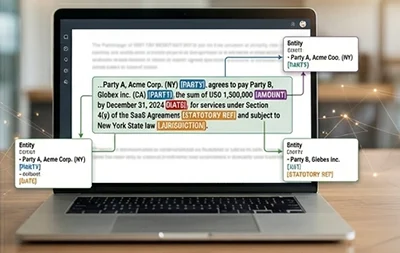
##### Contract Clause
Extraction
Annotate contracts to identify, classify, and extract key clauses including termination rights, indemnification, liability limitations, confidentiality, payment terms, and governing law provisions. Labeled clause datasets train AI models that speed up contract review.
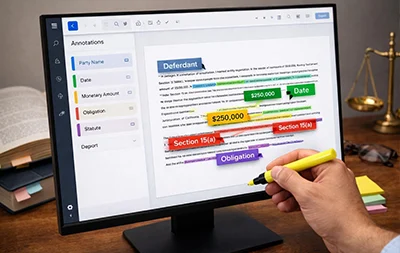
##### Legal Named Entity Recognition
Identify and label legal entities including party names, dates, monetary amounts, obligations, rights, jurisdictions, and statutory references across contracts, filings, and correspondence. As a result, legal NLP models can extract structured information from complex documents with high precision.
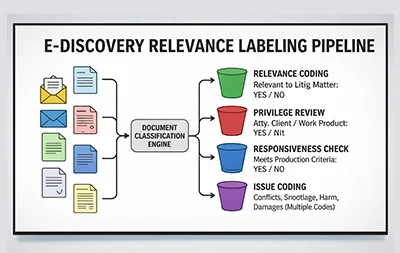
##### E-Discovery Relevance Labeling
Classify documents for relevance, privilege, responsiveness, and issue coding in litigation and regulatory investigation contexts. Therefore, legal teams reduce the time and cost of document review while maintaining the accuracy required for court submissions and regulatory responses.
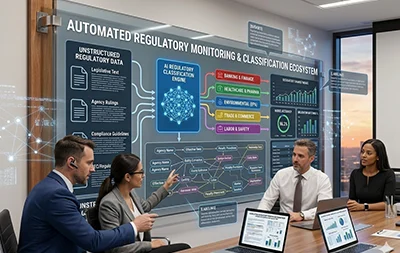
##### Regulatory Document Classification
Categorize and annotate regulatory filings, compliance guidelines, agency rulings, and legislative text to train AI models for automated regulatory monitoring. In addition, labeled regulatory datasets help compliance teams track obligations, identify changes, and generate reports efficiently.
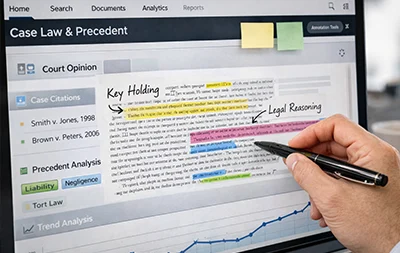
##### Case Law & Precedent Analysis
Annotate court opinions, judicial rulings, and case summaries to identify holdings, reasoning, citations, and outcome classifications. Consequently, legal research AI can surface relevant precedents, analyze judicial trends, and support case strategy development.
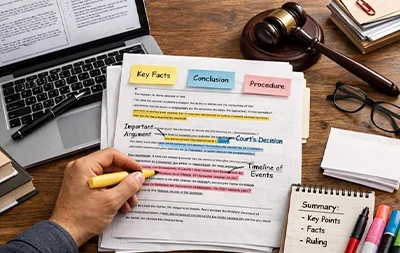
##### Legal Document Summarization
Create summarization training data by annotating key arguments, facts, conclusions, and procedural histories within legal filings, briefs, and opinions. Furthermore, labeled summary pairs enable AI models to generate accurate legal summaries that save attorneys hours of reading.
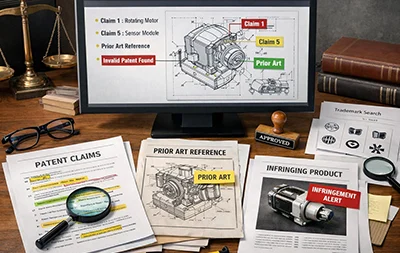
##### Intellectual Property Analysis
Annotate patent claims, trademark filings, and IP portfolios to identify claim scope, prior art references, classification categories, and infringement indicators. As a result, IP teams and patent attorneys gain AI-assisted tools for faster prior art searches and portfolio analysis.
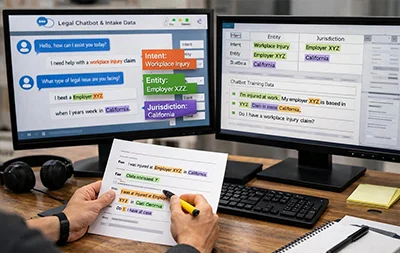
##### Legal Chatbot &
Intake Data
Annotate client intake conversations, legal FAQ interactions, and consultation transcripts for intent classification, entity extraction, and jurisdiction identification. In addition, labeled dialogue datasets train legal chatbots that provide accurate initial guidance and streamline client onboarding.
## Why Choose UsTrusted Partner for **Legal AI** and **LegalTech** Data Annotation
Annotera delivers secure, accurate, and confidentiality-aware data annotation for legal AI outsourcing solutions designed for the legal profession. Moreover, our annotators understand legal document structures and terminology. As a result, law firms, LegalTech companies, and corporate legal departments can build AI that meets the precision and confidentiality standards the profession demands.
### Legal Domain-Trained Annotators
Annotators receive specialized training in legal terminology, contract structures, litigation workflows, and jurisdictional variations before starting any project. Moreover, ongoing calibration with legal subject matter experts ensures annotation quality evolves with changing legal standards.
### Confidentiality-First Infrastructure
End-to-end encryption, project-level access controls, comprehensive annotator NDAs, and secure VPN-based annotation environments protect sensitive legal information and support attorney-client privilege requirements. As a result, firms can outsource annotation without compromising confidentiality.
### Precision-Grade Quality Assurance
A 3-tier QA process with legal-specific accuracy benchmarks, inter-annotator agreement tracking, and documented review trails ensures every dataset meets the standards required for legal AI applications. Therefore, models trained on Annotera data achieve the reliability that legal professionals expect.
### Flexible Engagement Models
Choose from dedicated team, project-based, or volume-based engagement models that adapt to litigation timelines, deal cycles, and regulatory deadlines. A free 48-hour pilot lets you evaluate quality before committing to a full production engagement.
## **Connect** with an **Expert**
Industry \*Security & SurveillanceAutonomous DrivingRoboticsRetailHealthcareOther
Area of Interest \*Text AnnotationImage AnnotationAudio AnnotationVideo Annotation
Preferred Location \*OnshoreNearshoreOffshore
Attach RFx Document
(\*.docx, .pdf, .zip only)
## Frequently Asked QuestionsGot Questions? We've Got Answers for You
Here are answers to common questions about data annotation for legal AI, contract analysis, and compliance-focused annotation workflows.
#### What types of legal documents does Annotera annotate?
We annotate contracts, court filings, judicial opinions, regulatory documents, patent applications, corporate correspondence, compliance guidelines, and client intake transcripts. Our services cover the full range of legal AI training data requirements across litigation, transactional, and regulatory use cases.
#### How do you protect confidential legal information?
We implement end-to-end encryption, project-level access controls, comprehensive annotator NDAs, secure VPN-based annotation environments, and audit trails for all data access. Our workflows are designed to support confidentiality requirements including attorney-client privilege considerations.
#### Do your annotators understand legal terminology and document structures?
Yes. Our legal annotation teams receive specialized training in legal terminology, contract structures, litigation workflows, and jurisdictional variations. Ongoing calibration sessions with legal subject matter experts ensure annotation quality remains consistent and accurate.
#### Can you handle large-scale e-discovery annotation projects?
Yes. As part of Fusion CX, with 17,000 people and 40 delivery centers across 13 countries, we can scale for large e-discovery reviews, regulatory investigations, and deal-related document analysis while keeping quality consistent against tight litigation deadlines.
#### How accurate is your legal annotation?
Accuracy is measured against benchmarks set for each project. A 3-tier QA process with legal-specific benchmarks, inter-annotator agreement tracking, and documented review trails supports consistent quality, and we agree quality metrics with your team for each specialized legal task.
## Our BlogsTransformative AI
Solutions in action
[More Blogs ](/okf/page/blog.md)

- August 10, 2026
### [India’s Role in Training Data for Global Autonomous Vehicle Programs](/okf/article/indias-role-training-data-global-autonomous-vehicle-programs.md)

- January 14, 2026
### [Autonomous Vehicle Annotation Quality: How to Build a Reliable QA Framework](/okf/article/how-precise-image-labeling-enables-safer-self-driving-systems.md)

- January 9, 2026
### [Computer Vision in Autonomous Vehicles: How Self-Driving Cars See](/okf/article/high-quality-data-annotation-autonomous-driving-systems.md)