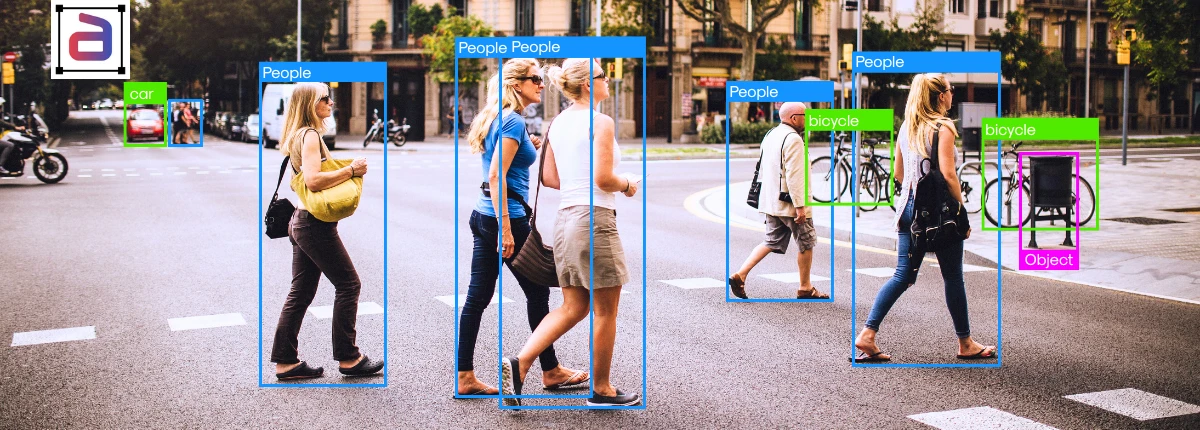
Artificial intelligence systems don’t understand images the way humans do. To a machine learning model, an image is simply a grid of pixels with numerical values. The bridge between raw pixels and real-world understanding is image annotation—a foundational process that enables computer vision models to accurately detect, classify, and interpret visual information. An image annotation guide explains how labeling images enables computer vision models to understand visual data, outlines key annotation techniques, and highlights why partnering with an expert image annotation company ensures accuracy, scalability, and reliable AI performance.
Table of Contents
As AI adoption accelerates across industries, image annotation has become a strategic capability rather than a back-office task. According to the Stanford AI Index, enterprise AI adoption has increased sharply year over year, with computer vision remaining one of the most widely deployed AI capabilities. This surge has made high-quality visual data annotation essential for organizations that want reliable, scalable AI systems.
In this in-depth guide, we explain what image annotation is, the most common annotation techniques, why quality matters, and how partnering with the right image annotation company through image annotation outsourcing can give AI teams a competitive edge.
What Is Image Annotation?
Image annotation is the process of labeling images with structured metadata so machine learning models can learn from them. These labels identify objects, regions, shapes, boundaries, or attributes within an image and translate visual content into machine-readable data. In parallel, the broader AI annotation market is forecast to grow rapidly (one major industry estimate places it at $1.45B in 2024, reaching $13.11B by 2033), underscoring how central annotation operations have become to AI delivery.
In supervised learning, annotated images act as ground truth. Models trained on these datasets learn to recognize patterns and make predictions on new, unseen images. Without accurate annotations, even the most advanced algorithms fail to perform reliably.
For this reason, any serious data annotation company makes image annotation a core service, especially for AI systems operating in real-world, high-stakes environments.
Common Types of Image Annotation
Different computer vision use cases require different annotation methods. Choosing the right approach directly impacts model performance and cost efficiency.
1. Image Classification
Each image is assigned one or more labels, such as “defective product” or “empty shelf.” Classification is useful when the entire image represents a single concept or condition.
2. Bounding Box Annotation
Rectangular boxes are drawn around objects of interest. This is one of the most widely used annotation techniques due to its balance of speed, accuracy, and cost.
3. Polygon Annotation
Polygons outline objects with irregular shapes, such as road damage, tumors in medical scans, or product contours. This method provides higher precision than bounding boxes.
4. Semantic Segmentation
Every pixel in an image is assigned a class label, enabling complete scene understanding. This approach is widely used in robotics and autonomous systems.
5. Instance Segmentation
Instance segmentation labels each object separately, even if multiple objects belong to the same class. This is critical for accurate object counting and tracking.
6. Keypoint and Landmark Annotation
Specific points such as joints or facial landmarks are annotated to support pose estimation, gesture recognition, and motion analysis.
Each of these annotation types requires specialized skills, robust tooling, and strong quality controls—making image annotation outsourcing a practical choice for many organizations.
Why Image Annotation Quality Is Critical
Annotation quality directly determines model accuracy, robustness, and reliability. Research consistently shows that noisy or inconsistent labels can significantly reduce model performance and introduce bias that persists across retraining cycles. This image annotation guide explains how annotated images train computer vision models, explores common annotation techniques, and explains why outsourcing image annotation helps organizations build scalable, high-quality datasets for reliable AI outcomes.
As AI expert Andrew Ng famously stated, “AI systems are only as good as the data they are trained on.” This insight is especially true for computer vision, where even small labeling errors can cascade into major prediction failures.
From a business perspective, poor data quality is expensive. Industry analysts estimate that poor-quality data costs organizations millions each year through rework, delayed deployments, and underperforming AI systems. High-quality annotation is therefore not an operational expense—it is risk mitigation.
The Image Annotation Workflow: Best Practices
1. Annotation Guidelines and Ontology
Clear labeling instructions define what should and should not be annotated, including edge cases, occlusions, and ambiguity handling.
2. Secure Tooling and Data Pipelines
Annotation tools must support required formats while ensuring data security, access control, and auditability.
3. Annotator Training and Calibration
Even experienced annotators require project-specific training. Calibration tasks align interpretations across distributed teams.
4. Multi-Layer Quality Assurance
High-quality workflows use automated validation, peer review, and expert audits to systematically reduce errors.
5. Continuous Feedback Loops
Insights from model performance should continuously inform annotation updates, improving dataset quality over time.
In-House vs. Image Annotation Outsourcing
Many organizations begin with internal annotation efforts but face challenges as datasets grow. Image annotation outsourcing becomes advantageous when teams need faster scalability, specialized expertise, consistent quality, and predictable costs.
Partnering with a specialized data annotation outsourcing provider allows AI teams to focus on model development while maintaining high labeling standards.
What to Look for in an Image Annotation Company
When evaluating an image annotation guide, organizations should prioritize proven QA frameworks, domain expertise, strong data security practices, flexible tooling support, and transparent quality metrics.
A true partner does more than label images—they help build datasets that scale with evolving AI requirements.
How Annotera Delivers High-Quality Image Annotation at Scale
Annotera combines trained human annotators, rigorous QA workflows, and secure delivery models to support production-grade computer vision systems. Our image annotation outsourcing services cover classification, bounding boxes, segmentation, and advanced annotation types across retail, robotics, manufacturing, and autonomous systems.
As a trusted data annotation company, Annotera focuses on consistency, accuracy, and long-term data reliability—ensuring AI models perform effectively in real-world conditions.
Ready to Build Better Computer Vision Models?
If your AI performance depends on accurate, scalable image data, partnering with the right annotation expert is critical. Annotera helps teams transform raw images into high-quality training datasets that power real-world AI success. Partner with Annotera today to explore a pilot or discuss how our image annotation services can support your next computer vision initiative.