

Every pixel assigned to the right class, with instance masks where objects must be separated, labeled by trained teams and checked against your gold set. Start with a free 48-hour pilot on your own images.
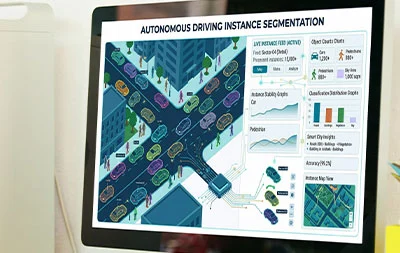
Segmentation models need to know exactly where one thing ends and the next begins. Annotera’s semantic segmentation services assign a class to every pixel in an image, so models learn complete scene context: road, sidewalk, vehicle, person, vegetation, sky. Where your model must separate individual objects of the same class, we add instance masks, and for full scene parsing we combine both into panoptic labels.
Our image segmentation annotation service covers street scenes, medical scans, aerial and satellite imagery, retail shelves and industrial inspection, with polygon and brush tools chosen to suit the boundary detail each class needs. Every batch is scored for boundary accuracy (IoU) and per-class consistency before delivery. For the differences between approaches, see our guides to semantic vs instance segmentation and panoptic segmentation. Segmentation is one of our image annotation services.
Choose the level of detail your model needs, from class-level masks to individual instances across video frames.
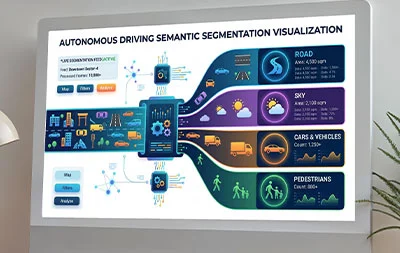
Every pixel assigned to a class, giving models complete scene understanding for perception and mapping.
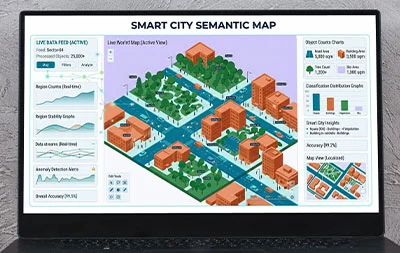
Large areas such as roads, vegetation, buildings and water segmented for mapping and environment models.
Individual objects of the same class separated with their own masks for counting and tracking models.
Dozens of classes labeled consistently in one pass, with clear rules for boundaries between them.
Medical, industrial and aerial images segmented at full resolution, where small regions matter most.
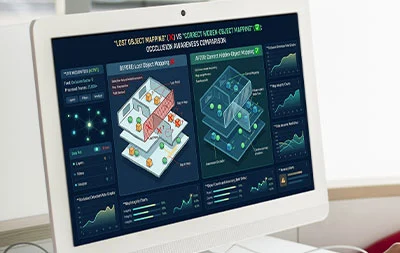
Partly hidden and overlapping regions labeled to agreed rules, so masks stay consistent in busy scenes.
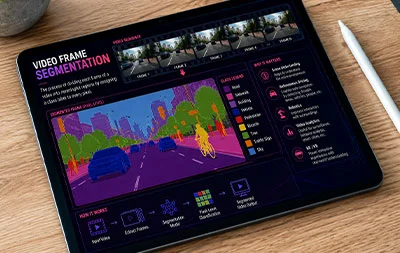
Sequential frames segmented with temporal consistency for models that track scenes over time.
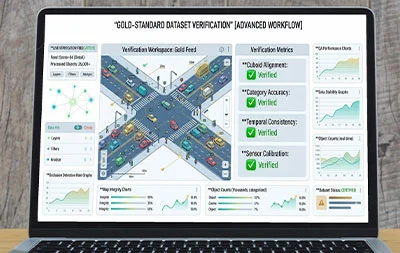
Masks scored for IoU and per-class accuracy at every stage, with issue logs delivered alongside the data.

Every semantic segmentation service we run follows the same sequence, so mask quality is proven on your own images before volume arrives.

Classes, boundary rules and how to treat edges, holes and occlusion are written down with visual examples.

A sample is segmented, usually within 48 hours, and scored for IoU and per-class accuracy against your gold set.

Annotators, team leads and independent QA check every batch, with model pre-segmentation where it helps.

Batches ship with quality reports, and the team grows with your volume without boundary drift.
Pixel-level work rewards patience, clear rules and strict QA. These are the commitments behind every Annotera segmentation program. Teams that want a fully managed operation can use our data annotation outsourcing services.

Teams trained on your imagery, from street scenes to medical scans, so boundary decisions stay consistent.

Masks are scored for IoU against gold sets, with tighter checks on thin, small and safety-critical classes.

Operations certified to ISO/IEC 27001:2022, SOC 2 Type II, HITRUST CSF and PCI DSS 4.0.1, with HIPAA-compliant workflows.

We work in your annotation platform or established tools, using model pre-segmentation and correction where it helps.

Clear rules for edges, holes, reflections and occlusion keep masks consistent across annotators and batches.

Teams scale with your volume, drawing on Fusion CX’s 17,000 people across 40 delivery centers in 13 countries.

Answers on segmentation types, accuracy, pricing and getting started.
Semantic segmentation services label every pixel of an image with a class, such as road, person or building, so computer vision models learn the full layout of a scene. A managed provider such as Annotera supplies trained annotators, class definitions, quality assurance and reporting.
Semantic segmentation labels every pixel by class but does not separate individual objects. Instance segmentation separates each object of a class with its own mask. Panoptic segmentation combines both. Our guide to semantic vs instance segmentation explains when to use each.
Against a gold set labeled by senior annotators, using intersection over union (IoU) per class and per image, with extra checks on small, thin and safety-critical classes where errors matter most.
Pricing depends on the number of classes, objects per image, boundary detail and image resolution. Programs are usually priced per image, per object or per dedicated annotator. A pilot on your own images gives an accurate quote.
Yes. Medical imagery runs in HIPAA-compliant workflows with annotators trained on the anatomy involved, and aerial and satellite imagery is segmented at full resolution for mapping and monitoring models.
Where it helps. Models can propose masks that annotators correct, which speeds up large classes, while fine boundaries and rare classes are labeled and checked by people.
Yes. We work in your in-house or commercial platform, or provide established tools, and deliver masks in the formats your training pipeline expects.
A pilot on a sample of your images is usually delivered within 48 hours of receiving the data and class map. Production ramp time depends on volume and complexity.