Why Medical AI Demands Pixel-Level Accuracy
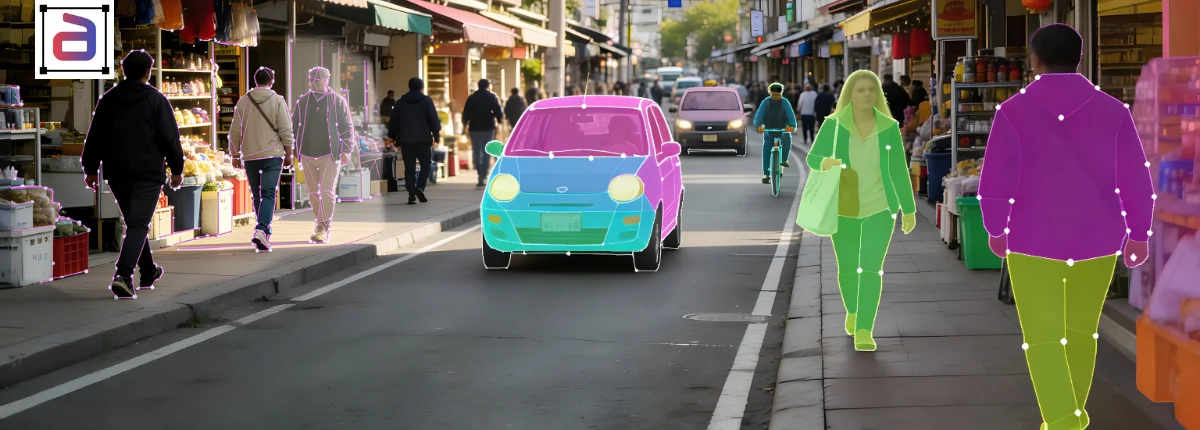
In medical AI, accuracy is not a performance metric—it’s a requirement. Whether you’re training a diagnostic imaging model, building AI-assisted pathology tools, or developing real-time surgical support systems, even a few misplaced pixels can lead to incorrect predictions, unreliable insights, or regulatory pushback. Polygon annotation services provide precise object boundary labeling for complex images, enabling high-quality training data for computer vision models in industries like agriculture, healthcare, autonomous driving, and retail.
Traditional annotation methods, such as bounding boxes, are often too coarse for medical use cases. Human anatomy, pathological structures, and clinical markers rarely fit neatly into rectangles. Tumors have irregular margins. Organs overlap. Lesions vary in shape, size, and texture across patients and imaging modalities.
This is where polygon annotation services become critical. By enabling pixel-level labeling of complex, irregular structures, polygon annotation provides the precision medical AI systems need to perform reliably in real-world clinical environments.
What Are Polygon Annotation Services?
Polygon annotation services involve manually drawing multi-point polygons around objects of interest in images or video frames to capture their exact shape and boundaries. Unlike bounding boxes, polygons closely follow an object’s contours, making them ideal for semantic and instance segmentation tasks.
In a service-based model like Annotera’s, polygon annotation includes:
- Human-in-the-loop labeling by trained annotators
- Custom annotation guidelines aligned to medical use cases
- Quality assurance and validation workflows
- Dataset-agnostic delivery compatible with ML pipelines
Importantly, polygon annotation services do not involve selling datasets. Instead, they focus on transforming your proprietary medical data into high-quality labeled training assets used to build, validate, and improve AI models.
Why Polygon Annotation Is Essential in Medical AI
Irregular Anatomical Structures
Human anatomy is inherently complex. Organs, tissues, and abnormalities rarely have clean edges. Polygon annotation allows annotators to trace exact anatomical boundaries, preserving clinical detail that would otherwise be lost.
Pixel-Level Segmentation for Diagnostics
Medical imaging models often rely on pixel-level classification to:
- Identify tumor margins
- Differentiate healthy vs abnormal tissue
- Segment organs for volumetric analysis
Polygon annotation provides the ground truth necessary for these tasks.
Improved Model Generalization
High-fidelity annotations help models generalize across:
- Different patients
- Imaging devices
- Lighting and contrast variations
- Clinical environments
This is especially critical in healthcare, where variability is unavoidable.
Medical Imaging Use Cases That Require Polygon Annotation
Radiology
Polygon annotation is widely used in tumor and lesion segmentation, organ boundary detection, and abnormality localization in CT, MRI, and X-ray images.
Digital Pathology
Whole-slide images contain dense, overlapping structures. Polygon annotation enables precise cell boundary labeling, tissue-type differentiation, and cancer grading support.
Surgical Video Analysis
For AI-assisted surgery and post-op review, polygon annotation enables precise frame-by-frame labeling of instruments and tissue interaction zones, even in dynamic environments.
Ultrasound and Real-Time Imaging
Low contrast and noise make precise labeling essential. Polygon annotation helps models learn subtle shape and texture cues that bounding boxes cannot capture.
Why Medical AI Teams Outsource Polygon Annotation
Building an in-house polygon annotation capability is challenging, costly, and slow—especially in regulated industries like healthcare.
Medical AI teams typically outsource polygon annotation services to:
- Scale quickly without hiring large annotation teams
- Maintain consistency across thousands of images or video frames
- Ensure quality and traceability through structured QA workflows
- Allow internal teams to focus on model development
The Polygon Annotation Workflow for Medical AI
1. Data Ingestion & Preprocessing
Secure data transfer, format normalization, and frame extraction for video-based projects.
2. Annotation Guideline Development
Clear definitions, boundary rules, and medical-use-case-specific taxonomies ensure consistency.
3. Polygon Annotation Execution
Multi-point polygon tracing, frame-by-frame labeling for video, and handling overlapping or occluded structures.
4. Quality Assurance & Validation
Multi-level reviews, inter-annotator agreement checks, and continuous feedback loops.
5. Delivery & Integration
Dataset-agnostic formats (COCO, JSON, Pascal VOC) delivered in versioned batches for easy ML integration.
Accuracy Metrics That Matter in Medical Polygon Annotation
Key quality indicators include:
- Boundary accuracy
- Label consistency
- Temporal stability across frames
- Clinical relevance of annotations
High-quality polygon annotation services focus on model-impact metrics—not just annotation speed.
Security, Compliance, and Data Handling
Professional medical annotation services ensure:
- Secure access controls and encrypted workflows
- Role-based annotation environments
- Audit-ready documentation
- Privacy-first, compliance-aligned processes
Why Annotera for Polygon Annotation Services in Medical AI
Annotera provides high-precision, service-led polygon annotation designed for complex medical AI workflows.
Key differentiators include:
- Trained annotators experienced with irregular medical data
- Custom polygon protocols
- Scalable delivery without accuracy trade-offs
- Dataset-agnostic services—you retain full data ownership
- Transparent QA metrics
Conclusion: Precision Annotation Is the Foundation of Reliable Medical AI
Medical AI systems are only as reliable as the data used to train them. When accuracy, explainability, and trust matter, polygon annotation services provide the pixel-level precision healthcare applications demand.
By partnering with Annotera, medical AI teams can reduce development risk, improve model accuracy, and accelerate validation timelines—building AI systems clinicians can trust.
Looking to improve the accuracy of your medical AI models? Partner with Annotera for high-fidelity polygon annotation services designed for healthcare-grade precision.