
Why Agricultural Imaging Is Inherently Complex
Agricultural AI operates in one of the most visually complex environments imaginable. Unlike controlled industrial or clinical settings, farms present constantly changing conditions—lighting variations, weather impact, seasonal growth cycles, overlapping crops, soil textures, and biological irregularities.
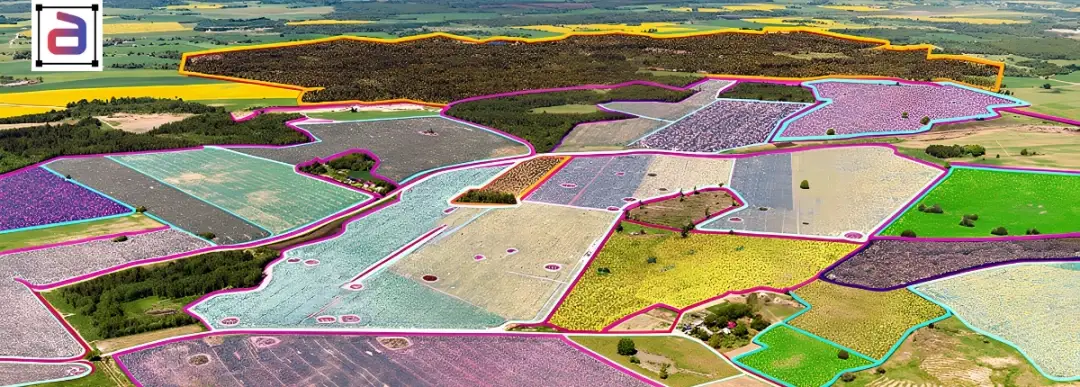
For computer vision models to perform reliably in agriculture, they must be trained on data that reflects this complexity. Bounding boxes are often insufficient when crops overlap, weeds intertwine with plants, or objects deform over time. This is why polygon video labeling has become a foundational requirement for advanced agricultural imaging systems.
Polygon annotation enables pixel-level precision, allowing AI models to understand fine-grained visual distinctions that directly impact yield prediction, crop health monitoring, and autonomous decision-making.
What Is Polygon Video Labeling in Agriculture?
Polygon video labeling involves tracing precise, multi-point shapes around objects of interest across video frames. In agricultural contexts, this allows annotators to capture the true contours of crops, weeds, fruits, livestock, and equipment—even as they move, grow, or partially occlude one another.
As a service, polygon video labeling focuses on:
- Frame-by-frame or keyframe-based polygon annotation
- Temporal consistency across video sequences
- Custom taxonomies aligned to agricultural research goals
- Dataset-agnostic delivery for machine learning pipelines
This approach ensures that agricultural AI models learn from accurate visual representations rather than simplified approximations.
Why Bounding Boxes Fail in Agricultural AI
Agricultural imagery challenges traditional annotation techniques in several ways:
- Irregular Shapes: Plants, leaves, and crops rarely conform to rectangular boundaries
- High Occlusion: Overlapping vegetation obscures clear object separation
- Environmental Noise: Soil, shadows, and debris introduce visual ambiguity
- Biological Variability: Growth stages and plant health alter object appearance
Polygon video labeling overcomes these limitations by capturing object boundaries exactly as they appear in real-world conditions.
Key Agricultural Use Cases for Polygon Video Labeling
Crop Health Monitoring
Polygon annotation allows AI models to segment leaves and stems precisely, enabling early detection of disease, nutrient deficiencies, and stress patterns.
Weed Detection and Differentiation
Weeds often grow interwoven with crops. Polygon video labeling enables models to distinguish between similar-looking plants at the pixel level, improving selective spraying and yield protection.
Yield Estimation
Accurate segmentation of fruit, grain, or other produce enables more reliable yield forecasting—especially when objects overlap or vary in size.
Livestock Tracking
For video-based livestock monitoring, polygon annotation helps capture animal boundaries accurately despite movement, occlusion, and herd clustering.
Autonomous Agricultural Machinery
Vision systems in drones, harvesters, and robotic weeders rely on high-fidelity annotations to navigate complex terrain and biological variability.
Polygon Annotation Techniques for Agricultural Video
Frame-by-Frame Polygon Annotation
Used when high temporal accuracy is required, particularly for fast-changing scenes or research-grade datasets.
Keyframe Annotation with Interpolation
Annotators label selected frames while maintaining shape consistency across adjacent frames, balancing precision with scalability.
Multi-Class Polygon Labeling
Different plant types, soil regions, and background elements are labeled simultaneously to support multi-task learning models.
Occlusion-Aware Labeling
Annotators apply consistent boundary rules when objects partially overlap or disappear from view.
Research Challenges in Agricultural Polygon Annotation
AgTech researchers face unique challenges when working with labeled video data:
- Ambiguous visual boundaries between crops and weeds
- Seasonal changes that affect annotation consistency
- Long video sequences leading to annotator fatigue
- Limited ground truth for rare crop diseases
A structured polygon video labeling service mitigates these issues through guidelines, image annotation quality checks, and iterative refinement.
How Annotation Services Support Agricultural Research
Specialized annotation partners provide more than just labeled data. They support research teams by:
- Developing custom annotation schemas
- Running pilot labeling phases for model validation
- Iterating annotation strategies as models evolve
- Maintaining consistency across long-term research projects
This service-led approach allows AgTech researchers to focus on experimentation rather than annotation operations.
Annotera’s Approach to Polygon Video Labeling for Agriculture
Annotera delivers polygon video labeling services designed for agricultural complexity:
- Annotators trained on biological and environmental variability
- Custom polygon protocols for crops, weeds, soil, and livestock
- Quality-first workflows with multi-level review
- Scalable delivery for research and production workloads
- Dataset-agnostic engagement—you retain full data ownership
Conclusion: Precision Annotation Enables Smarter Agricultural AI
Agricultural AI systems must operate in unpredictable, visually dense environments. Without precise training data, even the most advanced models struggle to perform reliably.
Polygon video labeling provides the pixel-level accuracy needed to train AI systems that can adapt to real-world agricultural conditions. By partnering with an experienced annotation service provider like Annotera, AgTech researchers can accelerate innovation while maintaining data quality and research integrity.
Ready to train agricultural AI models that perform reliably in real-world field conditions?
Annotera’s polygon video labeling services help AgTech teams capture pixel-level detail across complex, occluded, and fast-changing scenes—so your models can differentiate crops from weeds, segment produce accurately, and stay consistent across seasons.
Talk to Annotera to scope your labeling guidelines, run a pilot, and scale high-fidelity polygon annotation for agricultural video—without compromising quality or data ownership.


