
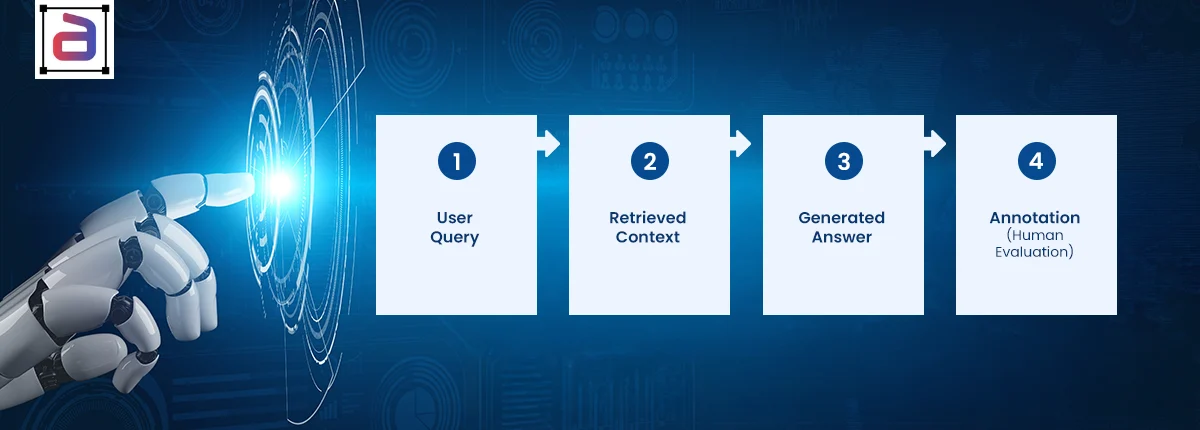
Retrieval-Augmented Generation systems combine a retriever and a generator. The retriever fetches context. The generator uses that context to produce an answer. The quality of that context depends on how the source documents were chunked — boundaries set at annotation time determine whether the retrieved segment contains the full concept the model needs. See how text chunking annotation affects RAG retrieval accuracy. If either fails, the user gets a wrong or fabricated answer — and has no way to know which component failed. That is why evaluation is not optional. It is the difference between a system you can deploy and one you cannot. This guide covers how to evaluate RAG systems in production. It walks through the three layers of evaluation (retrieval, generation, end-to-end), explains the ground-truth problem in enterprise knowledge bases, and shows how to calibrate between human and automated assessment. RAG Evaluation is the process of measuring the performance, accuracy, and reliability of Retrieval-Augmented Generation systems. It helps organizations assess retrieval quality, response relevance, factual consistency, and overall user satisfaction, ensuring AI applications deliver trustworthy and contextually accurate results at scale. Learn more about how semantic annotation improves RAG retrieval. Learn more about ground-truth datasets that reduce LLM hallucinations. Learn more about knowledge base annotation for RAG retrieval accuracy.
Key Points
- RAG evaluation must assess both retrieval quality and generation quality independently — a high-scoring system overall can mask a failing retrieval layer or a hallucinating generator.
- Retrieval evaluation metrics (precision, recall, NDCG) measure whether the right context was fetched; generation metrics (faithfulness, relevance) measure whether it was used correctly.
- Evaluation without a ground-truth dataset is guesswork: RAG systems require labeled question-context-answer triples to measure performance meaningfully.
- Production RAG evaluation must run continuously, not just at launch, because knowledge base drift and query distribution shifts degrade performance over time.
Table of Contents
The Three Layers of RAG Evaluation
RAG evaluation has three layers because a RAG system has three failure points. RLHF Annotation strengthens the three layers of RAG evaluation by assessing retrieval accuracy, response relevance, and user alignment, ensuring AI systems deliver trustworthy, context-aware, and high-quality outputs.
Retrieval evaluation. Can the system fetch the right context? Metrics: precision, recall, Mean Reciprocal Rank (MRR), normalized discounted cumulative gain (nDCG). A powerful generator cannot fix a retriever that returns irrelevant passages. Generation evaluation. Can the model produce a response grounded in the retrieved context? Metrics: faithfulness (alignment with context), answer relevance, factual correctness, fluency. A retriever can find the right document, but the generator can still hallucinate by adding details from its training data. End-to-end evaluation. Does the system work in production? Metrics: groundedness, hallucination rate, user satisfaction, latency, cost. Lab metrics are necessary but not sufficient. A system that scores high on precision and faithfulness can still fail in production if it is too slow or too expensive.
A Worked Evaluation Scenario
Consider an enterprise knowledge base with 10,000 documents covering product features, billing, compliance, and support procedures. A team builds a RAG system to answer customer questions. How do they know if it works?
Step 1: Retrieval evaluation. Run 100 test queries. For each query, the retriever returns the top 5 documents. A human reviewer marks which documents are relevant. If 80% of the top-5 results are relevant, recall@5 is 80%. This tells the team whether retrieval is the bottleneck. If recall is low, the problem is not the generator — the generator never saw the right context.
Step 2: Generation evaluation. For the same 100 queries, collect the retriever’s results and feed them to the generator. A human reviewer reads each answer and assesses: Is it factually correct? Does it use only the retrieved context, or does it add hallucinated details? Is it relevant to the question? This reveals whether the generator is the bottleneck. A high hallucination rate means the model is inventing answers rather than grounding them.
Step 3: End-to-end evaluation. Deploy the system to a subset of real users. Track: What fraction of answers do users rate as helpful? What fraction are marked as wrong? How many answers require a human escalation? This is the only evaluation that matters for deployment, because it measures what actually happens in production. Lab metrics can mislead. A system might score 95% on faithfulness but still frustrate users because it is slow or returns irrelevant results that happen to be fluent.
The Ground-Truth Problem in Enterprise Evaluation
Standard benchmarks like Natural Questions and TriviaQA have ground truth — labeled test sets that define the correct answer. Enterprise knowledge bases rarely do. For a question about “What is our parental leave policy?” the correct answer lives in one HR document. But a human reviewer might reasonably mark three related documents as relevant. Different reviewers disagree on what counts as correct.
This creates two problems. First, evaluating a RAG system requires human judgment at scale. Evaluating 100 queries manually is feasible. Evaluating 10,000 is not. Second, if reviewers disagree, which disagreement reveals a real system failure and which is just annotation variance?
The standard solution is inter-annotator agreement. Have two or three reviewers assess the same sample. Compute Cohen’s kappa or Krippendorff’s alpha. If agreement is below 0.70, the guidelines are unclear and need revision. If agreement is high, you can confidently evaluate on single-annotated data. This is the only way to distinguish signal from noise in enterprise evaluation.
Choosing Between Human and Automated Evaluation
Human evaluation is reliable but expensive and slow. Automated metrics are fast but often misleading. Neither alone is sufficient.
Human evaluation for. Defining quality standards. Assessing hallucination. Resolving ambiguous cases. Providing ground truth for training automated metrics. Budget 10–20 minutes per evaluation across retrieval, generation, and end-to-end. Automated evaluation for. Continuous monitoring in production. Scoring large batches quickly. Catching regressions before they reach users. LLM-as-a-judge approaches (using a strong model to evaluate outputs from a weaker model) are promising but unvalidated — they inherit hallucination from the judge model.
The standard pattern: use human evaluation to establish quality thresholds and calibrate automated metrics. Then use automated metrics to monitor production continuously. When an automated metric flags a potential regression, have a human reviewer check a sample. This combination scales.
Key Metrics and When to Use Them
For retrieval evaluation. Precision and recall are the standards. Precision answers: Of the retrieved documents, how many were relevant? Recall: Of all relevant documents in the knowledge base, how many did the system find? High precision, low recall means the retriever is conservative — it finds relevant documents but misses others. High recall, low precision means it is liberal — it finds relevant documents but also noise. Which trade-off matters depends on the use case. A medical system should favor high recall (missing a relevant study is worse than reviewing an irrelevant one). A customer support system might favor precision (irrelevant answers frustrate users more than missed questions).
For generation evaluation. Faithfulness and answer relevance are the critical pair. Faithfulness measures whether the answer stays grounded in retrieved context. Answer relevance measures whether it actually addresses the question. A response can be faithful (grounded in the retriever’s output) but irrelevant (answering the wrong question). Or relevant (addressing the query) but unfaithful (adding hallucinated details). Both failures matter, so track both metrics.
For end-to-end evaluation. Measure what you actually care about. If it powers customer support, measure user satisfaction (does the system help or frustrate?). If it powers internal search, measure latency (slow results are useless). Do not optimize generic metrics that do not reflect your business goal.
Tools and Frameworks
RAGAS, TruLens, and DeepEval are frameworks that automate metric computation. They are useful for benchmarking, but they all suffer from the same limitation: they rely on proxy metrics that may not reflect actual system quality. A high RAGAS score does not guarantee the system works in production. These tools are best used to catch regressions and maintain consistency, not as the sole basis for evaluation decisions.
Building Your RAG Evaluation Program
Start with 100 test queries representative of real usage. Have two or three reviewers assess retrieval and generation independently. Compute agreement. Refine guidelines until agreement is above 0.70. Define acceptable thresholds for each metric aligned with your business goals (e.g., “retrieval precision must be at least 85%”). Once thresholds are set, use automated metrics to monitor production continuously. Every month or quarter, pull a fresh sample of production queries, have humans assess them, and check whether automated metrics are still calibrated. If real-world performance drifts from automated scores, recalibrate.
How Annotera Supports RAG Evaluation
Annotera provides human evaluation at scale for RAG systems. We assess retrieval quality, generation faithfulness, and groundedness across large test sets. Our teams compute inter-annotator agreement, establish quality thresholds, and provide the ground truth needed to calibrate automated metrics. The result is a reliable evaluation foundation for production RAG systems.
Conclusion
RAG evaluation is not one metric or one method. It is a three-layer assessment combining retrieval, generation, and end-to-end measurement, grounded in human judgment and calibrated to your business goals. Teams that invest in rigorous evaluation build systems their organizations trust.
Ready to evaluate your RAG system rigorously? Partner with Annotera for human-led evaluation that grounds your metrics in real-world performance.