Artificial intelligence is no longer limited to recognizing simple objects in static images. Today’s AI systems are expected to understand motion, depth, context, and spatial relationships in real time. From autonomous vehicles navigating busy streets to intelligent surveillance systems detecting suspicious activity, video-based AI models are rapidly transforming industries worldwide.
But behind every high-performing computer vision system lies one critical foundation: high-quality annotated data.
The real challenge for many AI companies is determining whether their models require 2D video annotation or 3D video annotation. While both approaches play a vital role in AI training, choosing the wrong annotation strategy can impact model accuracy, scalability, and operational efficiency.
At Annotera, we help enterprises build smarter AI systems through scalable and precision-driven annotation solutions. As a trusted data annotation company and video annotation company, we understand that selecting the right annotation methodology is essential for long-term AI success.
In this blog, we break down the differences between 2D and 3D video annotation, their use cases, advantages, and how businesses can determine the right fit for their AI models.
Key Points
- 2D annotation works for flat, front-facing camera views.
- 3D annotation adds depth, orientation, and scale for LiDAR and stereo camera data.
- Autonomous vehicles need 3D annotation for safe object detection in all directions.
- Task complexity and sensor type determine which annotation method you need.
Table of Contents
Why Video Annotation Matters in Modern AI
Video annotation involves labeling objects, actions, movements, and environmental details frame by frame within video datasets. These annotations allow machine learning models to recognize patterns, detect objects, track motion, and make decisions in dynamic environments.
The demand for annotated video data is growing rapidly alongside the global expansion of AI technologies.
According to industry reports, the global computer vision market is expected to surpass USD 111 billion by 2034, fueled by increasing adoption of AI-driven automation across transportation, healthcare, retail, and security sectors.
This growth has also accelerated the need for reliable data annotation outsourcing and video annotation outsourcing solutions that can scale high-quality training data pipelines efficiently.
As Andrew Ng, AI pioneer and founder of DeepLearning.AI, famously stated: “AI is the new electricity.”
However, even the most advanced AI models cannot perform effectively without accurately labeled training data.
What Is 2D Video Annotation?
2D video annotation refers to labeling objects within flat video frames using X and Y coordinates. Annotators identify objects frame by frame using techniques such as bounding boxes, polygons, semantic segmentation, or keypoint labeling.
This is one of the most widely used annotation methods in computer vision because it is scalable, cost-efficient, and suitable for a broad range of AI applications.
Common Types of 2D Video Annotation
- Bounding box annotation
- Polygon annotation
- Semantic segmentation
- Keypoint annotation
- Object tracking
Industries Using 2D Video Annotation
2D annotation is commonly used in:
- Smart surveillance systems
- Retail analytics
- Facial recognition
- Sports analytics
- Medical imaging
- Traffic monitoring
- Content moderation AI
Because of its efficiency, many organizations partner with a specialized video annotation company to handle large-scale labeling projects with faster turnaround times.
Advantages of 2D Video Annotation
Faster and More Scalable
2D annotation workflows are comparatively simpler, enabling annotation teams to process massive datasets quickly.
For businesses training AI models on millions of frames, scalability becomes a major operational advantage.
Cost-Effective for AI Development
Compared to 3D annotation, 2D labeling requires less computational infrastructure and fewer specialized tools, making it ideal for organizations optimizing AI development budgets.
This is one reason why many startups and enterprises rely on video annotation outsourcing providers to reduce operational overhead.
Ideal for Standard Computer Vision Tasks
If your AI model primarily focuses on:
- Object detection
- Image classification
- Activity recognition
- Motion tracking
then 2D annotation often provides sufficient training accuracy.
Limitations of 2D Video Annotation
Despite its widespread adoption, 2D annotation has important limitations.
No Depth Perception
2D annotations cannot accurately measure the distance between objects or understand environmental depth.
Reduced Spatial Awareness
AI models trained only on 2D datasets may struggle in complex real-world environments where spatial reasoning is essential.
Occlusion Challenges
Objects hidden partially behind other objects can be difficult to track accurately in 2D environments.
For advanced autonomous systems, these limitations can significantly affect model reliability.
What Is 3D Video Annotation?
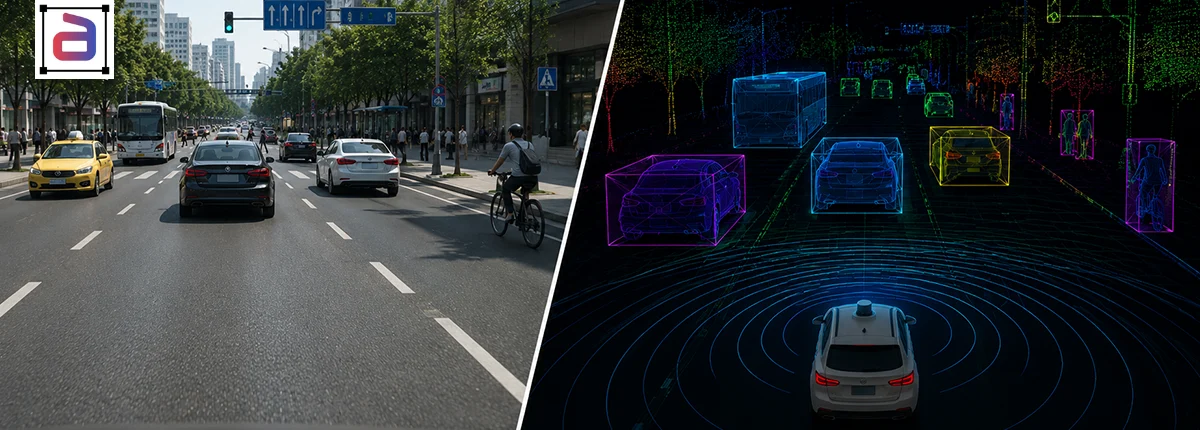
3D video annotation introduces depth information by labeling objects across X, Y, and Z coordinates. This enables AI models to understand object dimensions, orientation, movement, and spatial positioning within real-world environments.
3D annotation often combines video footage with LiDAR, RADAR, and point cloud data for enhanced environmental understanding.
Common Types of 3D Annotation
- 3D cuboid annotation
- LiDAR annotation
- Point cloud labeling
- Volumetric segmentation
- Sensor fusion annotation
As AI systems become increasingly autonomous, 3D annotation is rapidly becoming a critical requirement.
Elon Musk once remarked: “Self-driving cars are essentially solved software problems.”
Yet solving those “software problems” requires enormous volumes of accurately annotated 3D training data.
Industries Driving 3D Video Annotation Demand
3D annotation is essential for AI applications requiring advanced spatial intelligence, including:
- Autonomous vehicles
- Robotics
- Drone navigation
- Smart city infrastructure
- Industrial automation
- Warehouse robotics
- AR/VR systems
Industry analysts predict the autonomous driving data annotation market will experience significant growth over the next decade due to rising investments in intelligent mobility systems.
Advantages of 3D Video Annotation
Advanced Spatial Intelligence
3D annotation enables AI models to understand distance, orientation, and environmental relationships with greater precision.
This capability is crucial for navigation-based AI systems.
Improved Object Tracking
Unlike 2D annotation, 3D cuboids can maintain accurate object tracking even in crowded or partially obstructed scenes.
Better Decision-Making in Real-World Environments
Autonomous systems must interpret dynamic environments accurately to make safe decisions.
3D annotation significantly improves contextual awareness for these AI models.
Enhanced Performance in Complex Use Cases
For applications such as autonomous driving or robotics, 3D datasets improve detection accuracy, trajectory prediction, and environmental mapping.
Challenges of 3D Video Annotation
While highly powerful, 3D annotation comes with operational complexity.
Higher Annotation Costs
3D workflows require advanced tools, sensor integration, and highly trained annotation specialists.
Longer Processing Time
Point cloud labeling and sensor synchronization increase project timelines significantly.
Infrastructure Demands
Training 3D computer vision models often requires substantial GPU processing power and large-scale data infrastructure.
This is why enterprises increasingly partner with experienced data annotation outsourcing providers that specialize in advanced 3D annotation workflows.
2D vs 3D Video Annotation: Which One Does Your AI Model Need?
The right choice ultimately depends on your AI application, operational goals, and deployment environment.
Choose 2D Video Annotation If:
- Your AI model focuses on standard object detection
- You need large-scale annotation at lower cost
- Depth perception is not mission-critical
- Your datasets rely primarily on RGB camera footage
Choose 3D Video Annotation If:
- Your AI system requires spatial awareness
- You are developing autonomous navigation systems
- Your model relies on LiDAR or sensor fusion
- Distance estimation and motion prediction are critical
In many enterprise AI projects, hybrid annotation strategies combining both 2D and 3D data are becoming increasingly common.
Why Annotation Quality Determines AI Success
Regardless of whether you choose 2D or 3D annotation, data quality remains the single most important factor influencing model performance.
Poor annotations can result in:
- False detections
- Model bias
- Tracking failures
- Reduced prediction accuracy
- Safety risks in autonomous systems
That is why choosing the right annotation partner matters.
At Annotera, we combine domain expertise, scalable workflows, and multi-level quality assurance processes to deliver highly accurate AI training datasets.
As a trusted data annotation company, we support enterprises with:
- High-precision video annotation
- 2D and 3D labeling solutions
- LiDAR and point cloud annotation
- Dedicated QA pipelines
- Scalable annotation teams
- Secure data handling frameworks
Our tailored video annotation outsourcing solutions help organizations accelerate AI model development while maintaining quality and consistency at scale.
The Future of AI Depends on Better Annotation
As AI systems evolve toward real-time intelligence and autonomous decision-making, the importance of high-quality video annotation will continue to grow.
2D annotation remains highly effective for scalable computer vision applications, while 3D annotation is becoming indispensable for AI systems that must interpret the physical world with depth and precision.
The key is not choosing the “better” technology universally — it is selecting the annotation approach that aligns with your AI model’s real-world objectives.
Partner with Annotera for Scalable AI Annotation Solutions
Whether you are building next-generation surveillance systems, autonomous platforms, robotics solutions, or intelligent analytics tools, Annotera provides enterprise-grade annotation support designed for modern AI workflows.
As a leading video annotation company, we help businesses unlock accurate, scalable, and high-performance AI training data through customized annotation strategies.
Ready to Build Smarter AI Models?
Partner with Annotera to access reliable data annotation outsourcing and advanced video labeling services tailored to your industry needs. Contact Annotera today to scale your AI training datasets with precision, speed, and quality.
A closely related read: How To Label Human Actions in Video Datasets For AI Models.
A closely related read: Scaling Video Annotation for Large Computer Vision Datasets: Challenges and Solutions.