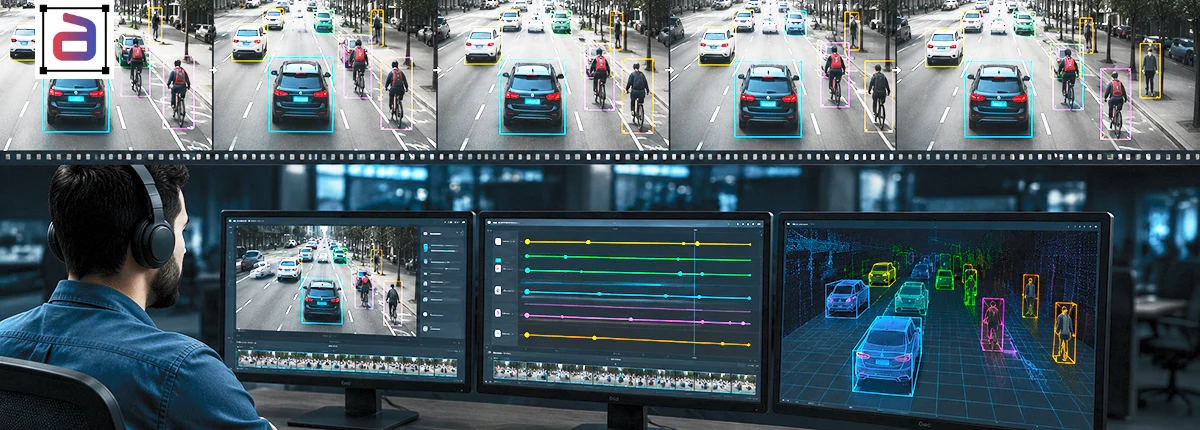
Artificial intelligence is rapidly transforming industries through video-driven applications such as autonomous vehicles, smart surveillance, retail analytics, healthcare imaging, and sports intelligence. However, even the best annotation can fail on temporal consistency. The specific mechanics of maintaining that continuity in bounding boxes are covered in temporal continuity in video bounding boxes. Even the most advanced AI models can fail without one critical component: temporally consistent video annotation. Temporal consistency in video annotation ensures accurate object tracking across frames. The event tracking and temporal segmentation techniques that maintain that consistency at high volume are the focus of scaling temporal segmentation for high-volume video annotation., thereby improving AI model stability, motion understanding, and real-world decision-making performance. Learn more about choosing between frame interpolation and frame-by-frame methods.
In video annotation, accuracy is not just about labeling objects correctly in a single frame. It is about ensuring that those labels remain stable, coherent, and contextually accurate across an entire video sequence. This process, known as temporal consistency, directly impacts how effectively AI systems understand motion, behavior, and real-world interactions.
As enterprises scale AI initiatives, the demand for reliable annotation workflows has significantly increased. According to Grand View Research, the global data collection and labeling market is expected to surpass $17 billion by 2030, fueled largely by computer vision and video AI adoption. This growth highlights the increasing importance of working with a trusted data annotation company that can deliver high-quality, temporally consistent datasets at scale.
At Annotera, we believe that high-performing AI models begin with intelligent, consistent, and production-ready annotation pipelines.
Key Points
- Temporal consistency means the same object carries the same identity and attributes across every frame — without it, tracking models learn contradictions instead of patterns.
- Inconsistent object IDs between frames are the most common and most damaging error type in video annotation because they corrupt tracking logic across the entire sequence.
- Human review of temporal consistency cannot be sampled — a single frame where an ID switches invalidates the entire track segment surrounding it.
- Video annotation quality audits must check temporal consistency explicitly as a separate metric from per-frame accuracy, as the two do not always correlate.
Table of Contents
What Is Temporal Consistency in Video Annotation?
Temporal consistency refers to maintaining stable annotations across consecutive video frames. If an object appears throughout a sequence, its labels, object IDs, tracking paths, and segmentation masks must remain consistent from beginning to end.
Unlike static image annotation, video annotation introduces the complexity of time and motion. Every object evolves across frames, and AI systems rely on that continuity to understand behavior patterns accurately.
For example:
- A pedestrian crossing a street must retain the same identity label across frames.
- A moving vehicle should maintain consistent tracking coordinates.
- Action recognition systems must interpret motion sequences without interruption.
Without temporal consistency, AI systems often produce unstable predictions, identity-switching errors, and inaccurate behavioral analysis.
As Andrew Ng, Founder of DeepLearning.AI, famously stated: “Data is the food for AI. If the data is inconsistent, the AI system becomes unreliable.”
This is especially true for video AI applications where continuity matters as much as precision.
| Without Temporal Consistency | With Temporal Consistency |
|---|---|
| ID switching | Persistent IDs |
| Flickering labels | Stable labels |
| Broken trajectories | Smooth tracking |
| Poor motion learning | Accurate motion understanding |
| Lower model accuracy | Better AI performance |
Why Temporal Consistency Is Critical for AI Performance
1. Improves Object Tracking and Motion Understanding
Modern AI systems are increasingly designed to interpret movement, predict trajectories, and analyze interactions in real time. These capabilities depend heavily on temporally consistent annotations.
Whether it is autonomous driving, warehouse robotics, or crowd analytics, object tracking models require stable annotations across thousands of frames.
When annotations fluctuate, models struggle to:
- Predict movement accurately
- Maintain object identities
- Detect motion patterns
- Understand environmental context
At Annotera, our annotation specialists combine AI-assisted workflows with human validation to ensure tracking stability across complex video datasets. This hybrid approach enables organizations to build smarter and more reliable computer vision systems.
Consequently, businesses looking for scalable video annotation outsourcing solutions increasingly prioritize providers with advanced temporal QA capabilities.
2. Reduces AI Errors and Prediction Instability
Inconsistent annotations often lead to:
- False positives
- Missed detections
- Tracking drift
- Flickering segmentation outputs
For example, in retail analytics, inconsistent customer tracking can distort footfall analysis and purchasing behavior insights. Similarly, in surveillance systems, identity inconsistencies may trigger false security alerts.
This is why leading AI companies no longer evaluate annotation quality frame by frame alone. Instead, they assess how consistently annotations behave across time.
A professional video annotation company understands that temporal consistency is essential for reducing model drift and improving production-level AI performance. Moreover, temporal video annotation helps AI models maintain contextual continuity across video sequences. A professional video annotation company understands that temporal consistency is essential for reducing model drift and improving production-level AI performance.
3. Essential for Autonomous and Safety-Critical AI Systems
Few industries demonstrate the importance of temporal consistency more clearly than autonomous driving.
Self-driving vehicles continuously analyze video feeds to:
- Detect pedestrians
- Track nearby vehicles
- Interpret traffic conditions
- Predict motion behavior
A single annotation inconsistency can compromise the model’s understanding of a dynamic environment.
According to McKinsey & Company: “Autonomous systems depend on massive quantities of accurately labeled sensor and video data to achieve safe deployment.”
This growing complexity has accelerated demand for enterprise-grade data annotation outsourcing solutions that combine scalability with rigorous quality assurance.
At Annotera, our teams are trained to manage complex edge cases including:
- Occlusion handling
- Fast-moving objects
- Poor lighting conditions
- Dense urban traffic
- Multi-object interactions
These capabilities help organizations build AI systems that operate safely and reliably in real-world conditions.
4. Strengthens Human-in-the-Loop Quality Assurance
Although automation has improved annotation speed, human expertise remains essential for maintaining temporal consistency.
AI-assisted tools can propagate annotations across frames, but human reviewers are required to validate:
- Object continuity
- Label accuracy
- Identity preservation
- Contextual interpretation
This is where human-in-the-loop (HITL) workflows become critical.
At Annotera, we implement multi-layer quality assurance frameworks that include:
- Sequence-level reviews
- Consensus validation
- Automated drift detection
- Domain-specific QA protocols
As Fei-Fei Li, Professor at Stanford University and AI researcher, stated: “The strength of AI depends on the quality of the data humans provide.”
Human intelligence remains indispensable in producing high-quality video datasets that reflect real-world complexity.
Challenges in Maintaining Temporal Consistency
Despite its importance, achieving temporal consistency at scale presents several operational challenges.
Occlusion and Reappearance
Objects frequently disappear behind obstacles before reappearing later in the sequence. Maintaining the same object identity throughout these interruptions requires contextual reasoning and experienced annotators.
Camera Movement and Motion Blur
Dynamic camera angles, lighting variations, and motion blur can significantly affect annotation stability.
Massive Frame Volumes
A single hour of video footage may contain more than 100,000 frames. Maintaining consistency across large-scale datasets demands sophisticated tooling, workflow management, and scalable review systems.
Complex Edge Cases
Unpredictable human behavior, adverse weather conditions, and crowded scenes create annotation ambiguity that automation alone cannot solve effectively.
This is why organizations increasingly partner with a specialized data annotation company capable of balancing AI automation with human precision.
Best Practices for Temporally Consistent Video Annotation
Organizations seeking high-quality annotation outcomes should focus on several key best practices:
AI-Assisted Pre-Annotation
Machine learning models accelerate annotation by propagating labels across frames, while human reviewers ensure consistency and accuracy.
Sequence-Based Quality Checks
Reviewing full video sequences instead of isolated frames helps identify identity switches and tracking drift.
Standardized Annotation Guidelines
Clear annotation protocols improve inter-annotator agreement and reduce subjectivity across distributed teams.
Domain-Trained Annotators
Annotators with domain expertise better understand motion behavior, contextual interactions, and edge-case handling.
At Annotera, we combine advanced annotation tools with specialized human expertise to deliver scalable, enterprise-grade annotation solutions tailored to complex AI applications.
Why Businesses Choose Annotera for Video Annotation
As AI systems become more sophisticated, annotation quality has become a strategic differentiator rather than a back-office task.
Organizations choose Annotera because we provide:
- Scalable annotation operations
- Human-in-the-loop QA workflows
- High temporal consistency standards
- Domain-specific annotation expertise
- Flexible video annotation outsourcing models
- Reliable turnaround times
Our team understands that successful AI deployment begins with trustworthy training data.
Whether you are developing autonomous systems, surveillance platforms, retail intelligence solutions, or healthcare AI applications, Annotera delivers the precision and consistency required for real-world AI success.
Conclusion
Temporal consistency is the foundation of high-quality video annotation. Without it, AI systems struggle to understand motion, track objects accurately, and make reliable predictions in dynamic environments.
As video AI adoption continues accelerating across industries, enterprises must prioritize annotation quality, continuity, and contextual accuracy. Partnering with an experienced video annotation company ensures that AI models are trained on datasets built for stability, scalability, and real-world performance.
At Annotera, we combine advanced workflows, human expertise, and rigorous quality assurance to help businesses build smarter AI systems with confidence.
Ready to Build Smarter Video AI Solutions?
Looking for a trusted partner for scalable data annotation outsourcing and high-precision video annotation services? Contact our team as Annotera helps enterprises accelerate AI development with temporally consistent, enterprise-grade annotation solutions tailored for modern computer vision applications.