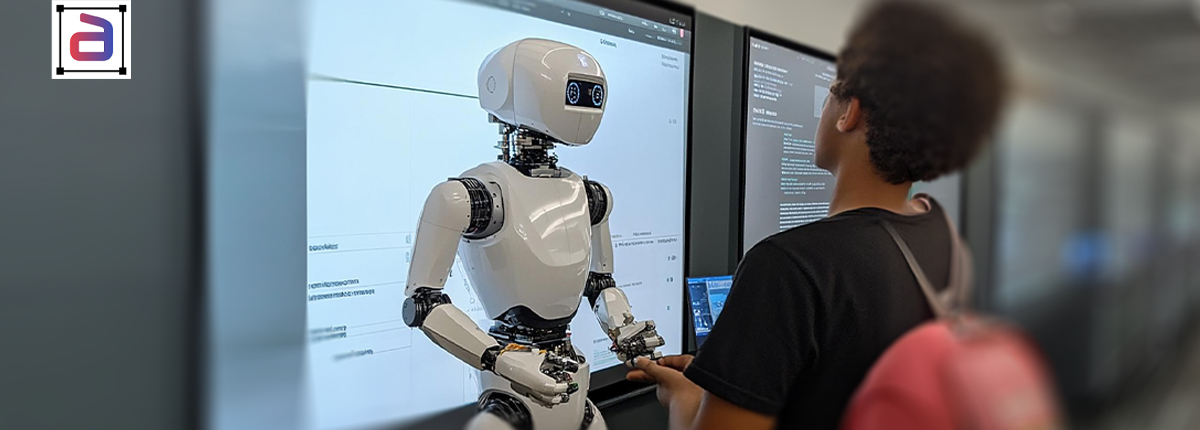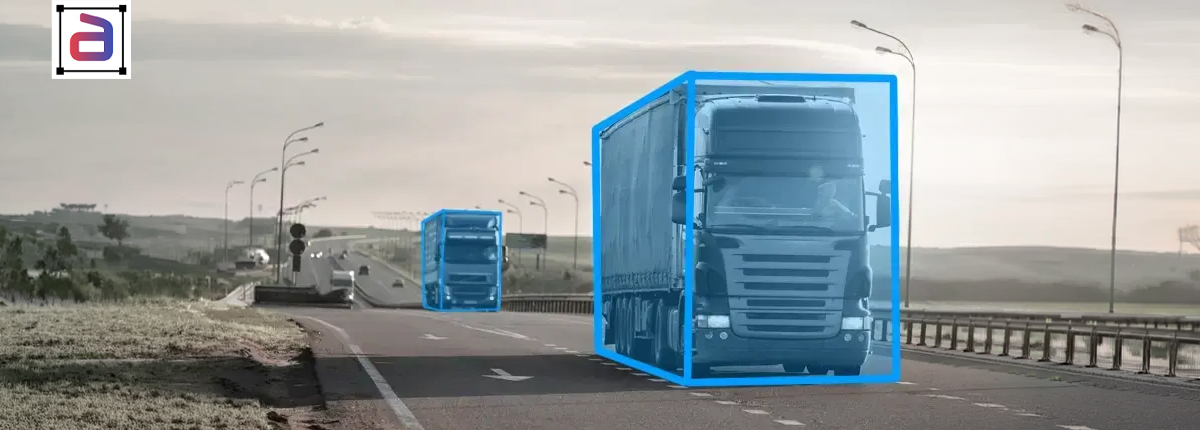
Image cuboid annotation enables autonomous systems to perceive depth, orientation, and spatial relationships beyond the boundaries of flat images. For perception engineers working on autonomous platforms, understanding the Z-axis is essential for accurate scene interpretation and real-world decision-making. Cuboids extend traditional image annotation into three dimensions, allowing AI systems to reason about distance, volume, and object positioning.
In autonomy-focused applications, image cuboid annotation is a critical component of perception stacks that must operate reliably in dynamic environments.
Why Autonomous Systems Need Z-Axis Awareness
Autonomous systems interact continuously with their surroundings. Whether navigating roads, warehouses, or open environments, these systems must understand how far objects are, how large they are, and how they relate spatially.
Without Z-axis awareness, perception models struggle with collision avoidance, object interaction, and motion planning. Image cuboid annotation provides the depth cues required to train models for these tasks.
Role of Image Cuboid Annotation in Perception Stacks
Perception stacks combine sensor inputs, vision models, and decision logic. 3D cuboid annotations support this pipeline by providing structured spatial labels that represent objects as three-dimensional entities.
These cuboids help models learn object boundaries, depth estimation, and orientation alignment, which are essential for downstream planning and control modules.
Autonomous Use Cases Enabled by Cuboids
Environment Mapping and Scene Understanding
Cuboid annotations allow autonomous systems to build structured representations of environments, supporting mapping and localization.
Obstacle Detection and Clearance Estimation
By understanding object volume and distance, systems can calculate safe paths and maneuvering space.
Object Interaction and Manipulation
Autonomous platforms that interact with objects rely on cuboids to estimate grasp points, approach angles, and spatial constraints.
Challenges in Image Cuboid Annotation for Autonomy
Annotating cuboids for autonomous systems poses challenges, including perspective distortion, occlusion, and limited depth cues in monocular images.
Perception engineers require annotations that are consistent across frames and viewpoints to ensure stable model behavior.
Precision and Consistency Requirements
Image cuboid annotation for autonomy demands high precision in:
- Depth estimation relative to camera position
- Orientation alignment across axes
- Consistent scaling across datasets
Even small inconsistencies can lead to cascading perception errors in deployed systems.
Scaling Image Cuboid Annotation for Autonomous Programs
As autonomous systems evolve, datasets expand rapidly to cover edge cases and new environments. Managed cuboid annotation services help teams scale data production while maintaining quality and consistency.
This scalability is vital for perception teams iterating on models across development and deployment cycles.
How Annotera Supports Autonomous Perception Teams
Annotera provides image cuboid annotation through trained teams experienced in autonomous system use cases. Annotation workflows follow strict spatial guidelines and include multi-layer quality assurance to maintain depth and orientation accuracy.
This approach supports perception engineers in building robust, production-ready autonomy models.
Conclusion
Seeing the Z-axis is fundamental to autonomy. Image cuboid annotation gives AI systems the spatial awareness needed to navigate, interact, and operate safely in the real world.
For perception engineers, high-quality cuboid annotation is not optional. It is foundational to reliable autonomous performance.
Developing or scaling autonomous perception systems? Partner with Annotera for expert-led cuboid annotation to enable a true three-dimensional understanding.