
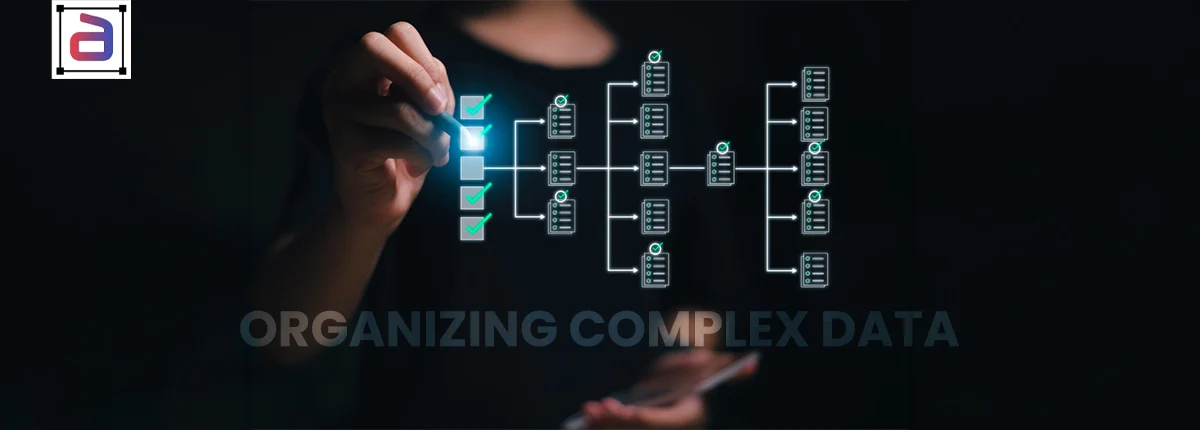
As enterprise datasets grow in size and complexity, flat category structures struggle to reflect how information is actually organized and consumed. Documents often belong to multiple layers of meaning, from broad domains to highly specific subtopics. In this context, text categorization techniques that support hierarchical classification enable organizations to structure complex data using multi-level taxonomies.
For data architects, hierarchical text classification provides the foundation for scalable information architecture, governance, and advanced analytics.
Key Points
- Hierarchical text classification assigns documents to multiple levels simultaneously — broad domain, subdomain, and specific topic — enabling more precise retrieval and governance.
- Flat categorisation schemes fail when document meaning spans multiple levels of specificity; hierarchical systems capture the granularity that search and compliance applications require.
- Annotation for hierarchical classification must resolve ambiguity at each level independently: a document correctly placed at the top level can be incorrectly categorised at the subdomain level.
- Taxonomy design for hierarchical classification must balance depth (specificity) against breadth (coverage) to avoid category proliferation that makes consistent annotation impossible.
Table of Contents
Why Flat Classification Falls Short
Flat classification assigns a single-level label to a document. While simple to implement, this approach cannot represent nuanced relationships between topics.
Consequently, search relevance declines, category sprawl increases, and downstream systems lose contextual clarity. Therefore, more expressive categorization models are required.
What Hierarchical Text Classification Enables
Hierarchical text classification organizes documents across parent and child categories. As a result, content can be discovered and analyzed at multiple levels of abstraction. Hierarchical text classification organizes content through multiple levels of categories, enabling AI systems to identify both broad topics and specific intents. This approach improves text classification accuracy, supports complex taxonomies, and helps conversational AI understand user requests with greater contextual precision across diverse domains and interactions.
Modern hierarchies may include:
- Domain → function → process
- Industry → regulation → clause type
- Product → feature → issue category
These structures reflect how enterprises naturally reason about information.
How Text Categorization Techniques Support Hierarchies
Text categorization techniques leverage taxonomy-aware models, rule layering, and supervised learning to accurately assign documents to multiple levels.
By training models on hierarchical labels, systems learn both broad context and fine-grained distinctions. Text categorization techniques support hierarchical structures by organizing data into multi-level taxonomies, enabling granular classification from broad categories to specific subtopics. This improves data retrieval, contextual understanding, and workflow automation, allowing enterprises to manage complex datasets efficiently while maintaining consistency, scalability, and structured knowledge representation across systems.
Architectural Benefits for Enterprise Systems
Improved Search and Retrieval
Hierarchies allow users to filter content progressively, improving precision without sacrificing recall.
Scalable Governance and Compliance
Policy enforcement can occur at appropriate levels of the hierarchy, simplifying audits and access control.
Analytics and Reporting Consistency
Hierarchical categories enable roll-up reporting and trend analysis across granular and aggregated views.
Challenges in Designing Hierarchical Taxonomies
Creating and maintaining hierarchies requires careful taxonomy design, clear definitions, and version control. Additionally, categories evolve as business needs change.
However, with disciplined governance and annotation standards, hierarchies remain stable and extensible.
Why Expert Annotation Matters for Hierarchical Classification
Accurate hierarchical labeling demands consistency across levels. Expert-managed annotation ensures documents are correctly placed within the taxonomy, preventing drift and misalignment. Effective text classification annotation enables structured content organization by assigning data to hierarchical categories and subcategories. This improves information retrieval, content management, recommendation systems, and AI-driven decision-making across large datasets.
As a result, data architects can trust classification outputs across systems and time.
How Annotera Supports Hierarchical Text Categorization
Annotera applies advanced text categorization techniques through governed workflows aligned to client-specific taxonomies. Multi-layer QA ensures category accuracy across all hierarchy levels.
Consequently, enterprises gain structured datasets ready for search, analytics, and AI-driven applications.
Conclusion
Organizing complex data requires more than single-layer labels. Hierarchical text classification reflects real-world information structure and supports enterprise-scale intelligence.
Through advanced text categorization techniques, organizations can manage complexity while preserving clarity and control.
Designing taxonomies or modernizing enterprise information architecture? Partner with Annotera for expert-managed text categorization techniques built for hierarchical data organization.
A closely related read: Text Categorization for News and Media Platforms.