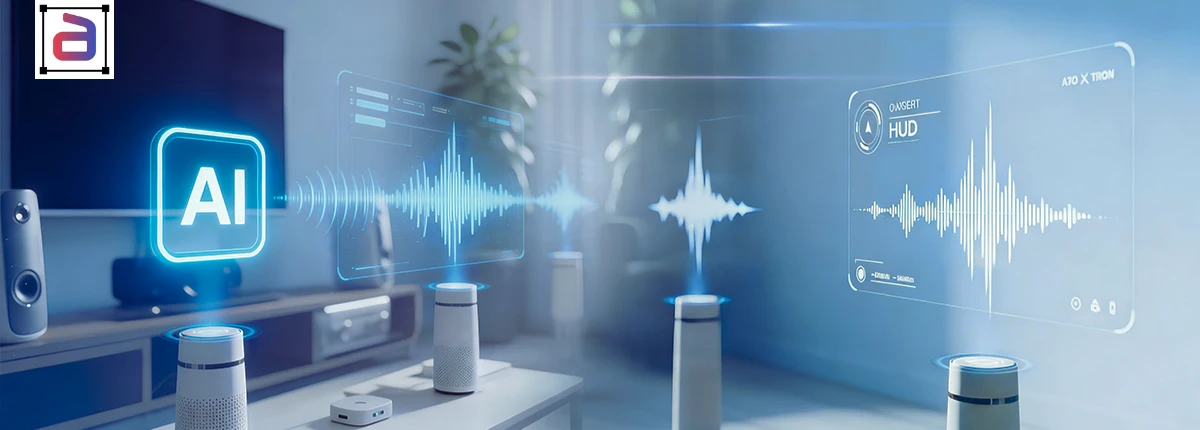
Smart homes are no longer defined solely by voice commands. The next wave of innovation turns smart speakers and connected devices into intelligent listeners that understand their environment. Acoustic event detection enables IoT systems to recognize meaningful sounds such as baby cries, water leaks, smoke alarms, or breaking glass—without requiring user interaction.
- The goal: Transform smart speakers into reliable “smart ears.”
- The barrier: Privacy concerns and high false-alarm rates in domestic environments.
- The solution: Precise acoustic event detection training optimized for edge-device performance.
Table of Contents
Key Points
- Smart home acoustic event detection annotation must cover the acoustic signatures of each target sound in the specific domestic environments where the product will be deployed, not in controlled recording studios.
- Far-field detection annotation — detecting sounds from across a room through a smart speaker microphone — requires training data annotated under realistic distance and reverberation conditions.
- Smart home safety event annotation must include negative examples of acoustically similar non-target sounds: the sound of a dog cry does not need to trigger a baby monitor alert, but the two sounds can be confused by under-annotated models.
- Annotation for smart home event detection must cover device-to-device variation in how the same sound is captured by different smart speaker models with different microphone arrays.
The Friction Point: When Smart Homes Cry Wolf
User trust defines success in consumer IoT. If a device triggers alerts too often or at the wrong time, users disable features—or abandon the product entirely.
In domestic environments, sound overlaps constantly. Televisions, appliances, children, pets, and background media all compete for acoustic space. When a baby-cry detector triggers every time a TV is on, the system becomes a nuisance rather than a utility.
Acoustic event detection must therefore prioritize precision over sensitivity. Smart-home AI needs to know not just when sound is present, but when it matters.
“False alarms don’t just annoy users. They permanently erode trust in the device.” — Consumer IoT Product Lead
Why Acoustic Event Detection Matters For Smart-home Growth
For IoT product managers, sound-based intelligence unlocks new value layers without adding new hardware.
With accurate acoustic event detection, smart-home systems can:
- Alert parents to baby cries even when rooms are closed
- Detect water leaks before visible damage occurs
- Identify smoke alarms when users are away
- Recognize glass breakage during potential break-ins
However, these capabilities only succeed if detection remains reliable under real household conditions.
Sound event detection helps smart-home systems recognize alarms, breaking glass, doorbells, appliances, and unusual noises, enabling faster responses, improved safety, intelligent automation, and more context-aware connected-home experiences.
Training For The Edge: Constraints That Shape Sound AI
Smart-home devices operate under strict constraints. Unlike cloud-based systems, edge devices must process audio locally to protect privacy and reduce latency.
This introduces three training challenges:
Limited Compute And Power Budgets In Acoustic Event Detection
Edge hardware requires lightweight models. Acoustic event detection training must therefore focus on high-signal data rather than brute-force scale.
On-device Inference Only
Privacy-first architectures restrict continuous audio streaming. Models must learn from short, event-driven snippets instead of long recordings.
Real-time Response Expectations
Users expect immediate alerts. Any delay caused by heavy models or noisy data reduces perceived intelligence.
As a result, dataset quality becomes more important than dataset size.
Overcoming Household Noise With Precise Labeling In Acoustic Event Detection
Homes generate some of the most complex acoustic environments AI must handle. Distinguishing a breaking window from a dropped kitchen glass requires nuanced training data.
| Sound event | Common false trigger | What the model must learn |
|---|---|---|
| Baby cry | Television audio | Emotional harmonic patterns |
| Water leak | Sink usage | Continuous low-frequency flow |
| Glass break | Dishware impact | High-frequency shatter signature |
| Smoke alarm | Phone ringtone | Repetitive tonal cadence |
Acoustic event detection succeeds when the training data clearly and consistently captures these distinctions.
Privacy By Design: Training Without Surveillance
Privacy concerns are a major barrier to adoption in smart homes. Users reject systems that feel intrusive.
Effective acoustic event detection respects privacy by:
- Training on short, anonymized clips
- Avoiding speech content capture
- Performing inference locally on-device
- Using event-based triggers instead of continuous recording
This approach allows IoT teams to deliver value without compromising user trust.
The Annotera Edge For Smart-home AI
Annotera supports IoT product teams with acoustic event detection datasets built specifically for domestic environments.
Our “Private Home” dataset library includes:
- Audio recorded in real homes across regions
- Diverse household layouts and materials
- Natural background noise from daily life
- Carefully labeled event boundaries to reduce false positives
“Models trained on real homes behave differently from those trained in labs.” — Smart Home AI Engineer
By grounding training data in realistic conditions, we help teams ship sound-aware features users actually keep enabled.
Turning Sound Into A Competitive Advantage For Acoustic Event Detection
For IoT product managers, the opportunity is clear. Sound-based intelligence extends device capabilities without increasing hardware costs.
However, success depends on discipline in training. Acoustic detection must remain accurate, privacy-preserving, and edge-efficient.
Products that listen intelligently feel helpful. Products that listen poorly feel intrusive.
If your smart-home roadmap includes sound-aware features, high-quality training for acoustic event detection is essential. Learn how Annotera helps teams reduce false alarms and improve on-device performance. Power smarter living with precise sound intelligence. Partner with us and learn how our expert data annotation teams can train AI that accurately detects household sound events—from alarms to appliance activity. Build safer, more responsive smart home systems with high-quality audio datasets tailored for real-world environments.
A closely related read: Scaling Your AI Strategy With Generative AI And Human-in-the-Loop Processes .
A closely related read: How Data Annotation Outsourcing Improves AI Accuracy and Time-to-Market.