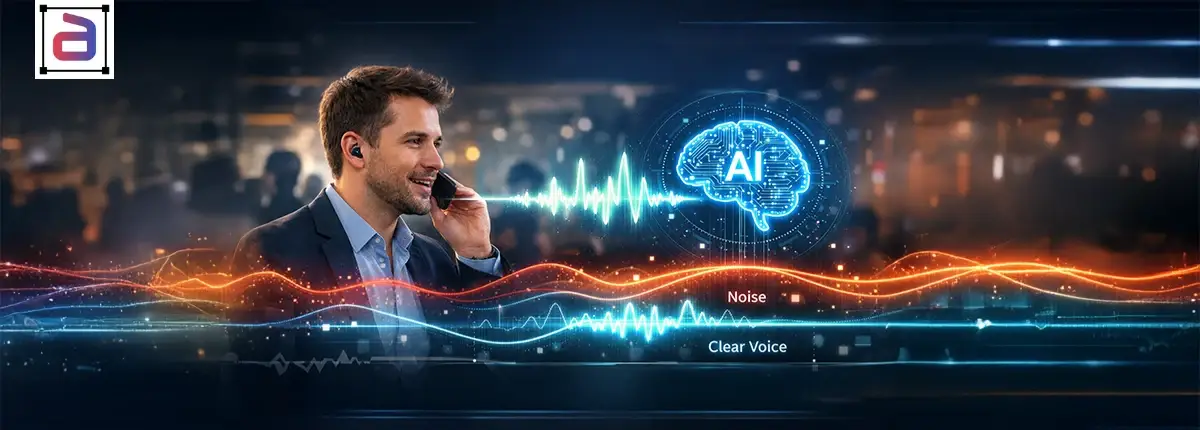
Voice-enabled hardware is shrinking. Expectations, however, are growing.From wearables and automotive systems to smart kiosks and industrial devices, modern hardware must deliver clear speech recognition in environments filled with interference. For hardware designers, this creates a hard constraint: microphones have physical limits.This is where audio noise tagging becomes a critical enabler of software-defined clarity.
Even the most advanced MEMS (Micro-Electro-Mechanical Systems) microphones can only capture so much signal before noise overwhelms clarity. At that point, improving performance becomes a data and software problem, not a hardware one. Separating signal from noise starts with disciplined labeling, as covered in our audio event tagging guide.
Table of Contents
Key Points
- Noise tagging for wearable and embedded audio AI must cover the specific interference patterns of the deployment form factor: spectacle-frame microphones, in-ear devices, and chest-worn devices each have distinct noise profiles.
- Hardware-specific noise annotation matters because the same ambient sound produces different spectrograms when captured by different microphone placements — noise suppression models trained on one device fail on another.
- Noise tagging for clarity in noisy environments must cover near-field and far-field noise differently: close-proximity noise to the microphone is a harder suppression problem than distant background noise.
- Audio noise annotation for speech enhancement must include realistic noise-speech overlap scenarios — noise that arrives at the same time and frequency as speech — not just noise-only and speech-only segments.
The Challenge: Physical Limits of Microphones
Microphone performance is bounded by physics. Moreover, size, power consumption, placement, and cost all cap achievable signal quality. Noise labeling services classify background sounds such as traffic, wind, machinery, and crowd chatter within audio datasets. These annotations help AI models separate speech from interference, improving speech recognition accuracy, acoustic robustness, and performance in real-world, noisy operating conditions.
Why Hardware Hits a Wall
- MEMS microphones have a finite Signal-to-Noise Ratio (SNR)
- Smaller devices amplify internal electrical interference
- Environmental noise cannot be eliminated at the capture stage
- Adding more hardware increases size, cost, and power draw
“You can’t design your way out of physics—but you can train your way around it.”
Also,once audio is captured, only software and data determine how well speech is recovered.
The Solution: Software-Defined Clarity
Instead of relying solely on physical components, modern systems achieve clarity by teaching AI models how to interpret sound.
Software-defined clarity uses labeled audio data to help models:
- Recognize noise patterns
- Distinguish interference from speech
- Adapt filtering dynamically
- Preserve intelligibility under changing conditions
Moreover, this approach depends on audio noise tagging—a specialized annotation process that identifies how different types of noise interact with speech.
What Is Audio Noise Tagging?
Audio noise tagging is a data annotation service that labels background and interference sounds in audio recordings so that AI systems can learn to handle them intelligently. Also ,unlike transcription or basic sound classification, noise tagging focuses on:
- Non-speech sounds produced by the environment or device
- Overlapping noise sources
- Temporal behavior of interference
- Hardware-specific noise patterns
Also, Annotera performs noise tagging on client-provided audio, delivering model-ready labeled data aligned with specific hardware architectures.
The Hardware-Focused Noise Tagging Playbook
1. Internal Component Noise Labeling
Modern devices generate their own noise. Moreover, sources such as coil whine, power regulation artifacts, and electrical interference often contaminate audio at the source. Without explicit labeling, AI models treat this noise as part of the environment.
Noise tagging enables models to learn what the device itself sounds like.
| Internal Noise Source | Impact on Speech |
| Coil whine | High-frequency distortion |
| Power noise | Speech masking |
| Electrical interference | False activations |
By labeling these signals, models can digitally subtract them during inference.
2. Acoustic Echo Cancellation (AEC) Through Tagging
Devices that play audio also hear it.
Also, without proper handling, a device’s own output can:
- Trigger wake-words
- Confuse speech recognition
- Degrade conversational accuracy
Noise tagging supports Acoustic Echo Cancellation (AEC) by labeling:
- Device-generated audio output
- Reflections and reverberations
- Timing relationships between output and input
“If a device can’t tell its own voice apart from the user’s, clarity collapses.”
Tagged data allows models to ignore self-generated audio without suppressing real speech.
3. Microphone Array Calibration with Multi-Channel Noise Labeling
Many devices rely on microphone arrays to improve capture quality. However, beamforming algorithms are only as good as the data used to train them.
Multi-channel noise labeling enables:
- Channel-specific noise identification
- Directional noise awareness
- Fine-tuning of beamforming weights
| Without Multi-Channel Labeling | Without Multi-Channel Labeling |
| Static beam patterns | Adaptive beamforming |
| Poor directional accuracy | Improved speech focus |
| Inconsistent performance | Stable real-world clarity |
This is especially valuable in compact hardware where microphone spacing is limited.
Why Hardware Teams Outsource Audio Noise Tagging
Noise tagging requires:
- Audio-trained annotators
- Consistent taxonomies
- Scalable workflows
- Dedicated QA processes
For hardware teams, building this internally often slows development.
| In-House Tagging | Professional Noise Tagging |
| Limited scale | Elastic capacity |
| Engineering overhead | Dedicated annotation teams |
| Inconsistent labeling | Standardized quality |
Outsourcing allows teams to focus on design and deployment, rather than on annotation operations.
Annotera’s Approach to Audio Noise Tagging
Annotera delivers audio noise tagging as a production-ready service, aligned with hardware and AI development cycles. Smart city audio tagging classifies sounds from urban environments, including traffic, sirens, construction, alarms, and crowd activity. Annotera applies structured labeling methods to help AI models distinguish sound events accurately, supporting environmental monitoring, anomaly detection, and public safety.
Key capabilities include:
- Custom noise schemas per device type
- Support for internal and environmental noise
- Multi-channel and overlapping noise tagging
- Human QA with inter-annotator agreement checks
- Secure, dataset-agnostic workflows
Further, Annotera does not sell datasets. All services are performed on client-provided audio.
The Business Impact: Smarter Data Beats Bigger Hardware
High-quality noise tagging enables hardware teams to:
- Build smaller, sleeker devices
- Reduce reliance on additional microphones
- Improve clarity without increasing cost or power consumption
- Outperform larger hardware by working smarter at the data level
“The winning devices aren’t the biggest—they’re the ones trained best.”
Designing Hardware That Hears Beyond Its Limits
Microphones will always have constraints. But with the right data, AI systems can learn to hear past those limits. Moreover, audio noise tagging gives hardware designers a way to overcome physical barriers using software intelligence—delivering clearer speech, better recognition, and superior user experiences in real-world environments.
Partner with Annotera to turn raw device audio into training data that helps your hardware hear smarter, not louder.
Related reading: audio quality annotation for robust models.
A closely related read: Training AI to Hear Through Background Interference: Noise Annotation Techniques for Real-World Robustness.