Get A Quote

Voice AI for the Road: Cutting Through the Cabin Noise With Automotive Voice AI Labeling

Voice AI is rapidly becoming a core interface inside vehicles. From navigation and infotainment to hands-free calling and climate control, drivers increasingly rely on voice interactions to stay focused on the road. At the center of reliable in-car experiences is automotive voice AI labeling, which enables systems to understand driver intent even in noisy, unpredictable environments.

Table of Contents

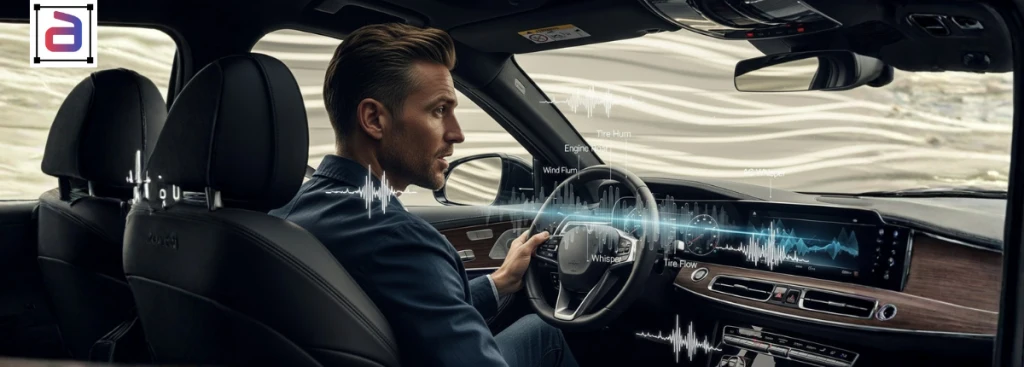
    The in-vehicle environment creates one of the toughest challenges for voice technology: cabin noise. Road vibrations, engine hum, wind resistance, music, passenger conversations, and open windows compete directly with the driver’s voice. When systems misunderstand intent, they trigger missed commands and repeated prompts that frustrate users and introduce real safety risks. Audio annotation is central to automotive voice AI labeling, enabling systems to accurately interpret driver commands amid engine noise, road sounds, and overlapping speech. Precise transcription, intent tagging, and noise labeling ensure reliable voice recognition and real-time, safety-critical responses inside vehicles.

    For automotive and mobility teams, building reliable in-car voice AI starts with getting labeling right.

    Why Cabin Noise Breaks Automotive Voice AI

    Unlike controlled indoor settings, vehicles introduce constantly changing acoustic conditions. Noise levels fluctuate with speed, road surface, weather, and driving behavior. A voice command issued at a red light sounds very different from the same command on a highway.

    Traditional systems struggle because teams often train them on clean or lightly disturbed audio. When these systems encounter real-world cabin noise, transcription accuracy drops and intent classification fails. The system then responds with the familiar breakdown: “I didn’t get that.”

    Without a robust labeling processes, even advanced models fail to generalize in real driving conditions.

    The Real Risk: Distraction and Driver Frustration

    In automotive contexts, failed voice interactions are more than a poor user experience. They increase cognitive load and tempt drivers to repeat commands, raise their voice, or switch to manual controls. Voice intent labeling becomes reliable when datasets reflect real user behavior, including diverse phrasing, accents, and contextual variations. Consistent intent taxonomies, expert human review, and rigorous quality checks ensure voice systems accurately understand and respond to user intent.

    Each additional interaction distracts from driving. Over time, drivers lose trust in the system and stop using voice features altogether—undermining the promise of voice-first vehicle interfaces.

    Why Automotive Voice AI Labeling Matters More Than Perfect Transcription

    Automotive voice AI does not need flawless transcripts. It needs to quickly and accurately understand intent.

    Drivers speak differently in cars. They issue shorter, more urgent commands and often interrupt themselves mid-sentence. Background noise can distort words, but accurate automotive voice AI labeling still captures the intent—navigate home, call a contact, or adjust the temperature.

    When teams prioritize intent over pristine text, automotive voice AI performs reliably even in compromised audio conditions.

    The Role of Automotive Voice AI Labeling in Noisy Environments

    High-quality labeling trains systems to recognize user goals despite noise, distortion, and variability. Annotators evaluate audio in real driving conditions, accounting for overlapping sounds, clipped speech, and stress patterns.

    This audio-first approach ensures that intent models learn from realistic scenarios rather than idealized recordings, dramatically improving first-time resolution inside the vehicle.

    Common In-Car Voice Scenarios That Stress Automotive Voice AI

    ScenarioWhy It’s Challenging
    Highway drivingConstant low-frequency road noise
    Open windowsWind interference and distortion
    Music playbackCompeting audio signals
    Passenger conversationsOverlapping speech
    Emergency maneuversElevated stress and urgency

    Building Automotive Voice AI That Works on the Road

    To perform reliably in self-driving vehicles, automotive voice AI systems must train on data that reflects how drivers actually speak. Effective automotive voice AI labeling captures accents, speaking styles, emotional states, and real driving conditions.

    Teams must treat automotive voice AI labeling as a continuous process. When systems miss commands, route incorrectly, or take the wrong action, those failures should flow directly back into annotation workflows to expand and refine the intent library.

    Best Practices for Automotive Voice AI Labeling Teams

    Automotive voice AI must handle more than simple, single-step commands. Real-world driving introduces complexity, urgency, and frequent mid-command changes that systems must interpret correctly without distracting the driver.

    Support Complex, Multi-Step Automotive Voice Intents

    Drivers often revise commands mid-sentence, especially when conditions change. Requests like “Find a gas station… no, the cheaper one” are common and must be understood as a single evolving intent, not multiple failures.

    Accurate automotive voice AI labeling helps models correctly interpret layered commands—keeping the driver’s hands on the wheel and attention on the road.

    Design Automotive Voice AI Labeling for Safety-Critical Commands

    Certain in-car voice commands carry far higher stakes. Panic or high-stress utterances—issued during breakdowns, near-misses, or emergencies—require immediate and accurate execution.

    Automotive voice AI labeling for these scenarios must prioritize clarity, urgency, and zero ambiguity. Specialized intent categories and stricter quality thresholds ensure the system responds correctly the first time.

    Measure Success Through Resolution and Safety

    In automotive environments, success is not just about convenience. It is about whether the correct action is taken instantly, without repetition or manual intervention.

    The Annotera Perspective on Automotive Voice AI Labeling

    As a data annotation service provider, Annotera supports automotive and mobility teams with labeling processes tailored to in-vehicle environments.

    Our annotators are trained to identify intent through heavy background noise, overlapping speech, stress, and rapid corrections that occur during real driving scenarios. By labeling intent directly from audio captured in challenging cabin conditions, we help automotive voice AI remain reliable—even when conditions are unpredictable.

    We do not build voice platforms, deploy models, or sell datasets. Our focus is singular: delivering accurate, audio-first labeling so in-car systems can act as dependable, safety-focused co-pilots.

    Final Thoughts

    Voice AI in vehicles must work even in the harshest conditions. From complex, multi-step requests to high-stress safety commands, in-car systems must cut through cabin noise and interpret intent without hesitation. This reliability is built at the data layer. By investing in labeling grounded in real driving conditions, automotive teams can create voice experiences that keep drivers safe, reduce distraction, and build lasting trust in connected vehicle technology. Ready to build voice AI that performs reliably on the road? Partner with us, a trusted data annotation company, offering secure, scalable data annotation outsourcing to label complex automotive audio and accelerate deployment of production-ready voice AI systems.

    Share On:

    Get in Touch with UsConnect with an Expert

      Related PostsInsights on Data Annotation Innovation