Artificial intelligence is no longer evolving in isolated stages—it is accelerating across industries at unprecedented speed. From autonomous vehicles and healthcare diagnostics to smart retail and intelligent surveillance, AI systems are increasingly powered by video data. However, AI models are only as effective as the datasets used to train them. This is where the role of a trusted video annotation company becomes mission-critical.
As enterprises demand faster, smarter, and more scalable AI systems, the future of video annotation is undergoing a major transformation. Automation is reducing manual workloads, synthetic data is expanding training possibilities, and multimodal learning is enabling AI to interpret video alongside audio, text, and sensor data.
At Annotera, we see these advancements not as temporary trends, but as the foundation of next-generation AI development. Businesses that embrace intelligent annotation strategies today will be better positioned to lead tomorrow’s AI-driven economy.
Key Points
- Automation in video annotation increases throughput but introduces systematic errors that human review must catch before mislabeled data enters training pipelines.
- Synthetic data can supplement annotated video for rare scenarios but cannot replace human-labeled data for the edge cases that matter most in production AI.
- Multimodal video annotation — linking visual events with audio, text, and metadata — is the next frontier and requires tightly coordinated cross-modal annotation workflows.
- Annotation pipeline architecture decisions made early in a computer vision project determine how well the dataset scales as model requirements grow.
Table of Contents
Why Video Annotation Matters More Than Ever
Video data provides significantly richer contextual information than static images. It captures movement, object interactions, environmental changes, timing, and behavioral patterns—all essential for training advanced computer vision systems.
Today’s AI-powered applications rely heavily on annotated video data, including:
- Autonomous driving systems
- Healthcare and surgical AI
- Smart city surveillance
- Sports analytics
- Retail customer behavior analysis
- Robotics and industrial automation
As AI pioneer Andrew Ng famously stated: “AI is the new electricity.”
The statement perfectly captures the current reality: AI is becoming embedded into every major industry, and accurate annotation is the infrastructure that powers it.
For organizations building scalable AI systems, partnering with an experienced data annotation company is no longer optional—it is a strategic advantage.
Automation Is Revolutionizing Video Annotation
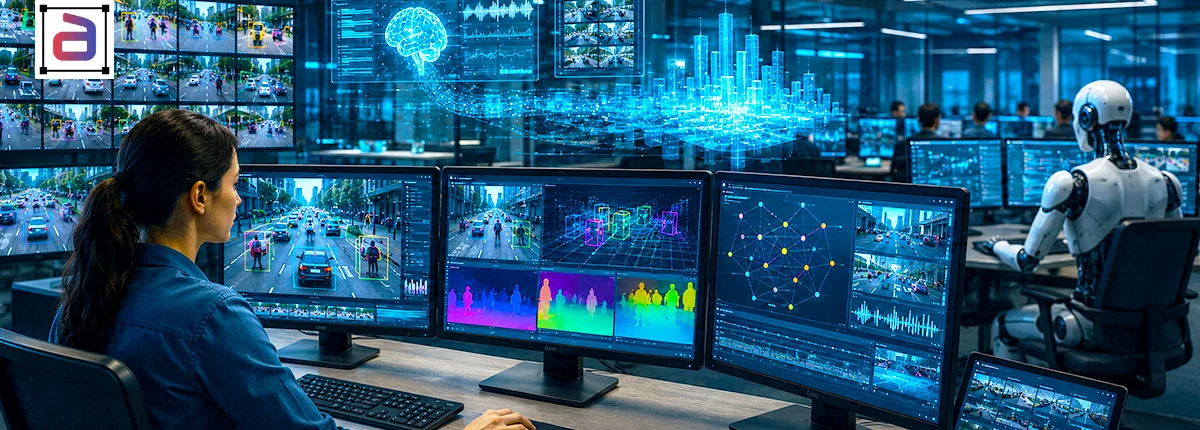
Traditional video annotation workflows often require annotators to manually label thousands of frames, track moving objects, and maintain consistency across complex sequences. While effective, this process can become extremely time-consuming and resource-intensive as datasets grow larger. Automation is revolutionizing video annotation by accelerating labeling workflows and improving dataset consistency. Moreover, AI-powered automation combined with video semantic segmentation enables faster object recognition, enhanced scene understanding, and more scalable training data generation for intelligent surveillance systems.
The future, however, lies in AI-assisted annotation.
Modern annotation platforms now use machine learning algorithms to automate repetitive tasks such as:
- Object tracking across frames
- Automatic bounding box generation
- Semantic segmentation
- Pose estimation
- Scene classification
- Motion detection
Instead of manually labeling every frame, annotators can validate and refine AI-generated predictions. This hybrid approach dramatically improves efficiency while preserving quality and accuracy.
At Annotera, we combine intelligent automation with expert human validation to deliver scalable annotation solutions tailored for enterprise AI projects. This balanced methodology helps businesses accelerate model training while reducing operational costs.
Yet automation alone is not enough.
As Fei-Fei Li, Professor of Computer Science at Stanford University, once said: “The strength of AI is not in replacing humans, but in augmenting human capabilities.”
This philosophy defines the future of annotation workflows. Human expertise remains essential for handling edge cases, contextual ambiguities, and complex real-world scenarios that automation still struggles to interpret accurately.
Synthetic Data Is Expanding AI Possibilities
One of the biggest challenges in AI training is obtaining large volumes of high-quality annotated video data. Real-world data collection can be expensive, time-consuming, and often restricted by privacy regulations.
This challenge has accelerated the rise of synthetic data.
Synthetic data refers to artificially generated datasets created using simulations, gaming engines, 3D rendering, and generative AI models. Instead of capturing real-world footage, businesses can generate virtual environments containing vehicles, pedestrians, machinery, weather conditions, and various edge-case scenarios.
The advantages are substantial.
Faster Dataset Creation
Synthetic environments allow organizations to generate thousands of labeled video sequences within a fraction of the time required for manual annotation.
Better Edge-Case Simulation
Rare but critical scenarios—such as accidents, low-visibility weather, or hazardous industrial conditions—can be simulated repeatedly and safely.
Lower Annotation Costs
By reducing dependence on real-world data collection, businesses can optimize annotation budgets while improving scalability.
Enhanced Privacy Compliance
Synthetic datasets help organizations avoid privacy concerns associated with recording real individuals or sensitive environments.
However, synthetic data works best when combined with real-world annotated datasets. AI systems still require authentic environmental complexity and natural human behavior to generalize effectively.
This growing demand for hybrid data pipelines is why many organizations are investing in strategic video annotation outsourcing partnerships that can manage both synthetic and real-world annotation workflows efficiently.
Multimodal Learning Is Redefining Annotation Requirements
AI models are evolving beyond single-input learning systems. Modern AI increasingly relies on multimodal learning, where multiple forms of data are processed simultaneously.
Instead of analyzing only video, advanced AI systems now integrate:
- Video feeds
- Audio signals
- Speech recognition
- Textual data
- Sensor inputs
- LiDAR data
- Thermal imaging
For example, autonomous vehicle AI must simultaneously process video, radar, GPS, and environmental signals to make accurate driving decisions. Similarly, healthcare AI systems may combine surgical videos, voice recordings, and patient reports to improve diagnostic accuracy.
This evolution is significantly increasing annotation complexity.
Annotators now need to:
- Synchronize audio with video actions
- Label speech and emotional tone
- Map sensor data to visual events
- Connect text-based metadata with video sequences
- Identify relationships across multiple modalities
At Annotera, we recognize that multimodal AI requires more than traditional labeling approaches. It demands scalable infrastructure, domain expertise, and precision-driven quality assurance processes.
As businesses pursue increasingly sophisticated AI models, partnering with a specialized data annotation outsourcing provider becomes essential for maintaining accuracy and scalability across diverse datasets. Video classification enables AI systems to categorize content based on scenes, actions, objects, events, and contextual cues. As multimodal learning advances, classification increasingly combines visual, audio, and textual signals, creating richer datasets that help models understand complex video content with greater accuracy, consistency, and contextual awareness.
Human Expertise Will Continue to Drive Quality
Despite rapid advancements in automation and synthetic data generation, human intelligence remains at the core of effective video annotation.
AI tools can accelerate workflows, but they still struggle with:
- Contextual interpretation
- Cultural nuances
- Ethical judgment
- Ambiguous scenarios
- Complex behavioral analysis
Human annotators provide the critical decision-making layer that ensures high-quality AI training data.
At Annotera, our annotation specialists work alongside intelligent automation systems to deliver datasets that meet enterprise-grade quality standards. This collaborative approach helps organizations build AI systems that are not only scalable, but also reliable and trustworthy.
The future of AI annotation will not be fully automated—it will be intelligently augmented.
Why Businesses Are Turning to Annotera
As AI adoption accelerates globally, organizations need annotation partners that can adapt to rapidly evolving technologies and increasing dataset complexity.
Annotera helps businesses stay ahead through:
- Scalable video annotation services
- AI-assisted annotation workflows
- Multimodal data expertise
- Human-in-the-loop quality assurance
- Flexible video annotation outsourcing solutions
- Industry-specific annotation capabilities
Whether you are building autonomous systems, healthcare AI models, or next-generation computer vision applications, high-quality data annotation remains the foundation of success.
Conclusion
The future of AI video annotation is being shaped by automation, synthetic data, and multimodal learning. Together, these technologies are transforming how AI systems are trained, optimized, and deployed across industries.
Yet amid all this innovation, one truth remains constant: high-quality annotated data determines AI performance.
Businesses that invest in intelligent annotation strategies today will gain a significant competitive advantage tomorrow. By partnering with an experienced video annotation company like Annotera, organizations can accelerate AI development while maintaining the precision, scalability, and reliability required for real-world deployment.
Ready to Build Smarter AI Systems?
Annotera delivers scalable, accurate, and future-ready annotation solutions designed for next-generation AI applications. From automated video labeling to multimodal data annotation, our experts help businesses transform raw data into powerful AI intelligence. Contact Annotera today to discover how our advanced data annotation company solutions can accelerate your AI initiatives with precision and confidence.
This connects closely with trends specific to video annotation.
For more on this, cases where manual precision still beats automation.