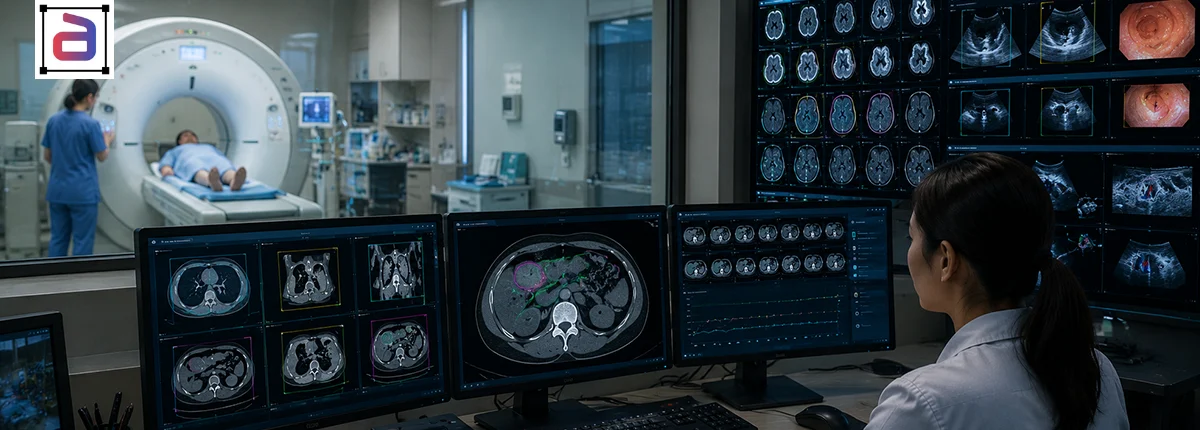
Artificial intelligence is redefining healthcare at an unprecedented pace. From robotic-assisted surgeries to real-time diagnostic support, AI-powered systems are transforming how clinicians detect diseases, perform procedures, and deliver patient care. Yet behind every high-performing healthcare AI model lies one critical foundation: high-quality annotation. Polygon-specific work is in polygon annotation services for medical AIation: accurately medical video annotation.
Among the most valuable data types in modern healthcare AI is video. Surgical recordings, endoscopy footage, ultrasound scans, and diagnostic imaging videos provide rich clinical insights that AI systems can learn from—provided the data is properly labeled. Learn more about surgical video annotation for robotic-assisted procedures.
This is where medical video annotation becomes indispensable.
At Annotera, we help healthcare innovators unlock the full potential of AI through precise, scalable, and secure annotation solutions. As a specialized video annotation company, Annotera empowers organizations to build advanced AI models for surgical intelligence, diagnostic automation, and clinical decision support.
Key Points
- Medical video annotation requires clinical domain expertise at every stage — instrument identification, tissue classification, and procedural step labeling are not tasks for general annotators.
- Surgical AI trained on mislabeled video poses direct patient safety risks; annotation quality standards in medical AI must exceed those applied in commercial computer vision.
- Endoscopy, ultrasound, and surgical footage each require distinct annotation protocols because image characteristics, relevant entities, and label taxonomies differ substantially.
- Regulatory submission for medical AI requires annotation audit trails demonstrating annotator qualifications, inter-annotator agreement, and quality control procedures.
Table of Contents
The Growing Role of Video Data in Healthcare AI
Modern healthcare environments generate enormous volumes of video data every day. Minimally invasive surgeries, robotic procedures, radiology imaging, and patient monitoring systems continuously produce visual datasets that can train sophisticated AI algorithms.
According to Grand View Research, the global healthcare data annotation tools market was valued at nearly USD 130 million in 2022 and is projected to grow at a CAGR of 27.5% through 2030. This rapid expansion reflects the increasing adoption of AI across hospitals, medical research institutions, and healthcare technology companies.
However, raw medical videos alone cannot train AI systems effectively. These datasets must first be structured and labeled with exceptional accuracy. As healthcare AI continues to evolve, medical video data is becoming increasingly valuable. Moreover, hospitals and research institutions are leveraging annotated videos to improve diagnostics, enhance surgical precision, and accelerate AI-driven clinical decision-making across diverse healthcare applications.
Medical video annotation involves identifying and labeling:
- Surgical instruments
- Anatomical structures
- Tissue boundaries
- Disease markers
- Procedural stages
- Motion patterns
- Clinical events
These annotations teach AI systems how to interpret complex medical environments with precision.
As Andrew Ng, AI pioneer and founder of DeepLearning.AI, famously stated: “AI is the new electricity.”
In healthcare, annotated medical data is the infrastructure powering that electricity.
Why Precision Matters in Medical Video Annotation
Healthcare AI is fundamentally different from traditional AI applications. Inaccurate annotations in retail or entertainment systems may create inconvenience. In healthcare, annotation errors can directly affect patient outcomes.
AI models used in surgical navigation or diagnostics require highly accurate and context-aware datasets. Even small inconsistencies can reduce model reliability and compromise performance.
At Annotera, we recognize that medical annotation demands more than technical labeling expertise. It requires deep attention to detail, quality assurance, and scalable workflows aligned with healthcare standards.
As a leading video annotation company, Annotera delivers annotation solutions designed to support high-stakes healthcare environments where precision is non-negotiable. Precision in medical video annotation is critical because even minor labeling errors can affect AI model performance. Therefore, accurate annotations not only improve diagnostic reliability but also enhance surgical guidance, clinical decision-making, and overall patient safety in healthcare AI applications.
Advancing AI in Surgical Applications
One of the most exciting applications of medical video annotation is surgical AI.
Operating rooms are increasingly integrating computer vision systems capable of analyzing procedures in real time. These systems help surgeons improve efficiency, reduce errors, and enhance patient safety. AI-powered surgical systems are transforming modern operating rooms by improving procedural accuracy and efficiency. Furthermore, annotated medical videos enable AI models to recognize instruments, track surgical phases, and assist surgeons with real-time insights during complex medical procedures. Learn more about tracking animal movement using video object detection. Learn more about tracking animal movement using video object detection.
Annotated surgical videos enable AI systems to perform tasks such as:
Surgical Instrument Tracking
AI models can identify and track surgical instruments frame-by-frame during procedures. This capability supports robotic-assisted surgeries and workflow optimization.
Procedure Phase Recognition
By labeling different stages of surgical procedures, AI systems learn to recognize procedural transitions and provide contextual assistance during operations.
Real-Time Anomaly Detection
AI-powered systems can flag abnormalities such as unexpected bleeding, tissue damage, or procedural deviations in real time.
Surgical Performance Analytics
Hospitals and training institutions increasingly use AI-driven analytics to assess surgical precision, movement efficiency, and procedural consistency.
A Reuters report highlighted that AI-assisted post-operative reporting systems produced significantly fewer discrepancies compared to manually written reports by surgeons. This demonstrates how AI is already improving operational accuracy in healthcare environments.
Another Reuters report revealed that AI-guided camera systems are enabling surgeons to perform certain minimally invasive procedures with minimal human assistance—marking a major step toward surgical automation.
None of these advancements would be possible without expertly annotated medical video datasets.
Transforming Diagnostic Applications with AI
Medical video annotation is equally critical in diagnostic AI.
Healthcare organizations increasingly rely on AI models to analyze:
- Ultrasound videos
- Echocardiograms
- Endoscopy recordings
- Retinal imaging
- MRI sequences
- Continuous patient monitoring feeds
Annotated datasets help AI systems identify subtle patterns associated with diseases, abnormalities, and physiological changes.
For example, AI systems trained on annotated endoscopy videos can assist clinicians in detecting gastrointestinal polyps and early-stage cancers with greater accuracy.
Similarly, AI-powered cardiac monitoring systems can identify arrhythmias faster than conventional review processes.
As Fei-Fei Li, Professor of Computer Science at Stanford University, noted: “The holy grail of AI is to replicate human intelligence.”
In healthcare, achieving that intelligence requires clinically accurate annotated data that teaches AI systems how to “see” and interpret medical complexity.
The Challenges of Medical Video Annotation
Medical video annotation is far more demanding than standard video labeling projects.
Healthcare datasets often involve:
- Highly complex anatomy
- Low-visibility surgical environments
- Rapid instrument movement
- Tissue deformation
- Long-duration video recordings
- Sensitive patient information
Additionally, healthcare organizations must comply with strict regulatory requirements related to privacy, confidentiality, and data security.
This is why many healthcare companies choose video annotation outsourcing to experienced partners capable of handling large-scale projects with accuracy and compliance.
At Annotera, our annotation workflows are designed to address these challenges through:
- Rigorous quality assurance protocols
- Scalable annotation infrastructure
- Secure data handling processes
- Customized annotation guidelines
- Multi-level review systems
As a trusted data annotation company, Annotera ensures that healthcare AI developers receive high-quality datasets optimized for model performance and clinical reliability.
Why Healthcare Organizations Choose Annotera
Healthcare AI development requires more than annotation volume—it requires annotation excellence. Healthcare organizations choose Annotera for surgical video annotation because of its commitment to clinical accuracy, robust quality assurance, and scalable delivery. Moreover, Annotera’s expertise in medical AI datasets helps accelerate innovation while ensuring compliance, consistency, and precision.
Annotera combines domain-focused workflows, advanced quality control, and scalable delivery capabilities to support organizations building next-generation healthcare technologies.
Our expertise includes:
- Surgical video annotation
- Diagnostic imaging annotation
- Object tracking and segmentation
- Temporal event labeling
- Medical AI dataset preparation
- Human-in-the-loop quality validation
Whether organizations are developing robotic surgery platforms, diagnostic imaging systems, or AI-powered clinical tools, Annotera delivers annotation services tailored to the unique demands of healthcare AI.
As AI adoption accelerates, reliable data annotation outsourcing is becoming a strategic advantage for healthcare innovators seeking faster development cycles and higher-performing AI models.
The Future of Medical Video Annotation
The future of healthcare AI will depend heavily on the quality of annotated medical datasets.
Emerging technologies such as autonomous surgical robotics, AI-assisted diagnostics, predictive healthcare analytics, and smart operating rooms will continue driving demand for specialized annotation services.
While automation tools are evolving, human expertise remains essential for ensuring contextual accuracy and clinical precision.
At Annotera, we believe that the future of healthcare AI will be built through a combination of advanced technology and expert human intelligence. Our mission is to help healthcare organizations accelerate innovation with annotation solutions they can trust.
Conclusion
Medical video annotation is no longer a supporting process—it is a foundational pillar of healthcare AI innovation.
From enabling real-time surgical intelligence to improving diagnostic accuracy, annotated medical videos are powering the next generation of intelligent healthcare systems.
However, healthcare AI demands exceptional accuracy, scalability, and domain expertise. Organizations developing AI-driven healthcare solutions need annotation partners capable of meeting these standards consistently.
Annotera stands at the forefront of this transformation as a trusted video annotation company and experienced data annotation company delivering high-quality annotation solutions for complex medical AI applications.
Ready to Build Smarter Healthcare AI Solutions?
Partner with Annotera to accelerate your healthcare AI initiatives with secure, scalable, and precision-driven annotation services. Whether you need surgical video labeling, diagnostic data preparation, or enterprise-scale video annotation outsourcing, our experts are ready to support your success. Contact Annotera today to discover how our annotation expertise can help power the future of intelligent healthcare.
A closely related read: How Data Annotation Enables AI in Radiology, Pathology, and Diagnostics.