Artificial intelligence is evolving at an unprecedented pace, and computer vision sits at the center of this transformation. From autonomous vehicles and smart surveillance systems to healthcare diagnostics and retail analytics, AI-powered visual systems are reshaping industries worldwide. However, behind every high-performing computer vision model lies one critical foundation: accurately annotated video data.
As enterprises increasingly train AI systems on massive video datasets, scaling annotation workflows has become both a strategic necessity and a significant operational challenge. According to Grand View Research, the global AI data annotation market is expected to grow substantially over the next decade as organizations accelerate AI adoption across industries. This surge highlights a growing reality — AI models are only as reliable as the data used to train them. Learn more about unique challenges in marine video datasets.
For businesses developing advanced computer vision solutions, partnering with an experienced video annotation company like Annotera can help ensure scalable, high-quality annotation workflows that drive better AI outcomes.
Key Points
- Scaling video annotation introduces quality drift: annotation consistency that holds at 1,000 frames breaks down at 1,000,000 frames without systematic monitoring.
- The primary bottleneck in large computer vision datasets is not annotation speed but inter-annotator agreement — fast but inconsistent labeling produces data that hurts model performance.
- Tooling selection for large-scale video annotation determines throughput, but quality control infrastructure determines whether that throughput is actually usable for training.
- Staged delivery with continuous quality audits is more cost-effective than batch delivery followed by large-scale rework when annotation errors are discovered late.
Table of Contents
Why Video Annotation Is Critical for Computer Vision
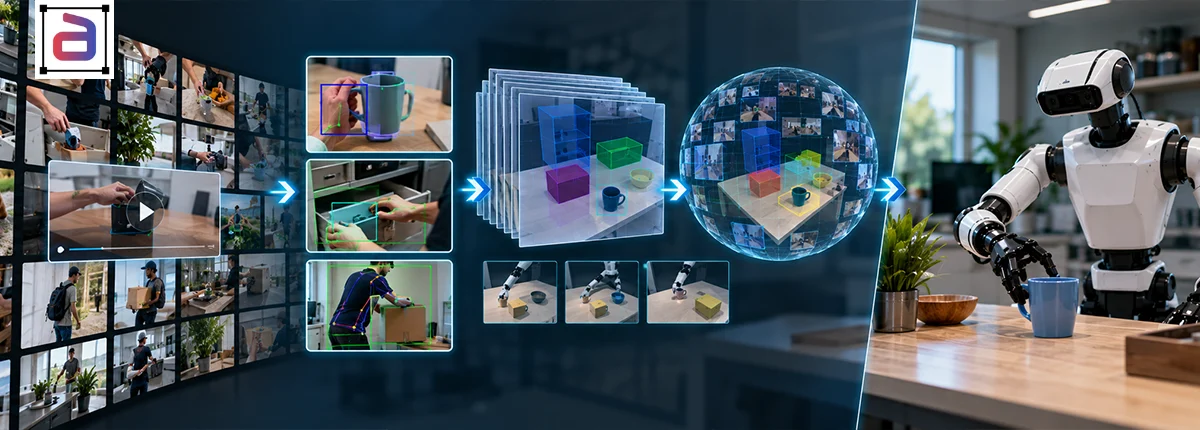
Video annotation involves labeling objects, actions, movements, events, and environmental contexts frame by frame to train machine learning algorithms. Unlike image annotation, video labeling requires temporal continuity, object tracking, and consistent labeling across thousands of sequential frames.
Computer vision applications rely on video annotation for:
- Object detection and tracking
- Autonomous navigation
- Activity recognition
- Facial recognition
- Traffic analysis
- Medical video interpretation
- Sports performance analytics
- Retail behavior monitoring
Modern AI systems require enormous datasets to improve accuracy and reduce bias. The YouTube-8M dataset, one of the world’s largest labeled video datasets, contains millions of annotated videos designed specifically for large-scale machine learning research. Medical video annotation is critical for computer vision because it enables AI models to accurately identify anatomical structures, track movements, and improve diagnostic and surgical decision-making.
As datasets continue growing in complexity and size, organizations must address the operational challenges associated with scaling annotation pipelines.
The Biggest Challenges in Scaling Video Annotation
Scaling video annotation introduces several operational challenges, including managing massive datasets, maintaining temporal consistency, and ensuring annotation accuracy. Moreover, businesses must balance scalability, quality assurance, and cost efficiency to build reliable computer vision models successfully.
1. Managing Massive Volumes of Video Data
Video datasets are exponentially larger than image datasets. A single autonomous vehicle can generate terabytes of video footage daily, creating immense annotation demands.
Each frame may require object bounding boxes, segmentation masks, pose estimation, or behavioral tagging. Consequently, annotation projects can quickly become resource-intensive and time-consuming.
Andrew Ng, Founder of DeepLearning.AI, famously stated: “The quality of your data is more important than the quantity of your algorithms.”
This quote perfectly reflects the reality of modern AI development. Without high-quality annotation, even the most advanced models struggle to perform reliably.
For organizations handling enterprise-scale AI projects, this is where data annotation outsourcing becomes a practical and scalable solution.
2. Maintaining Temporal Consistency
One of the most difficult aspects of video annotation is ensuring consistency across frames. Objects move, overlap, disappear, or become partially occluded during video sequences.
For example, in autonomous driving applications, pedestrians and vehicles must be tracked accurately throughout changing environmental conditions. Even small inconsistencies can introduce training noise and reduce model accuracy.
Maintaining temporal consistency requires:
- Standardized annotation protocols
- Skilled annotators
- Multi-stage quality reviews
- AI-assisted tracking systems
An experienced video annotation company can implement these quality control mechanisms at scale while maintaining operational efficiency.
3. Handling Complex Edge Cases
Real-world video environments are unpredictable. AI systems must learn to interpret:
- Low-light conditions
- Motion blur
- Weather disruptions
- Crowded scenes
- Partial object visibility
- Rapid object movement
These edge cases are often where AI systems fail if training datasets lack sufficient diversity and annotation precision.
Fei-Fei Li, Co-Director of Stanford’s Human-Centered AI Institute, once said: “AI is only as good as the data we train it on.”
This insight emphasizes why high-quality annotation workflows are essential for improving model robustness and real-world performance.
At Annotera, edge-case annotation receives special attention through rigorous reviewer workflows and domain-focused quality assurance processes.
4. Scaling Human Annotation Teams
As AI datasets expand, organizations often require hundreds of annotators working simultaneously across multiple projects. Coordinating large annotation teams while maintaining consistency presents significant operational challenges.
Additionally, modern annotation tasks increasingly require domain expertise. Healthcare AI projects, for example, may require medically trained annotators, while autonomous driving projects demand expertise in traffic behavior and object classification.
This growing complexity has fueled demand for data annotation outsourcing services that provide:
- Trained annotation specialists
- Scalable workforce infrastructure
- Project management support
- Faster turnaround times
- Dedicated QA teams
By outsourcing annotation operations, businesses can focus internal resources on model development and deployment rather than workforce management.
5. Controlling Annotation Costs
Manual video annotation remains labor-intensive and expensive, especially for advanced tasks such as semantic segmentation and multi-object tracking.
According to Reuters, sophisticated AI systems may require millions of annotations, making operational scalability a major financial concern for enterprises.
Organizations today are increasingly adopting hybrid human-in-the-loop workflows that combine AI automation with human validation. This approach significantly improves efficiency while maintaining annotation accuracy.
At Annotera, AI-assisted annotation pipelines help clients reduce annotation turnaround times without compromising quality.
Solutions for Scaling Video Annotation Successfully
AI-Assisted Annotation Workflows
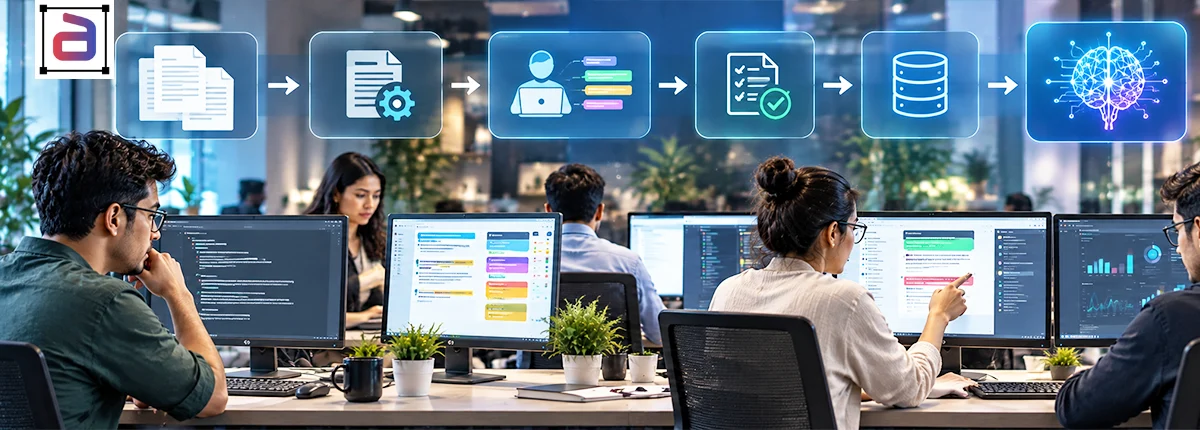
Automation has become essential for modern annotation pipelines. AI-assisted tools can pre-label frames, automate object tracking, and accelerate repetitive tasks.
Human annotators then validate and refine predictions, creating a balanced workflow that combines machine speed with human accuracy.
This human-in-the-loop methodology helps organizations scale annotation projects more effectively while improving dataset consistency.
Standardized Annotation Guidelines
Clear annotation guidelines are critical for minimizing inconsistency across distributed teams.
Successful annotation operations require documented standards for:
- Object labeling
- Occlusion handling
- Edge-case treatment
- Frame continuity
- Taxonomy management
Annotera follows structured annotation protocols tailored to each client’s AI use case, ensuring consistent and reliable training data.
Multi-Layer Quality Assurance
Quality assurance is the backbone of successful annotation projects. Without rigorous QA systems, annotation errors can negatively impact model training outcomes.
Leading annotation providers implement:
- Peer reviews
- Expert validation
- Automated quality checks
- Performance benchmarking
- Continuous feedback loops
At Annotera, multi-stage QA workflows help maintain exceptional annotation accuracy across large-scale computer vision datasets.
Cloud-Based Annotation Infrastructure
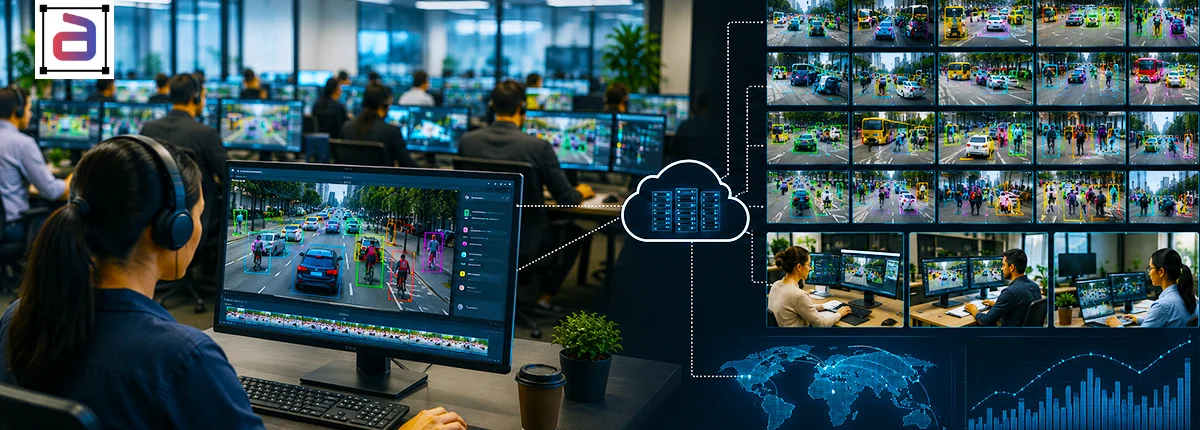
Cloud-enabled annotation platforms support distributed collaboration, secure data management, and real-time project monitoring.
These systems improve scalability by enabling:
- Centralized project tracking
- Remote workforce coordination
- Real-time quality monitoring
- Faster annotation delivery cycles
Modern cloud infrastructure also allows seamless integration with AI training pipelines, accelerating overall model development.
Why Businesses Choose Annotera
As a trusted data annotation company, Annotera delivers scalable annotation solutions designed for enterprise AI applications. Our expertise spans video annotation, image annotation, text annotation, and content moderation workflows across industries.
Businesses partner with Annotera because we provide:
- Skilled annotation professionals
- Scalable workforce management
- AI-assisted annotation workflows
- Rigorous quality assurance
- Faster project turnaround
- Secure and compliant data handling
Whether organizations require video annotation outsourcing for autonomous vehicles, healthcare AI, retail analytics, or surveillance systems, Annotera helps accelerate AI development with precision-driven annotation support.
Conclusion
Scaling video annotation for large computer vision datasets is one of the most important challenges facing modern AI development. Massive data volumes, annotation consistency, workforce coordination, edge-case handling, and operational costs all require strategic solutions.
Organizations that invest in high-quality annotation workflows gain a competitive advantage by improving model accuracy, reliability, and deployment readiness.
As AI adoption continues accelerating, businesses increasingly rely on specialized annotation partners to manage complex data pipelines efficiently. By combining human expertise, AI-assisted workflows, and enterprise-scale infrastructure, Annotera helps organizations build smarter and more reliable computer vision systems.
Ready to Scale Your Computer Vision AI?
If your organization is looking for reliable data annotation outsourcing or enterprise-grade video annotation outsourcing solutions, Annotera is ready to support your AI journey. Connect with our experts today to build scalable, high-quality annotation pipelines that power next-generation computer vision models.
To go deeper on this topic, Annotating Long-Form Video Datasets.