The evolution of Large Language Models (LLMs) is no longer just about scaling parameters—it’s about scaling intelligence. As enterprises demand more reliable, explainable, and context-aware AI systems, a new paradigm is taking center stage: multi-agent collaboration. Learn more about training data for multi-agent world models.
Instead of relying on a single model to perform complex reasoning tasks, multi-agent systems deploy multiple specialized agents that collaborate, critique, and refine outputs in real time. This shift mirrors how high-performing human teams operate—and it’s proving to be far more effective.
At Annotera, a trusted data annotation company, we see multi-agent collaboration as a transformative leap forward—especially when supported by high-quality training data, strategic data annotation outsourcing, and robust RLHF annotation services.
Key Points
- Multi-agent collaboration improves LLM reasoning by distributing subtasks across specialised agents that each focus on a narrower, more tractable problem.
- Single-agent LLMs hit accuracy ceilings on complex reasoning because they must context-switch between planning, retrieval, computation, and critique within one call.
- Agent collaboration introduces new failure modes: coordination errors, conflicting outputs, and cascading mistakes require validation layers between agents.
- The quality of a multi-agent system’s output is bounded by the weakest agent in the chain and the quality of the handoff data between them.
Table of Contents
What Is Multi-Agent Collaboration in LLMs?
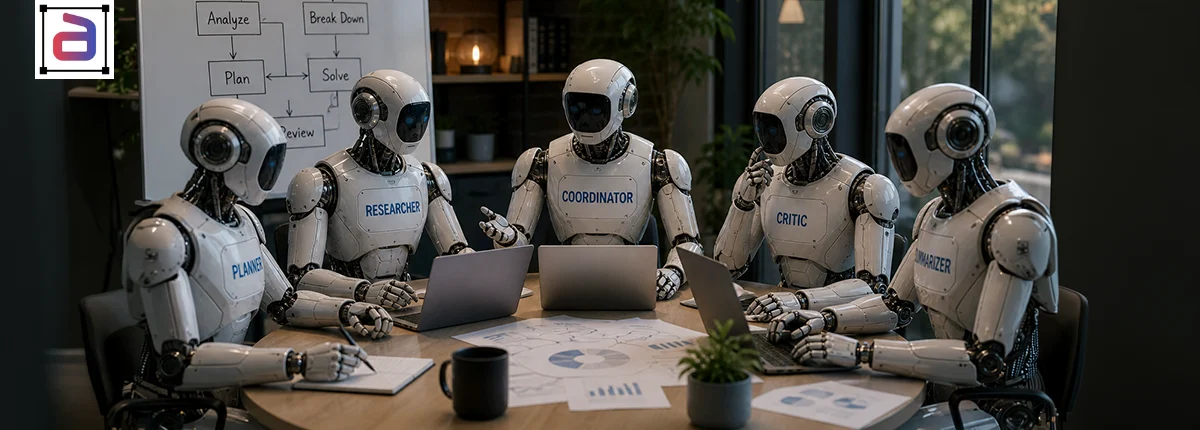
Multi-agent collaboration refers to an architecture where multiple AI agents—each powered by LLMs—work together to solve a problem. These agents are typically assigned specialized roles such as:
- Planner
- Executor
- Critic
- Verifier
Rather than producing a single-pass output, the system enables iterative reasoning, where agents exchange feedback and improve results collaboratively.
As researchers at Google note: “The most capable AI systems of the future will not be single models, but coordinated groups of agents working together.”
This collaborative framework introduces a powerful concept: distributed reasoning, where intelligence emerges from interaction rather than isolation.
Why Single-Agent LLMs Hit a Ceiling
Although single-agent LLMs can handle many language tasks effectively, they often struggle with complex reasoning, long-context understanding, and self-verification. As AI demands increase, these limitations become more apparent. Consequently, businesses are turning toward collaborative multi-agent systems to improve accuracy, scalability, and decision-making efficiency. Single-agent LLMs often struggle with domain complexity because they rely on a fixed knowledge base. Without access to comprehensive, ground-truth datasets, they are more likely to hallucinate, limiting their effectiveness in high-stakes enterprise applications.
Despite their capabilities, standalone LLMs face structural limitations:
- They struggle with long, multi-step reasoning tasks
- They lack built-in mechanisms for self-verification
- They are prone to hallucinations in ambiguous scenarios
- They operate within constrained context windows
This is where multi-agent systems provide a clear advantage.
According to MIT researchers:“Allowing models to critique and debate each other significantly improves both reasoning quality and factual accuracy.”
How Multi-Agent Collaboration Enhances Reasoning
Multi-agent collaboration improves LLM reasoning by enabling specialized AI agents to work together, validate outputs, and solve complex tasks more efficiently. Moreover, collaborative workflows reduce hallucinations and strengthen decision-making accuracy. As a result, organizations can build more scalable, reliable, and context-aware AI systems for enterprise applications.
1. Breaking Down Complex Problems
Multi-agent systems excel at task decomposition. Instead of forcing a single model to handle everything, tasks are divided into smaller components handled by specialized agents.
This structured approach improves clarity, reduces cognitive overload, and ensures each step is optimized.
2. Parallel Reasoning at Scale
Unlike sequential processing in single-agent systems, multi-agent architectures enable parallel execution.
Multiple agents can simultaneously explore different solution paths, dramatically improving efficiency and throughput.
Industry observations suggest that multi-agent workflows can improve task success rates by up to 70–90% in complex reasoning scenarios compared to linear approaches.
3. Built-In Critique and Validation
One of the most impactful features of multi-agent systems is peer review.
Agents can challenge assumptions, validate outputs, and refine conclusions—creating a feedback loop that reduces hallucinations and improves reliability.
As noted in recent AI research: “Collaborative verification is one of the most effective strategies for reducing model error in complex reasoning tasks.”
4. Role Specialization for Depth
Assigning roles to agents—such as generator, evaluator, or optimizer—introduces functional specialization.
Each agent becomes highly effective at its task, resulting in deeper and more accurate reasoning overall.
This mirrors real-world team dynamics, where specialization leads to better outcomes.
5. Emergent Collective Intelligence
When multiple agents interact effectively, something remarkable happens: emergent intelligence.
The system begins to outperform individual agents, producing insights that no single model could generate alone.
Research communities increasingly recognize this shift, with one study stating: “Well-coordinated agent systems can surpass individual model performance through collective reasoning.”
Real-World Applications
Multi-agent LLM systems are already driving impact across industries:
- Software Development: Coordinated agents handle coding, debugging, and testing
- Customer Support: Intelligent routing, sentiment analysis, and resolution optimization
- Healthcare: Multi-layer validation for clinical insights
- Research & Analytics: Parallel synthesis of large datasets
In enterprise environments, these systems are enabling faster decision-making, improved accuracy, and reduced operational overhead.
Why Data Quality Is the Foundation of Multi-Agent Systems
While architecture drives capability, data drives performance.
Multi-agent systems rely heavily on high-quality, well-structured datasets to function effectively. Each agent must be trained on precise, context-rich data to perform its role accurately.
At Annotera, we emphasize that:
“Even the most advanced multi-agent system is only as good as the data it learns from.”
As a leading data annotation company, Annotera ensures that AI systems are powered by clean, consistent, and domain-specific datasets.
The Strategic Role of Data Annotation Outsourcing
Scaling multi-agent systems requires vast volumes of annotated data across multiple domains and use cases. As AI systems continue to scale, data annotation outsourcing enables businesses to manage large, diverse datasets efficiently. Additionally, outsourcing improves annotation consistency, accelerates project timelines, and reduces operational costs. At Annotera, we combine domain expertise with scalable workflows to support high-quality AI training and multi-agent model development.
This is where data annotation outsourcing becomes a strategic advantage.
By partnering with expert providers like Annotera, organizations can:
- Accelerate dataset creation
- Maintain annotation consistency at scale
- Reduce operational costs
- Access domain-specific expertise
This enables faster deployment of multi-agent AI systems without compromising quality.
RLHF Annotation Services: Aligning Multi-Agent Intelligence
Beyond raw data, multi-agent systems require alignment with human expectations—and that’s where RLHF annotation services come in. As multi-agent AI systems become more sophisticated, RLHF annotation services play a critical role in aligning outputs with human expectations. Moreover, human feedback helps improve coordination between agents, reduce inconsistencies, and enhance reasoning accuracy. At Annotera, we deliver scalable RLHF workflows that strengthen collaborative intelligence across enterprise AI applications.
Reinforcement Learning from Human Feedback (RLHF) plays a critical role in:
- Training critic and evaluator agents
- Improving collaboration between agents
- Aligning outputs with human intent and ethics
- Continuously refining system performance
According to industry experts: “Human feedback remains essential in shaping AI systems that are not only intelligent, but trustworthy.”
At Annotera, our RLHF annotation services are designed to optimize both individual agent performance and inter-agent collaboration, ensuring that multi-agent systems deliver consistent, high-quality results.
Challenges to Consider
While promising, multi-agent systems introduce new complexities:
- Coordination overhead between agents
- Increased computational requirements
- Orchestration challenges
- Risk of cascading errors
However, with the right data infrastructure and annotation strategy, these challenges can be effectively managed.
The Future of AI: Collaborative Intelligence
The future of LLMs is not just bigger models—it’s smarter systems. As AI technologies evolve, collaborative intelligence is expected to redefine how LLMs reason, adapt, and make decisions. Furthermore, multi-agent systems will enable smarter automation, improved accuracy, and scalable problem-solving across industries. At Annotera, we help organizations prepare for this future through advanced data annotation and RLHF-driven AI training solutions.
Multi-agent collaboration represents a shift toward collective AI intelligence, where systems think, adapt, and improve through interaction.
As enterprises move toward more autonomous AI workflows, multi-agent systems will become a foundational architecture.
Final Thoughts
Multi-agent collaboration is redefining reasoning in LLMs—bringing greater accuracy, scalability, and reliability to AI systems.
But success in this new paradigm depends on one critical factor: high-quality data and human-aligned training.
As a forward-thinking data annotation company, Annotera empowers organizations to unlock the full potential of multi-agent AI through:
- Scalable data annotation outsourcing
- Domain-specific expertise
- Advanced RLHF annotation services
Build Smarter AI with Annotera
Ready to enhance your AI systems with multi-agent collaboration?So, partner with Annotera to access high-quality training data, expert annotation workflows, and RLHF-driven optimization that elevate reasoning and performance. Connect with Annotera today and take the next step toward building intelligent, collaborative AI systems.
Related reading: how annotators evaluate agent performance.