In today’s AI-driven economy, the ability to extract meaningful insights from visual data is no longer a competitive advantage—it’s a necessity. From autonomous systems to recommendation engines, the performance of AI models hinges on how well image data is structured and labeled.
Yet, many organizations still blur the lines between image categorization, tagging, and annotation. While they may appear similar, each serves a distinct purpose in the data pipeline. Understanding these differences is critical—especially when partnering with a data annotation company or leveraging data annotation outsourcing to scale operations.
At Annotera, we’ve seen firsthand how choosing the right labeling strategy can accelerate model accuracy, reduce costs, and unlock real business value.
Key Points
- Categorisation assigns an image to a predefined class; tagging adds descriptive attributes; annotation marks spatial locations and structures within the image — each serves a different model architecture.
- Conflating these three tasks leads to mismatched training data: an object detector trained on categorisation labels will fail because it has no spatial information.
- Task selection must follow model architecture: classification models need category labels, detection models need bounding boxes, segmentation models need pixel masks.
- Using the wrong labeling method for a model’s needs wastes annotation budget and delays production deployment by requiring complete re-annotation.
Table of Contents
Why Getting It Right Matters
The global data annotation tools market is growing rapidly, with projections estimating it will reach between $5.3 billion and over $6 billion by 2030, driven by the surge in computer vision and generative AI applications. More importantly, industry research suggests that up to 80% of an AI project’s time is spent on data preparation and annotation.
As AI pioneer Andrew Ng famously stated, “AI is the new electricity, but data is the fuel.”
Without high-quality labeled data, even the most sophisticated models underperform. That’s why businesses are increasingly investing in specialized image annotation services to ensure precision and scalability.
What is Image Categorization?
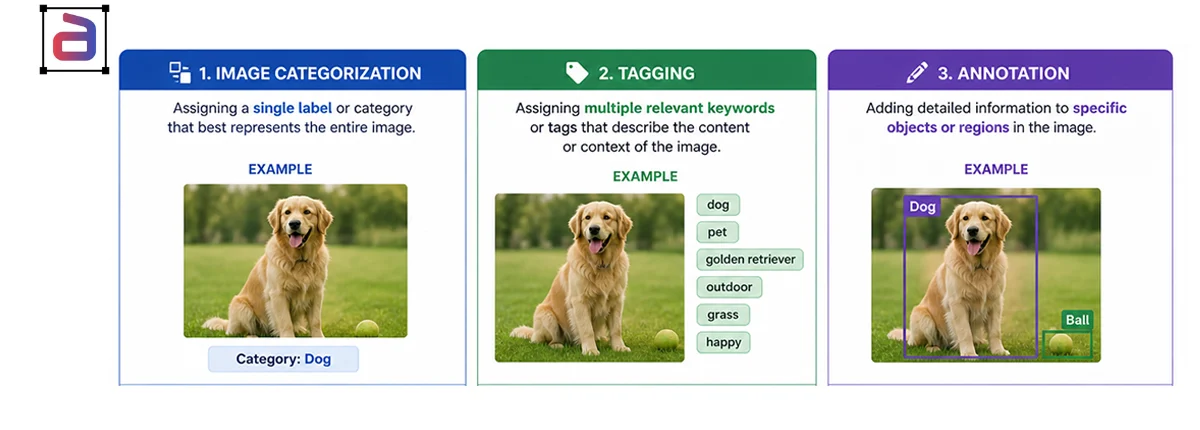
Image categorization is the most straightforward form of labeling. It assigns a single label or class to an entire image. Image categorization is the process of organizing and labeling images into predefined categories based on their visual content. It helps AI and machine learning models identify objects, scenes, patterns, or features within images, enabling applications such as facial recognition, autonomous vehicles, ecommerce search, and medical image analysis. Product Image Categorization is the process of classifying product images into predefined categories using AI and computer vision technologies. In e-commerce, it helps organize visual data efficiently, improve search accuracy, and enhance customer experiences through faster product discovery and smarter recommendation systems.
Example:
An image is classified as:
- “Car”
- “Dog”
- “Retail Store”
Key Characteristics:
- Single-label output
- High-level interpretation
- Ideal for classification models
Where It Works Best:
- Content moderation systems
- Product catalog organization
- Basic medical diagnostics
Categorization is fast and cost-effective but lacks depth. It answers what is in the image—but not where or how.
What is Image Tagging?
Image tagging builds on categorization by assigning multiple descriptive keywords to an image. It enhances contextual understanding and improves discoverability. Image tagging is the process of assigning relevant keywords or labels to images based on their visual elements. Additionally, it helps AI systems identify objects, people, locations, and activities within images. As a result, image tagging improves search accuracy, content organization, recommendation systems, and machine learning model performance.
Example:
An image could include tags like:
- “Beach”
- “Sunset”
- “Family”
- “Holiday”
Key Characteristics:
- Multi-label approach
- Context-rich metadata
- Improves search and indexing
Where It Works Best:
- Social media platforms
- Image search engines
- Digital asset management
Tagging introduces nuance but still lacks spatial awareness. It doesn’t identify object boundaries or positions within the image.
What is Image Annotation?
Image annotation is the most advanced and granular form of data labeling. It involves marking specific objects, shapes, or regions within an image. Image annotation is the process of labeling and marking visual elements within images to train AI and machine learning models. Moreover, it helps systems recognize objects, boundaries, patterns, and activities accurately. Consequently, image annotation supports applications such as autonomous vehicles, medical imaging, facial recognition, and intelligent surveillance systems.
Common Image Annotation Types:
Common image annotation types include bounding boxes, semantic segmentation, polygon annotation, keypoint annotation, and image tagging. Furthermore, each method serves different AI training objectives, such as object detection, facial recognition, or scene understanding. Consequently, selecting the right annotation type significantly improves machine learning model accuracy and performance.
- Bounding boxes
- Polygon annotation
- Semantic segmentation
- Keypoint detection
Example:
- Drawing bounding boxes around pedestrians
- Segmenting road lanes for autonomous driving
- Identifying facial landmarks for recognition systems
Key Characteristics:
- Pixel-level or object-level precision
- Enables complex model training
- Critical for computer vision tasks
According to industry insights, image annotation accounts for a significant share of AI data workflows, particularly in sectors like healthcare, automotive, and retail.
As computer scientist Fei-Fei Li emphasized, “The availability of labeled data is the real bottleneck in advancing AI.”
Key Differences at a Glance
| Feature | Image Categorization | Image Tagging | Image Annotation |
|---|---|---|---|
| Complexity | Low | Medium | High |
| Labels per Image | Single | Multiple | Multiple + spatial |
| Spatial Information | No | No | Yes |
| Use Case | Classification | Search & filtering | Object detection, segmentation |
| Insight Depth | Basic | Contextual | Detailed |
Choosing the Right Approach
Selecting the right labeling method depends on your AI use case and business goals.
- Use categorization when speed and scale matter more than detail
- Use tagging when contextual understanding improves user experience
- Use annotation when precision and spatial intelligence are critical
In reality, many enterprises use a combination of all three to build robust AI systems.
The Strategic Role of Data Annotation Outsourcing
As AI projects scale, managing in-house labeling becomes increasingly complex and resource-intensive. This is where data annotation outsourcing delivers measurable advantages. Data annotation outsourcing enables businesses to scale AI training projects efficiently while reducing operational costs and turnaround times. Furthermore, outsourcing provides access to skilled annotators, advanced quality control, and domain expertise. As a result, companies can accelerate AI development while maintaining high-quality datasets for machine learning models.
Why Businesses Outsource:
- Scalability: Handle millions of data points efficiently
- Cost Efficiency: Reduce operational overhead
- Quality Assurance: Access trained annotators and QA pipelines
- Faster Time-to-Market: Accelerate model deployment
Studies indicate that more than 50% of enterprises now outsource data labeling tasks, reflecting a clear shift toward specialized service providers.
How Annotera Delivers Superior Image Annotation Services
Annotera stands at the intersection of precision, scalability, and innovation. As a trusted data annotation company, we empower organizations to transform raw visual data into high-quality training datasets. Annotera delivers high-quality image annotation services through skilled annotators, advanced quality assurance workflows, and scalable project management. Moreover, our team supports diverse annotation requirements, including object detection, segmentation, and image tagging. Consequently, businesses receive accurate datasets that improve AI model performance, reliability, and real-world application outcomes.
What Makes Annotera Different:
Annotera combines industry expertise, scalable workflows, and rigorous quality assurance to deliver accurate annotation solutions for AI training. Additionally, we offer customized services, multilingual capabilities, and faster turnaround times. As a result, businesses can efficiently scale machine learning projects while maintaining data quality, consistency, and operational flexibility.
1. End-to-End Expertise
From simple categorization to advanced polygon and segmentation tasks, Annotera provides comprehensive image annotation services tailored to your needs.
2. Human-in-the-Loop Precision
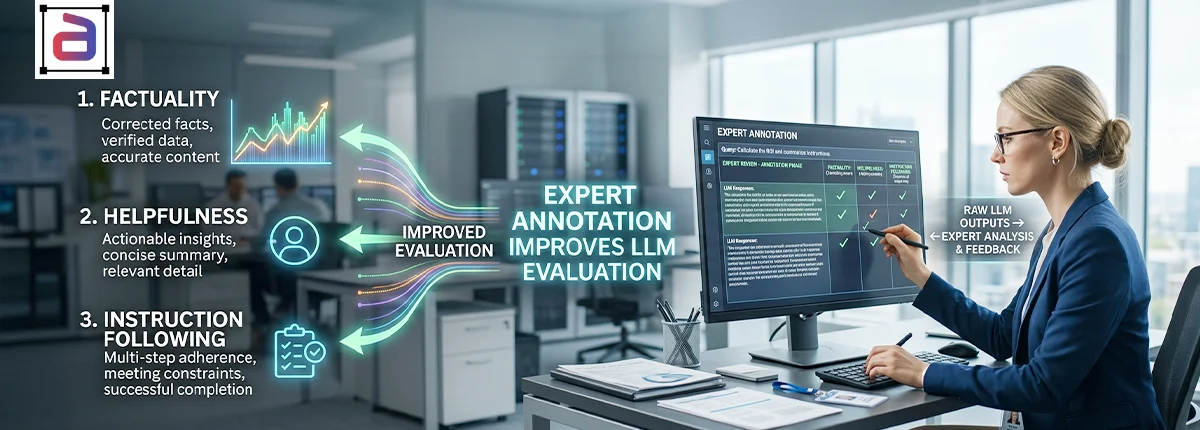
We integrate human expertise into every stage of the pipeline, ensuring accuracy and contextual relevance—especially critical for RLHF and advanced AI models.
3. Scalable Global Workforce
Our distributed teams enable seamless scaling without compromising quality or turnaround time.
4. Domain-Specific Knowledge
Whether it’s healthcare imaging, retail analytics, or autonomous systems, Annotera delivers industry-aligned annotation solutions.
As AI strategist Kai-Fu Lee notes, “The companies that win at AI are the ones with the best data.”
Annotera ensures you’re one of them.
Final Thoughts
Image categorization, tagging, and annotation are foundational pillars of modern AI pipelines—but they are not interchangeable.
- Categorization simplifies
- Tagging contextualizes
- Annotation operationalizes
Understanding and applying these techniques correctly can dramatically impact your AI model’s performance and ROI.
In an increasingly data-driven world, investing in high-quality annotation isn’t just a technical decision—it’s a strategic one.
Ready to Build Smarter AI with Annotera?
If you’re looking to scale with precision, reduce operational complexity, and unlock the full potential of your visual data, Annotera is your ideal partner.
Whether you need reliable image annotation services, expert-led data annotation outsourcing, or a full-service data annotation company, we’re here to help. Contact Annotera today and turn your data into a competitive advantage.
A closely related read: The ROI of Data Annotation Outsourcing for AI and ML Projects.