
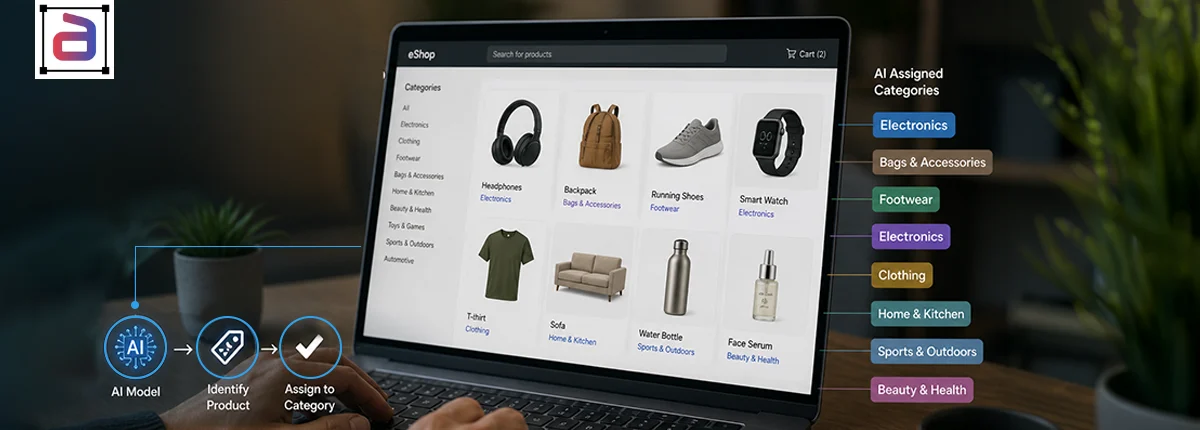
In the fast-evolving world of digital commerce, product discovery is everything. With millions of SKUs competing for attention, how products are organized and surfaced can make or break conversions. This is where product image categorization in e-commerce AI becomes a mission-critical capability.
At Annotera, we help businesses transform raw visual data into structured, actionable intelligence through advanced annotation workflows. In this guide, we explore what product image categorization is, why it matters, and how the right data annotation company can accelerate your AI success. Clean catalog data pairs naturally with e-commerce product segmentation and masking.
Key Points
- Product image categorisation is the infrastructure layer beneath search relevance, recommendation accuracy, and catalogue management in e-commerce AI systems.
- Incorrect category assignments cascade through the entire product catalogue: a misclassified SKU appears in wrong search results, recommendations, and reports simultaneously.
- Category taxonomy design determines annotation difficulty: overly granular taxonomies increase annotator error rates while too-flat taxonomies reduce model utility for search.
- Visual categorisation at e-commerce scale requires annotation programs that handle seasonal products, new categories, and cross-category items without taxonomy drift.
Table of Contents
What Is Product Image Categorization?
Product image categorization is the process of automatically classifying product images into predefined categories using AI models. These categories are based on visual attributes such as shape, color, texture, and contextual cues.
For example, an AI system can analyze an uploaded image and classify it as:
- “Women’s running shoes”
- “Bluetooth earbuds”
- “Modern table lamp”
Unlike manual classification, AI-powered systems operate at scale and with remarkable precision.
“AI is not just automating categorization—it’s redefining how products are discovered and experienced online.” — Industry Insight
Why Product Image Categorization Matters
In today’s competitive e-commerce landscape, accurate product image categorization improves search relevance, enhances customer experience, and increases conversions. Moreover, it helps retailers manage large inventories efficiently while enabling smarter recommendations. As AI-driven shopping continues to evolve, businesses increasingly rely on structured visual data to stay competitive and scalable.
Enhanced Product Discovery
Accurate categorization ensures that users can quickly find what they are looking for. Poorly categorized products often remain invisible, regardless of quality.
Increased Conversion Rates
Studies suggest that optimized product categorization can significantly improve conversion rates, while misclassification can lead to lost revenue and poor user experience.
Smarter Search and Filtering
With nearly half of online shoppers relying heavily on search, categorization ensures that search engines return relevant, high-quality results.
Scalable Catalog Management
E-commerce platforms handling large inventories benefit from automation that reduces manual overhead and accelerates go-to-market timelines.
“In e-commerce, taxonomy is strategy. The better your categorization, the better your customer journey.” — Retail Technology Expert
How AI Enables Product Image Categorization
AI enables product image categorization by analyzing visual patterns, shapes, colors, and textures through advanced computer vision models. Additionally, machine learning algorithms continuously improve accuracy using annotated datasets. As a result, e-commerce platforms can automate classification, reduce manual effort, and deliver faster, more consistent product organization at scale. AI-driven categorization is powered by a combination of advanced technologies:
Computer Vision Models
Deep learning architectures such as Convolutional Neural Networks (CNNs) interpret visual elements within images.
Feature Extraction
AI systems analyze:
- Shapes and contours
- Color distributions
- Patterns and textures
Training with Annotated Data
High-quality labeled datasets are essential. This is where image annotation services play a foundational role, enabling models to learn from accurate examples.
Automated Classification
Once trained, the model assigns categories in real time, often with high accuracy across large datasets.
Product Categorization vs Tagging vs Annotation
Although these terms are often used interchangeably, they serve different purposes in e-commerce AI. Product categorization groups items into predefined classes, whereas tagging adds descriptive keywords. Meanwhile, annotation labels specific image elements for AI training. Together, they improve search accuracy, recommendation systems, and overall catalog organization. These terms are often used interchangeably but serve distinct roles:
- Categorization: Assigning a product to a primary class (e.g., “smartphones”)
- Tagging: Adding descriptive keywords (e.g., “5G,” “dual camera”)
- Annotation: Labeling elements within images (e.g., bounding boxes, segmentation)
Annotation is the backbone of AI training, making it indispensable for effective categorization.
Real-World Use Cases in E-commerce
Product image categorization supports several e-commerce applications, including visual search, automated catalog management, and personalized recommendations. Additionally, it improves inventory organization and marketplace quality control. As retailers increasingly adopt AI-driven workflows, categorized visual data helps deliver faster shopping experiences and more accurate product discovery across platforms.
Visual Search
Customers can upload images and find similar products instantly, improving engagement and conversion.
Recommendation Engines
Categorized product data powers AI-driven recommendations, increasing average order value.
Automated Product Onboarding
Retailers can classify and list products at scale without manual intervention.
Marketplace Quality Control
Categorization helps detect inconsistencies, duplicate listings, and fraudulent uploads.
“The future of shopping is visual. AI categorization is what makes that future scalable.” — AI Commerce Analyst
Key Challenges in Product Image Categorization
Despite its advantages, implementing AI categorization comes with challenges:
Data Quality Gaps
Inaccurate or inconsistent labeling can significantly degrade model performance.
Complex Product Variants
Subtle differences in products—especially in fashion and electronics—can be difficult to distinguish.
Taxonomy Misalignment
Different marketplaces use different category structures, complicating standardization.
Edge Cases
Rare or ambiguous products often require human intervention for accurate classification.
These challenges highlight the importance of partnering with experts in data annotation outsourcing.
The Role of Data Annotation in Achieving Accuracy
AI models are only as good as the data they are trained on. High-quality annotation ensures:
- Precise labeling of product images
- Consistency across large datasets
- Improved model generalization
As a leading data annotation company, Annotera delivers:
- Scalable annotation pipelines tailored for e-commerce
- Domain-specific expertise across product categories
- Human-in-the-loop validation for quality assurance
- High-precision image annotation services
“High-quality data is the fuel of AI. Without it, even the most advanced models fail to deliver value.” — Andrew Ng
Benefits of AI-Powered Product Image Categorization
Speed and Efficiency
AI dramatically reduces the time required to categorize large image datasets.
Improved Accuracy
Automated systems minimize human error and ensure consistency.
Personalization at Scale
Categorized data enables hyper-personalized recommendations and targeted marketing.
Cost Optimization
Reducing manual processes leads to significant operational savings over time.
Future Trends in E-commerce Image Categorization
The evolution of AI will continue to enhance categorization capabilities:
- Multimodal AI combining text and image understanding
- Real-time categorization during product uploads
- Cross-platform taxonomy standardization
- Hyper-personalized visual shopping experiences
As AI adoption accelerates, businesses that invest in robust categorization frameworks will gain a significant competitive edge. For eg; AI-powered image classification automatically analyzes product images to identify categories, attributes, and visual characteristics. As a result, fashion retailers can organize catalogs more efficiently, improve product discoverability, and deliver faster, more accurate shopping experiences.
Why Annotera Is Your Ideal Annotation Partner
At Annotera, we go beyond traditional labeling. We enable businesses to build intelligent systems that scale.
Our expertise as a data annotation company includes:
- End-to-end data annotation outsourcing solutions
- Custom workflows aligned with your taxonomy
- High-quality image annotation services for e-commerce AI
- Scalable infrastructure to support enterprise-level needs
We combine human expertise with AI-assisted workflows to deliver unmatched accuracy and efficiency.
Final Thoughts
Product image categorization is not just a technical function—it’s a strategic enabler for modern e-commerce. From improving discoverability to driving conversions, its impact is far-reaching.
However, success depends on the quality of your training data and annotation processes. With Annotera, you gain a partner that understands both the technical and business dimensions of AI.
Ready to Transform Your E-commerce AI?
Don’t let poor categorization limit your growth. Partner with Annotera to unlock the full potential of AI-driven product intelligence. Get in touch today to explore our industry-leading image annotation services and scalable data annotation outsourcing solutions—designed to help your business categorize smarter, faster, and better.