In today’s data-driven economy, enterprises are no longer struggling with a lack of information — they are struggling with making sense of it. Every customer interaction, legal contract, research document, transaction record, and support conversation contains valuable business intelligence. Yet, most enterprise data remains unstructured and underutilized. This is where Named Entity Recognition annotation is transforming enterprise AI systems.
As organizations increasingly invest in intelligent automation, semantic search, and AI-powered analytics, enterprise knowledge graphs have emerged as a foundational technology for contextual intelligence. However, knowledge graphs are only as powerful as the quality of the annotated data behind them. One high-value application of this is annotation for legal contract analysis.
At Annotera, we help enterprises unlock the true value of unstructured data through scalable and high-precision NER annotation services designed specifically for enterprise knowledge graph development.
Key Points
- NER annotation for knowledge graphs must capture not just entity spans but entity types, relationships, and links to the correct knowledge base entry.
- Enterprise knowledge graphs fail when NER annotation conflates entities with the same name but different types (a person versus a company versus a location).
- Relationship annotation between entities — who owns what, who reports to whom — is what transforms a list of entities into a navigable knowledge structure.
- Knowledge graph annotation programs require domain-expert review because entity disambiguation in legal, medical, and financial documents requires specialist judgment.
Table of Contents
What is Named Entity Recognition (NER)?
Named Entity Recognition is a Natural Language Processing (NLP) technique that identifies and classifies important entities within text into predefined categories such as:
- Person names
- Organizations
- Locations
- Products
- Dates and time references
- Financial values
- Medical terminology
- Legal entities
- Technical concepts
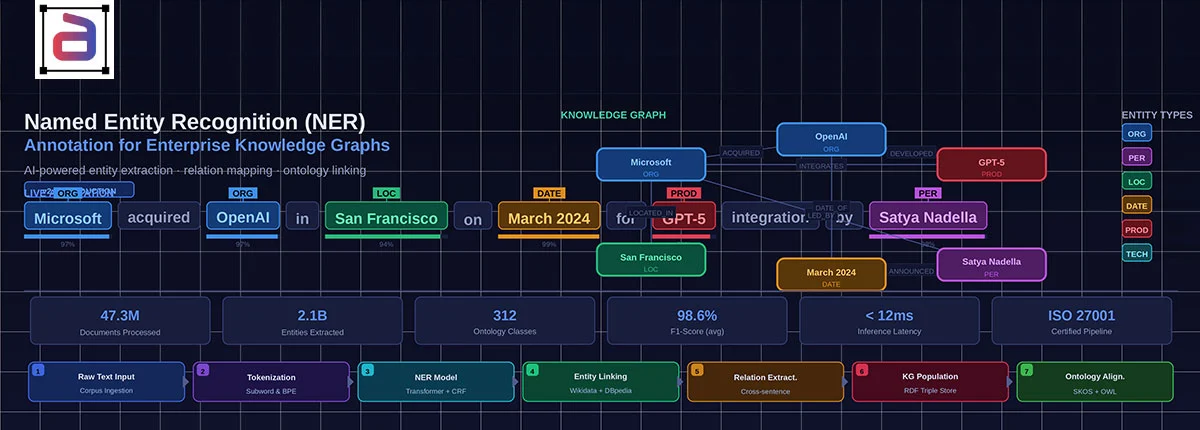
For example, in the sentence:
“Tesla signed a $5 billion agreement with Samsung in 2025.”
An NER model identifies:
- Tesla → Organization
- Samsung → Organization
- $5 billion → Monetary Value
- 2025 → Date
NER annotation involves manually labeling these entities so AI models can learn contextual understanding with high accuracy. Named Entity Recognition (NER) is a Natural Language Processing technique that identifies and classifies key entities within text. As a result, businesses can transform unstructured data into meaningful insights for AI and enterprise automation.
As Andrew Ng, founder of Andrew Ng, famously stated: “Data is the food for AI.”
Without properly annotated datasets, even the most advanced AI models struggle to deliver reliable outcomes.
According to Gartner, organizations that effectively operationalize AI and knowledge management systems can improve business productivity by up to 30%. The driving force behind these systems is accurate data annotation.
Why Enterprise Knowledge Graphs Are Becoming Essential
Modern enterprises operate across vast ecosystems of interconnected information. Knowledge graphs organize this information into structured relationships, enabling machines to understand context instead of relying solely on keyword matching. Enterprise knowledge graphs are becoming essential because they connect fragmented business data into meaningful relationships. Consequently, organizations can improve semantic search, decision-making, automation, and AI-driven insights across complex enterprise ecosystems.
Enterprise knowledge graphs connect:
- Customers
- Employees
- Products
- Contracts
- Transactions
- Suppliers
- Regulations
- Internal systems
This interconnected intelligence powers:
- Intelligent enterprise search
- Recommendation engines
- Fraud detection systems
- Conversational AI
- Customer analytics
- Compliance automation
- Predictive decision-making
According to McKinsey & Company, employees spend nearly 20% of their workweek searching for internal information. AI-powered knowledge systems dramatically reduce this inefficiency by improving semantic search and contextual data discovery.
However, building accurate knowledge graphs requires high-quality entity extraction — and that begins with NER annotation.
The Critical Role of NER Annotation in Knowledge Graphs
NER annotation serves as the foundation for enterprise knowledge graph creation. It enables AI systems to identify entities, understand relationships, and organize information into meaningful structures. NER annotation plays a critical role in knowledge graphs because it identifies and structures key entities from unstructured text. As a result, enterprises can establish meaningful relationships and improve contextual understanding across AI-driven systems. Semantic text annotation enhances knowledge graphs by identifying contextual relationships, entities, and meanings within datasets. Consequently, it improves information retrieval accuracy, strengthens Named Entity Recognition (NER), and enables smarter AI-driven knowledge discovery systems.
Transforming Unstructured Data into Structured Intelligence
Transforming unstructured data into structured intelligence enables enterprises to extract meaningful insights from documents, emails, and conversations. Consequently, businesses can improve automation, semantic search, and AI-driven decision-making with greater accuracy and efficiency. Enterprise data exists largely in unstructured formats:
- Emails
- PDFs
- Contracts
- Audio transcripts
- Customer chats
- Research reports
- Financial documents
NER annotation converts this fragmented information into machine-readable datasets that can populate knowledge graphs effectively.
Establishing Contextual Relationships
Knowledge graphs rely on relationships between entities. Establishing contextual relationships allows AI systems to connect entities based on meaning and interaction. Consequently, enterprises can improve knowledge graph accuracy, enhance semantic search capabilities, and generate deeper insights from complex unstructured datasets. NER annotation helps AI systems understand connections such as:
- Customer → purchased → Product
- Company → acquired → Organization
- Employee → belongs to → Department
Accurate annotation ensures these relationships remain contextually meaningful and reliable.
Improving Semantic Search
Traditional search engines focus on keyword matching. Knowledge graph-powered systems understand user intent and entity relationships. Improving semantic search enables AI systems to understand user intent and contextual meaning rather than relying solely on keywords. As a result, enterprises can deliver faster, more accurate, and highly relevant information retrieval experiences.
For example, a search for “Apple quarterly revenue” recognizes:
- Apple as the company
- Revenue as financial performance
- Quarterly as a time-based metric
This contextual understanding significantly improves enterprise information retrieval.
Industries Driving NER Annotation Adoption
Named Entity Recognition annotation enables machine learning models to understand contextual relationships within text by accurately tagging entities such as brands, dates, financial values, and locations. Industries such as healthcare, finance, legal, and e-commerce are rapidly adopting NER annotation to process complex unstructured data. As a result, organizations can enhance automation, compliance, customer intelligence, and AI-powered decision-making capabilities.
Healthcare
Healthcare organizations use NER annotation to identify:
- Diseases
- Medications
- Symptoms
- Treatment procedures
- Clinical entities
According to IBM, nearly 80% of healthcare data is unstructured. NER annotation enables healthcare AI systems to process patient records, clinical notes, and medical literature more efficiently.
Financial Services
Financial institutions leverage NER annotation for:
- Fraud detection
- Compliance monitoring
- Transaction intelligence
- Risk assessment
- Customer profiling
Knowledge graphs help uncover hidden transactional relationships and suspicious activity patterns.
Legal and Compliance
Legal enterprises process enormous volumes of contracts and regulatory documents. NER annotation helps identify:
- Legal clauses
- Jurisdictions
- Case references
- Regulatory obligations
- Contract entities
This accelerates document review and compliance workflows.
E-Commerce and Retail
Retail businesses use enterprise knowledge graphs to enhance:
- Product recommendations
- Customer personalization
- Brand sentiment analysis
- Inventory intelligence
NER annotation helps AI systems understand customer behavior and product relationships at scale.
Why Businesses Are Choosing Data Annotation Outsourcing
As enterprise AI initiatives expand, businesses increasingly rely on data annotation outsourcing to scale efficiently. Businesses are increasingly choosing data annotation outsourcing because it offers scalability, cost efficiency, and access to domain experts. Moreover, outsourcing helps organizations accelerate AI model development while maintaining high-quality annotation accuracy and operational flexibility.
Building in-house annotation teams often involves:
- High operational costs
- Complex workforce management
- Extended training timelines
- Quality consistency challenges
Partnering with a specialized text annotation company allows organizations to accelerate AI development while maintaining annotation precision.
According to Grand View Research, the global data annotation market is expected to witness substantial growth due to rising enterprise AI adoption across industries.
Organizations choose text annotation outsourcing because it offers:
- Faster turnaround times
- Scalable annotation operations
- Domain-specific expertise
- Multi-level quality assurance
- Cost optimization
- Access to trained linguistic specialists
At Annotera, we combine human expertise with AI-assisted workflows to deliver highly accurate annotation datasets for enterprise NLP systems.
Key Challenges in NER Annotation
While NER annotation delivers tremendous business value, enterprise-scale implementation requires handling several complexities. NER annotation involves challenges such as contextual ambiguity, domain-specific terminology, and large-scale data processing. Therefore, businesses require expert annotation workflows to maintain consistency, improve accuracy, and ensure reliable AI model performance across enterprise applications.
Industry-Specific Terminology
Healthcare, finance, insurance, and legal sectors contain domain-specific language that generic NLP models often fail to interpret accurately.
This requires customized annotation ontologies and expert reviewers. Industry-specific terminology often includes complex and highly contextual language that generic AI models may misinterpret. Therefore, accurate NER annotation is essential for improving domain-specific understanding across healthcare, finance, legal, and enterprise AI applications.
Contextual Ambiguity
Words may carry different meanings depending on context. Contextual ambiguity occurs when the same word or entity carries different meanings depending on usage. Therefore, precise NER annotation is crucial for helping AI systems accurately interpret context and improve decision-making reliability.
For example:
- “Amazon” may refer to a technology company or rainforest.
- “Java” may indicate a programming language or geographic location.
Human-in-the-loop validation is essential for maintaining contextual accuracy.
Large-Scale Data Volumes
Enterprise AI systems often require millions of annotated records. Scaling annotation operations while preserving quality demands robust workflow management and experienced annotation teams.
This is why organizations increasingly partner with an experienced data annotation company like Annotera. Large-scale data volumes create significant challenges for enterprise AI systems because processing massive unstructured datasets requires speed, consistency, and accuracy. Consequently, scalable NER annotation workflows become essential for maintaining high-quality model performance.
Why Annotera is the Right Partner for Enterprise NER Annotation
At Annotera, we understand that enterprise AI success depends on annotation quality, domain expertise, and scalability. Annotera delivers scalable, high-accuracy NER annotation services tailored for enterprise AI applications. Furthermore, our domain expertise, quality-driven workflows, and flexible data annotation outsourcing solutions help businesses accelerate knowledge graph and NLP model development.
Our specialized NER annotation services are designed to support:
- Enterprise knowledge graphs
- NLP model training
- Semantic search systems
- Conversational AI
- Intelligent document processing
- Regulatory compliance automation
As a trusted text annotation company, we provide:
- Domain-trained annotation specialists
- Custom entity taxonomy development
- Secure and scalable annotation pipelines
- AI-assisted annotation workflows
- Multi-stage quality assurance
- Flexible data annotation outsourcing models
Our team works closely with enterprises to create structured datasets that improve AI accuracy, contextual understanding, and business intelligence outcomes. Named Entity Recognition annotation helps AI systems identify and classify entities like people, organizations, locations, and products from unstructured text for accurate NLP model training.
As Satya Nadella once said, “AI is going to be one of the trends that is the next major shift in technology.”
Enterprises that invest in high-quality annotation infrastructure today will lead the AI-driven economy tomorrow.
Conclusion
Named Entity Recognition annotation is no longer just a technical NLP task — it is a strategic capability powering modern enterprise intelligence systems.
From semantic search and fraud detection to compliance automation and customer analytics, enterprise knowledge graphs rely heavily on accurate entity annotation to deliver meaningful insights.
As AI adoption accelerates across industries, businesses need reliable annotation partners capable of delivering scalable, high-quality datasets with contextual precision.
Annotera helps enterprises bridge the gap between unstructured information and intelligent AI systems through advanced NER annotation services tailored for enterprise knowledge graph development.
Ready to Build Smarter Enterprise AI Systems?
Partner with Annotera to transform unstructured enterprise data into structured intelligence with expert-driven NER annotation services.
Whether you need scalable text annotation outsourcing, custom entity taxonomy development, or enterprise-grade data annotation solutions, our specialists are ready to help accelerate your AI initiatives.
Contact Annotera today to power your next-generation knowledge graph and NLP applications with high-quality annotated data.
A closely related read: Training Healthcare AI to Identify Medical Entities.