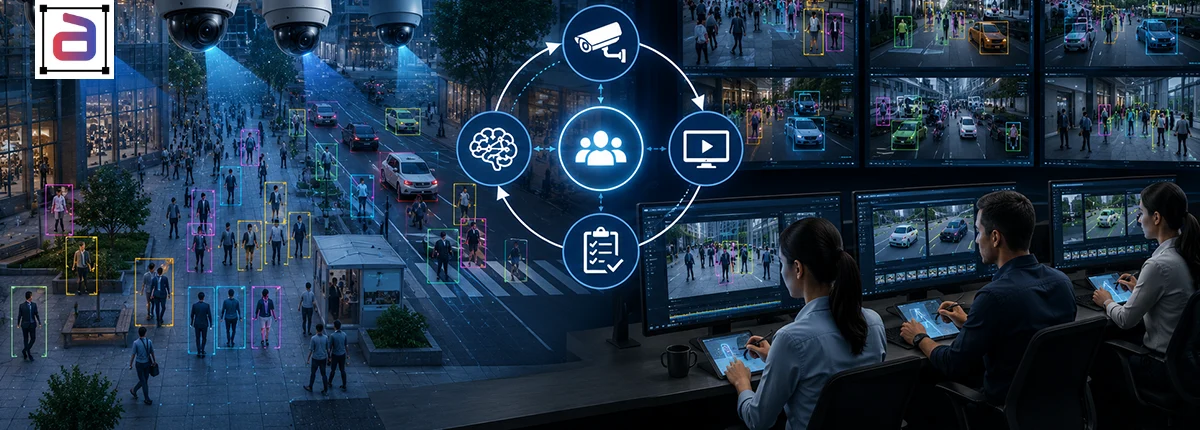
Artificial intelligence is redefining modern surveillance. Today’s AI-powered surveillance systems can monitor crowded public spaces, detect suspicious activities, analyze behavioral patterns, and respond to potential security threats in real time. From smart cities and transportation networks to retail stores and industrial facilities, intelligent surveillance has become a critical component of modern security infrastructure. Learn more about crowd behavior monitoring in public venues.
But behind every “intelligent” surveillance model lies something even more important — human intelligence.
Despite rapid advancements in automation and computer vision, AI surveillance systems still rely heavily on human-in-the-loop (HITL) video annotation to function accurately, ethically, and reliably. Machines can process massive amounts of video data, but humans provide the contextual understanding necessary to train AI systems for real-world environments.
At Annotera, we believe the future of surveillance AI is not fully automated — it is human-guided. Through expert-led annotation workflows, businesses can develop surveillance models that are more accurate, scalable, and responsible.
Key Points
- Human-in-the-loop review in surveillance AI annotation catches edge cases that automated pre-labeling consistently misclassifies — exactly the scenarios most likely to trigger false alerts.
- Surveillance annotation must cover intentional evasion behaviours (disguises, camera avoidance) alongside normal behaviour to make detection models robust.
- HITL annotation creates an escalation pathway: uncertain automated labels are routed to human reviewers before entering the training set, not after a model error in production.
- Privacy and legal constraints on surveillance training data require annotation programs to embed consent, anonymisation, and data minimisation into the workflow from day one.
Table of Contents
Why Human-in-the-Loop Matters in Surveillance AI
AI surveillance systems are only as good as the data they learn from. Video annotation helps AI models recognize objects, behaviors, movement patterns, and environmental context within surveillance footage.
However, real-world surveillance environments are unpredictable. Human-in-the-Loop annotation matters in surveillance AI because, although automation improves speed, human expertise ensures contextual accuracy, reduces false positives, and enhances ethical decision-making. As a result, AI surveillance systems become more reliable, scalable, and effective in real-world environments.
Lighting changes, weather conditions, crowded spaces, occlusions, unusual activities, and cultural differences often create scenarios that automated systems struggle to interpret correctly. A fully automated model may confuse harmless activity with suspicious behavior or fail to recognize genuine threats.
This is where human-in-the-loop annotation becomes essential.
Human annotators validate, correct, and refine AI-generated labels, ensuring the training data reflects real-world complexity. This collaborative workflow significantly improves model accuracy while reducing false positives and operational risk.
As AI researcher Fei-Fei Li famously stated: “AI is everywhere. It’s not that big, scary thing in the future. AI is here with us.”
But for AI to work effectively in surveillance systems, it still requires human judgment, oversight, and contextual reasoning. Human-in-the-Loop safety testing is essential for surveillance AI because automated systems can misinterpret complex scenarios. By incorporating human reviewers, organizations can validate detections, reduce false positives, and ensure AI-driven decisions remain accurate, accountable, and aligned with security objectives.
The Rising Demand for Video Annotation in Surveillance Systems
The rapid expansion of smart infrastructure and automated security systems is driving unprecedented demand for annotated video datasets. As AI-powered surveillance systems continue expanding across industries, the demand for accurate video annotation is rapidly increasing. Consequently, businesses are investing in scalable annotation solutions to improve AI model performance, enhance security monitoring, and support real-time decision-making.
According to Grand View Research, the global data annotation tools market exceeded USD 1 billion in 2023 and is expected to grow significantly through 2030 due to increasing AI adoption across industries.
This growth creates enormous demand for high-quality annotated surveillance footage used to train AI systems for:
- Intrusion detection
- Crowd monitoring
- Vehicle tracking
- Facial recognition
- Workplace safety monitoring
- Behavioral analysis
- Traffic management
- Public security operations
Every second of surveillance footage contains countless visual elements that must be accurately labeled before AI models can learn from them.
As a trusted data annotation company and video annotation company, Annotera helps organizations manage these complex annotation requirements with scalable, high-precision workflows tailored for enterprise AI systems.
Why Human Annotators Still Outperform Automation Alone
Automation has improved annotation efficiency, but fully automated annotation pipelines still face major limitations.
AI systems lack true contextual awareness.
For example, distinguishing between:
- A customer browsing and suspicious loitering
- A worker collapse and a resting posture
- A crowded public event and panic behavior
- An abandoned object and temporary placement
often requires nuanced human interpretation.
Human annotators provide:
- Contextual understanding
- Edge-case identification
- Behavioral interpretation
- Ethical oversight
- Quality assurance validation
This is especially critical in surveillance AI, where inaccuracies can lead to operational failures or serious security consequences.
Andrew Ng, one of the leading voices in AI, once noted: “The strength of AI is not replacing humans, but augmenting human capabilities.”
That principle perfectly defines modern Human-in-the-Loop surveillance annotation.
Rather than replacing humans, AI accelerates workflows while human reviewers ensure precision and accountability.
How Human-in-the-Loop Annotation Improves Surveillance AI
1. Higher Model Accuracy
Human validation reduces annotation errors that can negatively impact AI training outcomes. Accurate labeling directly improves object detection, tracking, and event recognition performance.
2. Better Handling of Edge Cases
Surveillance environments constantly produce unpredictable situations. Human reviewers help train AI systems to recognize unusual or rare events that automated systems often misclassify.
3. Reduced False Positives
False alarms are one of the biggest challenges in AI surveillance. Human oversight helps refine training data to improve decision-making accuracy and reduce unnecessary alerts.
4. Continuous Learning Loops
Human-in-the-loop workflows create feedback systems where annotators continuously refine AI-generated outputs, improving model performance over time.
5. Ethical and Responsible AI Development
Surveillance AI must operate fairly across diverse populations and environments. Human oversight helps reduce bias and improve dataset diversity, supporting more responsible AI deployment.
At Annotera, our annotation specialists combine domain expertise with structured quality control processes to ensure every dataset meets enterprise-grade accuracy standards.
The Growing Importance of Data Annotation Outsourcing
As surveillance AI projects scale, organizations often struggle to manage annotation operations internally. Surveillance datasets involve millions of video frames that require detailed, frame-level labeling.
This is why businesses increasingly adopt data annotation outsourcing and video annotation outsourcing strategies. The growing importance of data annotation outsourcing lies in its ability to deliver scalable, accurate, and cost-efficient video annotation for smart cities, thereby accelerating AI-driven urban infrastructure development.
Partnering with a specialized annotation provider offers several advantages:
- Faster project scalability
- Access to trained annotation teams
- Lower operational overhead
- Multi-layer quality assurance
- Faster turnaround times
- Secure data management
A professional video annotation company can also deploy AI-assisted annotation tools combined with human review to improve both speed and accuracy.
At Annotera, we help AI companies, security providers, and enterprise organizations accelerate surveillance AI development through scalable annotation solutions designed for complex video environments.
Human-in-the-Loop Is the Future of Surveillance AI
The future of AI surveillance will not be fully autonomous.
While AI continues advancing in automation and pattern recognition, human expertise remains essential for contextual intelligence, ethical oversight, and high-quality training data generation.
According to Reuters, demand for human-supported AI training data continues to grow as enterprises recognize the limitations of purely automated systems.
The industry is moving toward hybrid intelligence models where humans and AI systems work together to achieve greater efficiency and accuracy.
This evolution makes Human-in-the-Loop annotation not just valuable — but mission-critical.
Why Businesses Choose Annotera
At Annotera, we understand that surveillance AI requires more than just labeled data. It requires precision, scalability, contextual intelligence, and quality assurance at every stage of the annotation lifecycle.
As a leading data annotation company and video annotation company, we deliver:
- High-quality video annotation services
- Human-in-the-loop AI workflows
- Scalable annotation operations
- AI-assisted labeling pipelines
- Enterprise-grade data security
- Domain-trained annotation specialists
Whether organizations need data annotation outsourcing for large surveillance datasets or specialized video annotation outsourcing for advanced AI systems, Annotera provides the expertise needed to build reliable and intelligent surveillance models.
Build Smarter Surveillance AI with Annotera
AI surveillance systems are evolving rapidly, but their success still depends on high-quality human intelligence behind the scenes.
Annotera helps businesses develop more accurate, scalable, and responsible surveillance AI through expert-led Human-in-the-Loop annotation services tailored for enterprise needs.
Ready to improve your AI surveillance training data?
Explore Annotera to discover how our expert annotation teams can support your next-generation AI initiatives with scalable and secure video annotation solutions.