Autonomous vehicles are no longer futuristic prototypes confined to research labs. Today, they are rapidly becoming a defining force in global transportation innovation. Video annotation for computer vision covers the foundational concepts before domain-specific AV programs. Building the annotation programs that train these systems requires mastering the specific challenges — see the guide to mastering video annotation key challenges and best practices. From intelligent driver assistance systems to fully autonomous fleets, the automotive industry is investing heavily in AI-powered mobility solutions that can improve safety, efficiency, and driving intelligence. Video annotation for autonomous vehicle enables self-driving systems to accurately interpret dynamic road environments, improving perception, navigation, safety, and real-time decision-making capabilities. Learn more about customer behavior tracking through video annotation.
But behind every successful autonomous driving system lies a less visible yet mission-critical foundation: high-quality annotated data. A core part of this stack is polyline annotation for lane detection.
Modern autonomous vehicles rely on massive volumes of video data to understand roads, detect hazards, predict movement, and make real-time decisions. This is where video annotation becomes indispensable. Without accurately labeled video datasets, even the most advanced AI models cannot learn how to navigate the complexities of real-world driving environments.
At Annotera, we help organizations unlock the full potential of autonomous mobility through scalable, precise, and enterprise-grade annotation solutions. As a trusted data annotation company and specialized video annotation company, we empower AI teams with high-quality training data that fuels safer and smarter autonomous vehicle systems.
Key Points
- Autonomous vehicle perception requires annotation across all sensor modalities — camera, LiDAR, radar — with each requiring different annotation techniques and quality standards.
- The safety bar for AV annotation is higher than any other computer vision application: annotation errors translate directly into real-world collision risk.
- Edge case coverage is as important as volume: AV models fail at the boundaries of their training distribution, so annotation programs must systematically target rare scenarios.
- Temporal consistency across video frames is critical for AV tracking models that must predict object trajectories, not just detect current positions.
Table of Contents
Why Video Annotation Is the Backbone of Autonomous Driving AI
Self-driving vehicles process enormous amounts of visual information every second. Cameras, LiDAR, radar, and sensor systems continuously capture data about surrounding vehicles, pedestrians, road conditions, traffic signals, and unexpected obstacles. Video Annotation for Autonomous Vehicle systems helps AI models recognize moving objects, interpret traffic behavior, and improve real-time driving accuracy across complex environments.
However, raw video footage alone has no value unless AI systems can interpret it correctly.
Video annotation transforms unstructured footage into machine-readable intelligence by labeling objects, behaviors, trajectories, and environmental context frame by frame. This allows autonomous vehicle models to learn how real-world driving scenarios evolve over time.
Unlike static image annotation, video annotation provides temporal context — enabling AI systems to understand motion, predict behavior, and respond dynamically. Temporal consistency in video annotation enables autonomous driving AI systems to accurately track vehicles, pedestrians, and road conditions across frames, thereby improving motion prediction, object recognition, navigation accuracy, and real-time decision-making in dynamic driving environments.
For example, autonomous driving AI must determine:
- Whether a pedestrian intends to cross the street
- If a nearby vehicle is merging into another lane
- How cyclists move through intersections
- Whether road conditions are affected by rain, fog, or low visibility
- How traffic patterns shift during congestion or emergencies
These complex decisions are only possible through high-quality annotated video datasets.
As industry expert and AI pioneer Andrew Ng famously stated: “Data is food for AI.”
In autonomous driving, annotated video data is the fuel that powers intelligent decision-making.
The Rising Demand for Autonomous Vehicle Annotation
The autonomous driving industry is experiencing unprecedented growth, and the demand for labeled training data is expanding alongside it. High-quality Video Annotation for autonomous vehicle enables safer navigation by training perception models to detect pedestrians, lanes, obstacles, and unpredictable road scenarios.
According to industry reports, the global autonomous driving data annotation market is expected to exceed USD 10 billion by 2034, driven by rapid advancements in AI-powered transportation systems.
This surge reflects a major industry reality: autonomous vehicle performance depends heavily on the quality and diversity of training data.
As vehicles become more intelligent, annotation requirements also become significantly more complex. AI systems must not only recognize objects but also interpret behavior, context, environmental uncertainty, and edge-case scenarios.
This growing complexity has encouraged automotive organizations to partner with an experienced video annotation company capable of delivering scalable, high-accuracy datasets for advanced computer vision systems.
Key Video Annotation Techniques Used in Autonomous Vehicles
Autonomous driving AI depends on multiple forms of video annotation to build comprehensive environmental understanding.
Bounding Box Annotation
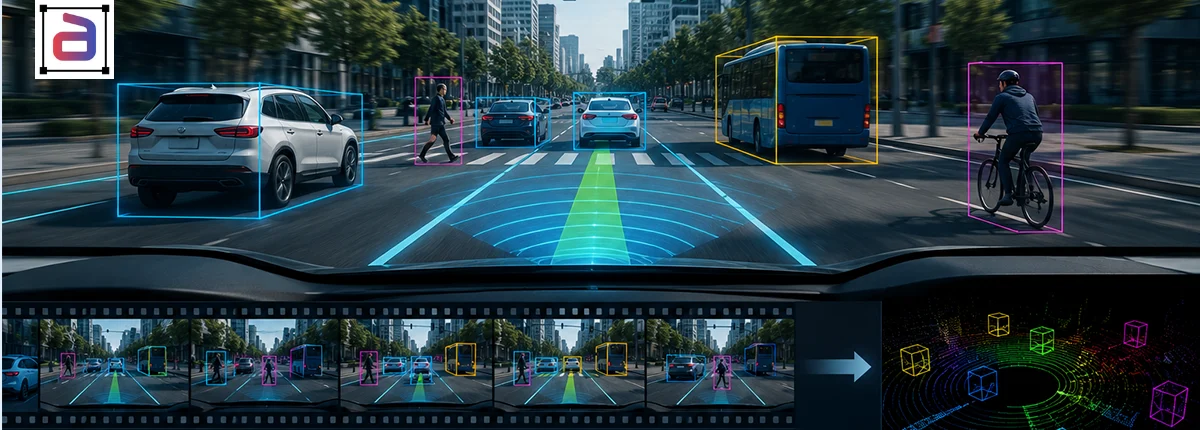
Bounding boxes identify and track objects such as vehicles, pedestrians, cyclists, traffic lights, and road signs across video frames. This helps AI systems detect and monitor moving entities in real time.
Semantic Segmentation
Semantic segmentation classifies every pixel within an image or video frame. Roads, sidewalks, lane markings, vehicles, and obstacles are individually labeled to create detailed scene awareness.
Object Tracking
Object tracking enables AI models to follow moving objects across consecutive frames, helping vehicles predict movement trajectories and assess collision risks.
Lane and Road Annotation
Precise lane detection is essential for vehicle navigation and driving stability. Annotated lane boundaries help autonomous systems maintain proper positioning and execute safe maneuvers.
3D Cuboid Annotation
3D annotations add spatial depth information to objects, improving perception accuracy and obstacle localization.
Edge-Case Annotation
Rare and unpredictable scenarios — such as fallen debris, sudden pedestrian movement, flooded roads, or emergency vehicle encounters — are labeled to strengthen AI resilience in real-world conditions.
At Annotera, our annotation teams combine domain expertise with rigorous quality control processes to ensure every frame contributes meaningful intelligence to autonomous vehicle learning systems.
Why Annotation Accuracy Directly Impacts Vehicle Safety
In autonomous driving, annotation quality is not just a technical requirement — it is a safety imperative.
Even small labeling inconsistencies can negatively affect AI performance.
For example:
- Incorrectly labeled lane markings may impact steering decisions
- Poor pedestrian annotations can weaken collision prediction
- Missing environmental context may reduce perception reliability
- Inaccurate object tracking can compromise motion forecasting
Tesla CEO Elon Musk once remarked: “The pace of progress in artificial intelligence is incredibly fast.”
However, fast AI progress without accurate training data creates serious operational risks.
This is why leading automotive innovators increasingly invest in reliable data annotation outsourcing solutions to maintain annotation consistency, scalability, and quality assurance.
At Annotera, our multi-layer review workflows, human-in-the-loop validation systems, and AI-assisted quality checks help minimize annotation errors while accelerating project timelines.
The Critical Role of Human Expertise in Video Annotation
While automation tools continue to evolve, human expertise remains essential in autonomous vehicle annotation. Human-in-the-Loop video annotation plays a crucial role in surveillance AI because human expertise helps interpret complex visual scenarios that automated systems often miss. Moreover, human reviewers improve annotation accuracy, reduce false positives, and ensure AI models can adapt effectively to real-world surveillance environments.
AI-assisted labeling platforms can accelerate repetitive tasks, but human annotators are still required to:
- Validate complex driving scenarios
- Resolve ambiguous object behavior
- Review edge cases
- Ensure contextual consistency
- Improve annotation precision
Human intelligence is especially important when dealing with unpredictable road environments that autonomous systems may rarely encounter during training.
This hybrid model — combining AI automation with expert human review — has become the industry standard for scalable and accurate annotation operations.
As a leading data annotation company, Annotera delivers this balance through advanced workflows designed specifically for AI-driven automotive applications.
Why Automotive Companies Choose Video Annotation Outsourcing
Building internal annotation operations for autonomous driving projects can be expensive, resource-intensive, and difficult to scale.
This is why many automotive organizations turn to video annotation outsourcing providers for specialized support.
Outsourcing enables companies to:
- Accelerate AI training cycles
- Scale annotation volumes efficiently
- Reduce operational overhead
- Access skilled annotation professionals
- Improve turnaround time
- Maintain consistent quality standards
A trusted video annotation company also provides secure infrastructure, customizable workflows, and automotive-specific expertise tailored to enterprise AI requirements.
At Annotera, we support global AI and automotive organizations with scalable annotation services designed for high-volume, safety-critical environments.
How Annotera Powers the Future of Autonomous Mobility
At Annotera, we believe autonomous driving innovation begins with exceptional data quality.
Our teams specialize in:
- Video annotation for autonomous vehicles
- Semantic segmentation
- Object tracking
- Lane detection
- LiDAR and sensor fusion annotation
- Edge-case data labeling
- Human-in-the-loop quality assurance
As a trusted partner for data annotation outsourcing and video annotation outsourcing, we help organizations build AI systems that are safer, smarter, and more reliable.
Our scalable annotation workflows are designed to support next-generation mobility solutions across autonomous driving, ADAS systems, intelligent transportation, and computer vision applications.
Conclusion
Autonomous vehicle AI is transforming the future of transportation, but intelligent systems can only perform as well as the data used to train them.
High-quality video annotation enables autonomous vehicles to understand dynamic environments, predict behavior, navigate safely, and respond intelligently to real-world road conditions.
As the industry advances toward higher levels of autonomy, the importance of accurate, scalable, and context-rich annotation will continue to grow.
At Annotera, we are proud to support this evolution with precision-driven annotation solutions tailored for the future of mobility.
Ready to Build Smarter Autonomous Vehicle AI?
Partner with Annotera to access enterprise-grade video annotation services designed for next-generation autonomous driving systems.
Whether you need large-scale dataset creation, edge-case annotation, semantic segmentation, or end-to-end data annotation outsourcing, our experts are ready to help accelerate your AI initiatives with accuracy and scale. Contact Annotera today to discover how our autonomous vehicle annotation solutions can power safer, more intelligent mobility systems.