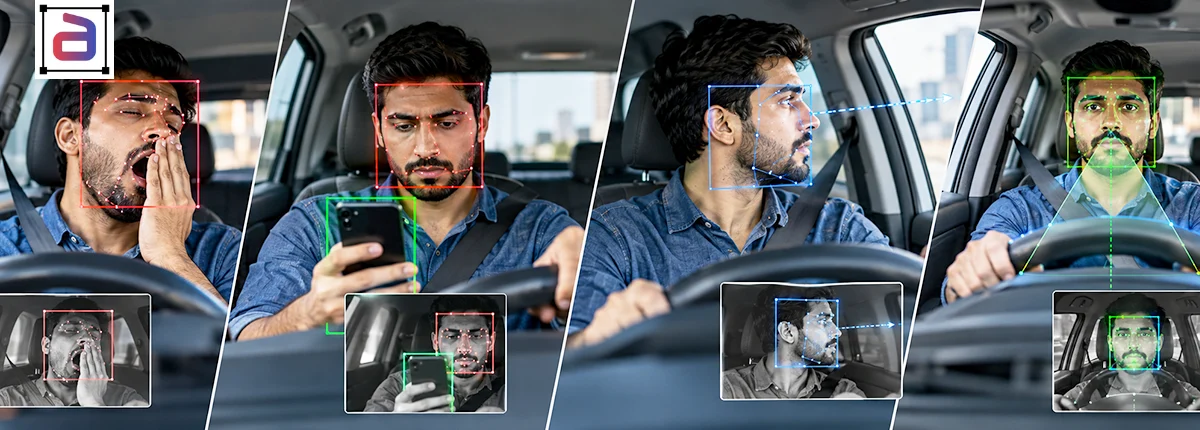
Behind every autonomous vehicle that navigates city streets, every medical AI that detects cancer, and every voice assistant that understands your commands lies an unglamorous truth: someone had to label the data. AI-powered annotation tools are changing this reality by automating the repetitive work that has slowed down AI development for years.
Every breakthrough in computer vision, NLP, or speech recognition has relied on massive amounts of annotated data. Yet much of this work involves repetition — drawing bounding boxes around thousands of images, transcribing hours of audio, or tagging text line by line. What if AI could help build the foundation for better AI? That’s exactly what’s happening today.
But what if the AI itself could help build the foundation for better AI? That’s exactly what’s happening today.
Table of Contents
Key Points
- AI-powered annotation tools increase throughput without proportionally increasing annotation cost by automating the routine labeling decisions that consume annotator time while escalating ambiguous cases to human judgment.
- The efficiency gains from annotation tool automation are realised only when the tool accuracy is calibrated to the task: tools with lower accuracy than the human annotation baseline require more correction work than annotation from scratch.
- Annotation tools must be evaluated on the specific annotation tasks in the deployment program: tools that perform well on standard object detection annotation may perform poorly on the specialised annotation types required for medical imaging or legal document labeling.
- AI-powered annotation efficiency gains must be measured against quality outcomes, not just throughput: tools that increase speed while degrading annotation quality produce cost savings that are reversed when the resulting model requires retraining.
The Scale of the Annotation Challenge
The numbers tell a compelling story. According to Global Information, the global data labeling market will surpass $8 billion by 2030. Research shows that manual annotation error rates can exceed 20% on repetitive tasks, and traditional annotation consumes 30–50% of an AI project’s timeline. Teams need to work faster, more accurately, and at scale.
Data is the new oil, but it must be refined. Annotation is the refining process. – Andrew ng.
The challenge isn’t just about volume. Teams need to work faster, more accurately, and at scale. This is why AI-powered annotation tools are transforming workflows across industries.
How AI-Powered Annotation Tools Automate Repetitive Work
AI-powered annotation tools handle high-volume, repetitive tasks quickly and consistently. What once took hours now takes a fraction of the time.
Pre-Labeling
AI models trained on large datasets automatically recognize and tag common objects. Instead of starting from scratch, humans refine pre-labeled outputs. Automated pre-labeling cuts annotation time by 50–70% in some workflows.
Auto-Segmentation
For tasks like semantic segmentation, AI classifies large regions — roads, skies, buildings — in a single pass. Annotators then fine-tune edges. This transforms hours of pixel-level work into minutes of refinement.
Smart Text and Audio Processing
Speech recognition systems identify speakers and draft transcriptions automatically. Humans correct accents, tones, and nuanced phrasing — focusing expertise where it matters most.
Boosting Accuracy and Consistency
Speed is only part of the story. AI-powered tools also improve data quality by reducing human fatigue and enforcing consistency. Teams looking to formalise this should review these 9 best practices for data annotation quality assurance.
Human annotators working on repetitive tasks inevitably experience accuracy decline. AI doesn’t tire or lose focus. It applies consistent labeling rules across every data point. Modern platforms embed automated QA that flags outliers, identifies inconsistencies, and directs human reviewers to areas needing validation.
The Synergy of Humans and AI
AI-powered annotation tools don’t replace humans — they enhance human capabilities. This Human-in-the-Loop (HITL) model ensures both efficiency and accuracy while embedding human ethics and nuance.
The cycle works like this: AI suggests labels, humans correct them, AI learns from corrections, and accuracy improves with each iteration. Annotators shift from repetitive box-drawing to quality supervision and domain specialization. Human expertise focuses on edge cases and contextual understanding.
Real-World Applications Across Industries
Autonomous Vehicles
Pre-labeling accelerates LiDAR and camera annotation, enabling safer, faster training for self-driving systems.
Healthcare
Automated segmentation of MRIs and CT scans saves radiologists hours of annotation time. AI-assisted workflows have improved radiologist efficiency by up to 65% without compromising diagnostic quality.
Retail and E-Commerce
Retail companies automate tagging of product images and customer reviews to fuel personalized recommendations at scale.
Finance
Financial firms use automated sentiment labeling in customer communications and fraud detection systems. AI-assisted annotation has reduced fraud detection lag times by up to 30%.
Conclusion
AI-powered annotation tools are transforming how teams build training data. By automating repetitive work and amplifying human judgment, these tools deliver faster timelines, higher accuracy, and scalable workflows. The future of annotation is not humans versus machines — it’s humans and machines working together.
Ready to accelerate your annotation workflows? Contact Annotera to explore how our AI-assisted annotation services can scale your AI development.