
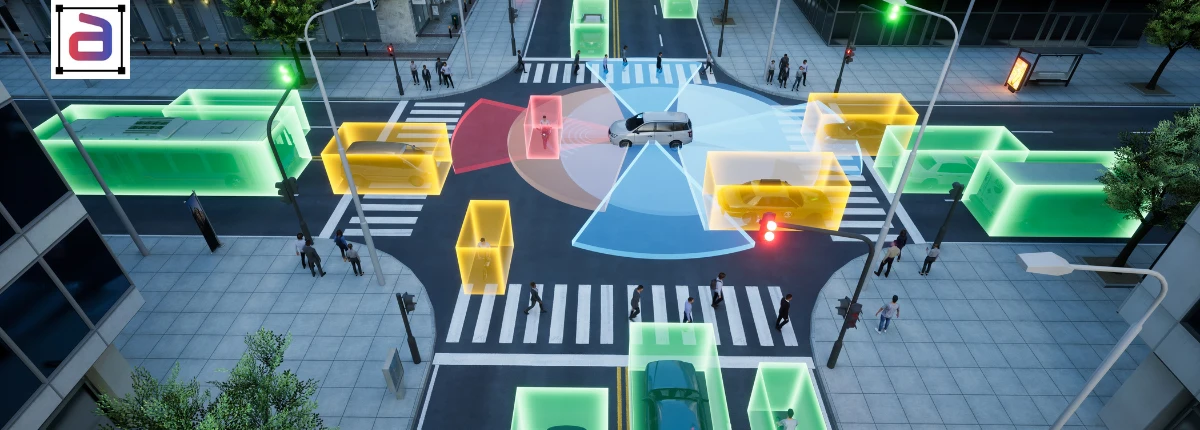
Autonomous vehicles (AVs) perceive the world through sensors, not human eyes. Cameras, LiDAR, radar, and other systems generate massive streams of raw data. High-quality labels turn this data into meaningful training examples that teach models to detect objects, understand scenes, predict motion, and make safe decisions.
Key Points
- AV label quality has a direct relationship to vehicle safety: a labeling program that accepts 2% error rate on pedestrian detection produces a model that will misclassify pedestrians in approximately 1 in 50 detection events at inference time.
- Label programs for autonomous vehicles must prioritise rare but safety-critical scenarios — children, cyclists, wheelchair users, unusual vehicles — over the common scenarios that dominate naturally collected data.
- Labeling for AV perception must cover the full sensor stack: camera labels, LiDAR labels, and radar labels must be consistent with each other for the fusion models that combine all three to learn correctly.
- Smart AV labels include not just object identity but motion state, predicted trajectory, and relationship to the ego vehicle — the richer the label, the more capable the downstream planning model.
Table of Contents
Why Accurate Labels Matter for Autonomous Vehicles
Labels are the bridge between raw sensor data and intelligent perception. They teach models to identify pedestrians, vehicles, lane markings, traffic signals, and countless other elements in complex driving environments. High-quality labeling directly improves object detection, semantic segmentation, tracking, and decision-making capabilities.
Without accurate labels, even the most advanced models develop blind spots, leading to higher error rates, unnecessary disengagements, or safety risks. Accurate vehicle tracking annotation helps autonomous vehicles understand how cars, trucks, and other road users move across consecutive frames. Consistent tracking IDs, precise boundaries, and reliable trajectories enable perception systems to estimate motion, predict behavior, and make safer driving decisions in complex, dynamic environments.
What Makes Labels “High-Quality” in AV Development
- Precision & Granularity — Accurate class identification and detailed attributes (e.g., distinguishing moving vs. parked vehicles, different types of vulnerable road users).
- Temporal Consistency — Stable tracking and labeling across video frames and sensor sequences.
- Multi-Modal Alignment — Proper synchronization between camera, LiDAR, radar, and other sensors.
- Edge Case Coverage — Strong focus on rare but critical scenarios (construction zones, emergency vehicles, unusual weather, occlusions, animals on road).
- Consistency Across Annotators — High inter-annotator agreement through clear guidelines and robust QA processes.
The Link Between Labeling Quality and Safety
Well-labeled datasets help reduce perception errors that can lead to unsafe behavior. Studies from companies like Waymo have shown that mature AV systems, trained on large volumes of high-quality data, can achieve significantly better safety metrics compared to human drivers in certain conditions.
Accurate labeling contributes to fewer false positives, better handling of edge cases, and more reliable performance across diverse environments, lighting conditions, and geographies.
Best Practices for AV Data Labeling
- Develop detailed, version-controlled annotation guidelines
- Use multi-stage quality assurance with expert review
- Prioritize edge cases and long-tail scenarios
- Maintain temporal consistency in video and sequential data
- Combine AI-assisted pre-labeling with human validation
- Implement strong ontology governance and feedback loops
Label Accuracy Requirements for Autonomous Vehicle Safety
Autonomous vehicle perception systems have zero tolerance for systematic annotation errors because the downstream consequence is physical — a missed pedestrian detection or a miscalibrated lane boundary triggers a real-world safety event, not a model benchmark failure. The label accuracy requirements reflect this:
- Pedestrian bounding boxes: Must include the full body extent including feet, with tight-fit tolerance of ≤10px at standard annotation resolution. Under-annotated pedestrian boxes (cutting off feet or head) degrade the detector’s ability to estimate ground contact point, critical for distance estimation.
- Lane marking polylines: Must follow the visible road marking centerline with ≤3px deviation. Lane marking annotation is the primary input for lane-keeping and lane-change planning models — systematic polyline drift translates directly to lateral positioning error.
- 3D LiDAR cuboids: Heading angle accuracy to ±2°, tight-fit on all six faces. Heading errors corrupt motion prediction by rotating the predicted trajectory of moving vehicles.
- Traffic sign classification: Zero-error classification required on regulatory signs (stop, yield, speed limit). Annotation schema must cover regional sign variants with explicit visual examples to prevent misclassification across geographies.
- Drivable surface segmentation: Pixel-level boundary accuracy at road edges, kerb lines, and construction zone boundaries. False drivable area (annotating non-drivable surface as drivable) is the highest-severity annotation error class in AV datasets.
Annotera’s AV annotation programs are built to these precision standards with per-class tolerance specifications, gold-standard embedded QA, and IAA monitoring per annotation type. Every AV project delivery includes a per-class accuracy report against held-out validation samples.
Temporal Annotation for AV Sequence Data
Beyond per-frame accuracy, AV annotation requires temporal consistency across sequences. Object IDs must be stable across frames, trajectory annotations must be physically plausible (no teleportation, consistent velocity profiles), and occluded objects must maintain their predicted position between visible frames. Annotera’s AV annotation workflow includes automated temporal consistency checks that flag ID switches and physically implausible motion before delivery.
Conclusion
Accurate labels are the foundation of safe, reliable autonomous driving systems. As AV technology scales from testing to widespread deployment, the quality and consistency of training data will determine real-world performance, regulatory approval, and public trust.
If you’re developing autonomous vehicle technology and need expert support with image, video, LiDAR, or multimodal data annotation, feel free to reach out to Annotera.
A closely related read: The 4D Challenge: Best Practices for Annotating LiDAR and Sensor Fusion Data in Autonomous Vehicles.
A closely related read: The Role of High-Quality Data Annotation in Autonomous Driving Systems.