Artificial intelligence is transforming industries at unprecedented speed—but behind every high-performing AI model is something less visible and equally important: high-quality training data. As AI applications expand across autonomous vehicles, computer vision, generative AI, robotics, speech recognition, and intelligent automation, companies need enormous volumes of accurately labeled data. This is driving organizations to rethink where and how their data operations are performed. Increasingly, the answer is nearshoring. Central America is emerging as an attractive destination for AI data operations, combining geographic proximity to the United States with improving digital infrastructure, growing technology capabilities, multilingual talent, and significant time-zone advantages. For organizations seeking scalable data annotation outsourcing, the region is becoming more than a cost-saving alternative—it is evolving into a strategic component of the global AI supply chain.
Key Points
- Central America is emerging as a strategic nearshore AI data hub, offering U.S. companies geographic proximity, compatible time zones, multilingual talent, and growing digital capabilities.
- AI adoption is increasing demand for high-quality training data, making data annotation outsourcing essential for computer vision, generative AI, robotics, speech AI, and other machine-learning applications.
- El Salvador presents an emerging opportunity for AI data operations, supported by its proximity to the U.S., Spanish-speaking workforce, and developing digital ecosystem.
- Quality matters more than cost in AI data annotation. Annotera combines human expertise, quality assurance, and scalable workflows to help organizations build accurate, reliable, production-ready AI datasets.
AI’s Growing Demand for High-Quality Data
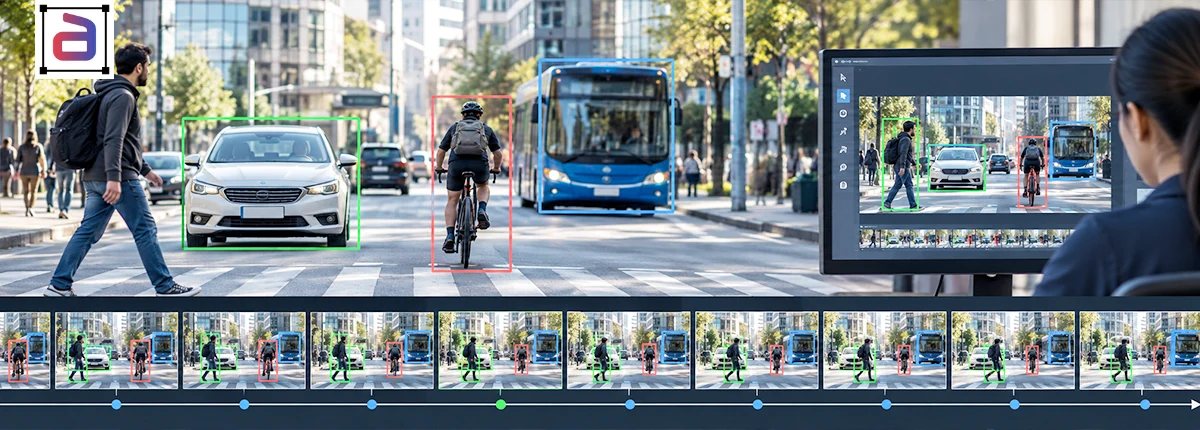
The AI industry’s evolution is increasing the complexity of data preparation. Modern models require far more than basic image tagging. Training pipelines can involve bounding boxes, semantic segmentation, transcription, sentiment classification, named-entity recognition, LiDAR annotation, video tracking, multimodal labeling, and human evaluation. The importance of human expertise is becoming increasingly evident. Reuters reported in 2025 that AI data company Turing’s revenue tripled to $300 million in 2024 as demand increased for human experts involved in training sophisticated AI systems. The company noted that AI laboratories are confronting a potential “data wall” as readily available internet-scale training data becomes increasingly limited. The implication is clear: AI advancement increasingly depends on better data—not simply more data. This is creating a major opportunity for specialized data-service ecosystems outside traditional technology centers.
Why Central America Is Well Positioned for Nearshore AI
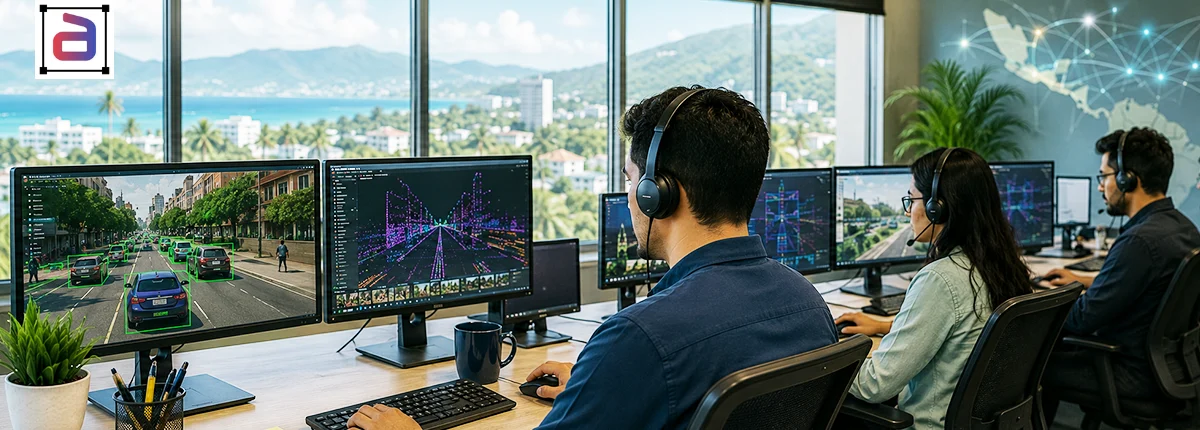
Nearshoring traditionally refers to moving business operations to a geographically closer country rather than a distant offshore destination. For U.S.-based AI companies, Central America offers an attractive combination of proximity, compatible working hours, cultural familiarity, and access to emerging digital talent. These factors matter particularly for data annotation. Annotation projects are rarely static. Guidelines change. Edge cases emerge. Quality thresholds evolve. New classes may need to be added. Annotation teams often need to communicate directly with project managers, machine-learning engineers, and quality teams. A nearshore model can make these feedback loops considerably easier to manage.
The World Bank has emphasized that Latin America and the Caribbean are well positioned to benefit from nearshoring, while also stressing that countries need stronger education, infrastructure, and technical capabilities to capture the opportunity. William Maloney, the World Bank’s Chief Economist for Latin America and the Caribbean, noted that “proximity alone cannot guarantee foreign direct investment.” That distinction is important. Central America’s opportunity is not simply about being geographically close to the U.S. It is about developing the capabilities required to become a dependable part of sophisticated global technology workflows.
AI Adoption Is Accelerating Across Latin America
The broader regional AI landscape is already showing strong momentum. According to the Economic Commission for Latin America and the Caribbean (ECLAC), Latin America and the Caribbean account for 14% of global visits to AI solutions and rank third worldwide in downloads of generative-AI applications. Yet the region remains underrepresented in AI investment. ECLAC reports that Latin America and the Caribbean represent approximately 6.6% of global GDP but attract only 1.12% of global AI investment. This gap represents both a challenge and an opportunity. As AI adoption expands faster than AI infrastructure and investment, countries that develop specialized capabilities—including data preparation, annotation, evaluation, and AI support services—can participate more deeply in the global AI economy. The latest Latin American Artificial Intelligence Index also highlights improvements in Central American and Caribbean countries, including advances in infrastructure, connectivity, education, and AI-related capabilities.
The Strategic Importance of El Salvador
Within this emerging ecosystem, El Salvador has characteristics that make it increasingly relevant to technology-enabled services. Its geographic proximity to the U.S., Spanish-speaking workforce, growing digital capabilities, and participation in the broader Central American technology ecosystem create potential for AI-support operations. For organizations evaluating a data annotation company in El Salvador, however, location should be only one part of the decision. The more important questions are:
- Can the provider consistently meet annotation-quality requirements?
- Does it have trained annotators and experienced QA teams?
- Can it scale teams as project volumes change?
- Can it support multilingual and culturally nuanced datasets?
- Does it maintain appropriate data-security controls?
- Can it integrate with existing annotation platforms and workflows?
- Does it provide transparent quality metrics and escalation processes?
These factors separate a genuine AI data partner from a conventional outsourcing operation.
Why Quality Matters More Than Cost
The temptation in outsourcing is to focus primarily on hourly rates. For AI development, that approach can be costly. Poorly labeled datasets can introduce noise, bias, and inconsistencies into machine-learning pipelines. When these errors propagate into model training, the resulting model may perform poorly in real-world conditions—even if the underlying algorithm is sophisticated. That is why successful data annotation outsourcing should be built around a structured quality framework.
A mature annotation operation should incorporate: Clear annotation guidelines: Every annotator must understand precisely what constitutes a correct label. Multi-level quality assurance: Samples should undergo systematic review, with disagreements tracked and resolved. Human-in-the-loop workflows: Automation can accelerate repetitive tasks, but human judgment remains critical for ambiguous or complex cases. Domain specialization: Autonomous driving, retail, healthcare, robotics, and conversational AI all require different annotation approaches. Scalable workforce management: Teams should be capable of expanding without compromising accuracy or consistency. In other words, the objective should not be the cheapest annotation—it should be reliable annotation at scale.
Where Annotera Fits Into the Nearshore AI Opportunity
At Annotera, we believe high-quality data is the foundation of production-ready AI. As a specialized data annotation company, Annotera helps organizations transform raw datasets into structured, machine-learning-ready assets through human-led annotation and quality-control workflows. Our capabilities span image, video, audio, text, and multimodal data, enabling AI teams to address diverse training requirements through a unified data operation. For businesses considering nearshore delivery models, Annotera’s approach goes beyond simply providing annotators.
We focus on building structured workflows around accuracy, consistency, scalability, and quality assurance. This becomes particularly important as AI systems move into increasingly complex real-world environments. An autonomous vehicle needs accurately labeled objects across different lighting and weather conditions. A retail AI system needs reliable product and customer-interaction data. A conversational AI model needs linguistically accurate text and audio. A robotics model needs perception and action data that reflects real-world variability. The quality of the underlying data can determine how effectively these systems perform.
Central America Could Become Part of the Next AI Data Infrastructure
The rise of Central America as a nearshore AI data hub reflects a broader transformation in global technology operations. AI companies no longer need to concentrate every component of development in a single geography. Instead, they can create distributed ecosystems in which model development, engineering, data operations, quality assurance, and specialized human expertise are strategically located across multiple regions. The World Bank has described nearshoring as an opportunity that can become transformational when countries combine geographic advantages with investments in education, digital infrastructure, and technical capabilities. Central America is moving in that direction. For U.S.-based organizations, the region can provide a compelling combination of geographic proximity, compatible working hours, expanding digital capabilities, and access to multilingual talent. For AI companies, it offers an opportunity to build more flexible and resilient data operations.
Conclusion: Nearshore AI Starts With the Right Data Partner
The next phase of AI development will not be determined solely by larger models or greater computing power. Data quality, human expertise, and operational scalability will increasingly determine which AI systems succeed in production. Central America’s emergence as a nearshore AI data hub is therefore more than an outsourcing trend. It is part of a larger shift toward distributed, specialized, and globally connected AI infrastructure. For organizations evaluating data annotation outsourcing, choosing the right partner is critical.
Annotera combines data annotation expertise, human-in-the-loop quality processes, and scalable workflows to help AI teams build dependable training datasets. Whether you are developing computer vision models, conversational AI, autonomous systems, robotics applications, or multimodal AI, the right data strategy can accelerate your path from experimentation to deployment. Ready to strengthen your AI data pipeline? Partner with Annotera to explore scalable, quality-focused data annotation solutions tailored to your project. Contact Annotera today and turn complex data into AI-ready intelligence.
A closely related read: Bilingual Spanish-English Talent: El Salvador’s Annotation Workforce.