Start Annotation

Label Every Sensor, Perfectly in Sync

Synchronize and annotate RGB, depth, LiDAR, IMU, and force/torque streams in one connected workflow — the fused, time-aligned ground truth physical AI depends on.

Multi-Sensor Fusion Annotation for Robotics and Embodied AI

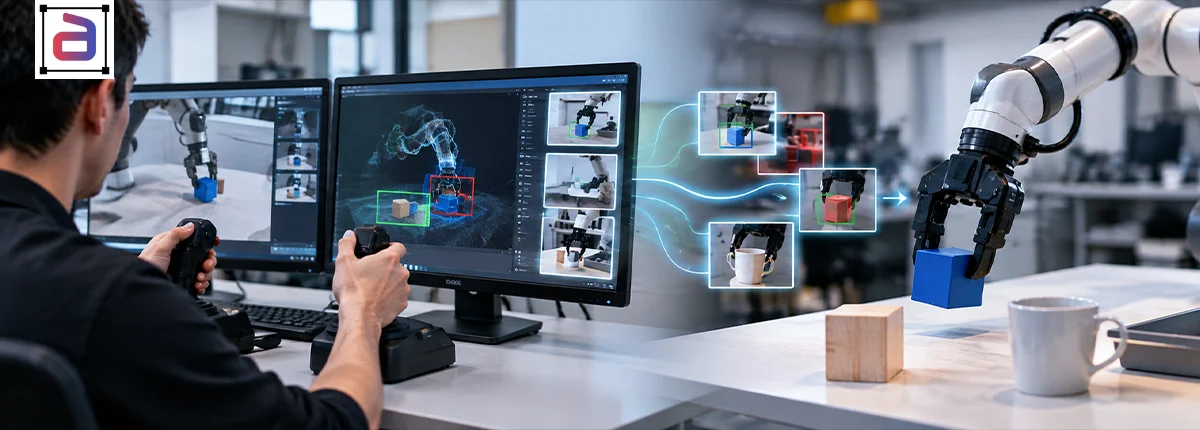
Physical AI robots do not perceive the world through a single camera. They fuse synchronized streams — RGB cameras, depth sensors, LiDAR, IMU, and force or torque readings — into one coherent picture of the environment. Annotating that multimodal data is fundamentally different from labeling a single video: every modality has to stay frame-accurate and time-aligned, or the fused training signal breaks down. Annotera specializes in exactly this.

Our annotators work with synchronized multi-sensor data in a single, connected workflow, producing consistent labels across modalities — 3D bounding boxes and segmentation on point clouds, object correspondence between camera and LiDAR, and event alignment across IMU and force/torque traces. With 20+ years of outsourcing expertise and 350+ trained specialists, Annotera delivers sensor-fusion annotation at the scale autonomy, manipulation, and humanoid programs require.

As robots add more sensors and the annotation standards for physical AI are still taking shape, the teams with clean, fused, time-aligned ground truth will train the most reliable perception. Annotera helps you build it.

ServicesTypes of Multi-Sensor Fusion Annotation

Physical AI robots do not perceive the world through a single camera. They fuse synchronized streams — RGB cameras, depth sensors, LiDAR, IMU, and force or torque readings — into one coherent picture of the environment. Annotating that multimodal data is fundamentally different from labeling a single video

LiDAR 3D Bounding Boxes & Segmentation

Objects in point clouds are labeled with 3D boxes and segmentation. As a result, robots gain accurate spatial perception of their surroundings.

Camera-LiDAR
Correspondence

Objects are matched between camera images and LiDAR point clouds. Therefore, fused perception models learn consistent cross-modal identity.

Depth & RGB-D
Labeling

RGB-D streams are annotated with object and surface labels. In addition, this supports grasp planning and close-range manipulation.

IMU & Motion Event Tagging

Motion events are aligned to IMU traces and the visual stream. Consequently, models learn to associate movement with sensed dynamics.

Force/Torque Event Annotation

Contact and force events are labeled and time-aligned with video and motion. Moreover, this gives manipulation models a tactile-adjacent signal.

Cross-Sensor Time Synchronization

All modalities are validated for frame-accurate temporal alignment. As a result, the fused dataset stays coherent across sensors.

FeaturesCore Strength Behind Annotera’s Multi-Sensor Fusion Annotation Services

Physical AI robots do not perceive the world through a single camera. They fuse synchronized streams — RGB cameras, depth sensors, LiDAR, IMU, and force or torque readings — into one coherent picture of the environment. Annotating that multimodal data is fundamentally different from labeling a single video

Frame-Accurate Synchronization

Rigorous time-alignment across every modality keeps fused labels coherent — the non-negotiable requirement for sensor-fusion training.

Full Multimodal Coverage

RGB, depth, LiDAR, IMU, and force/torque handled in one connected workflow, rather than stitched together from separate vendors.

Scalable, Secure Delivery

SOC-compliant workflows and flexible capacity scale multi-sensor annotation to production volume without compromising accuracy or security.

Why Choose Us? Reliable Partner for Multi-Sensor Fusion Annotation Services

Physical AI robots do not perceive the world through a single camera. They fuse synchronized streams — RGB cameras, depth sensors, LiDAR, IMU, and force or torque readings — into one coherent picture of the environment. Annotating that multimodal data is fundamentally different from labeling a single video

Proven Expertise

20+ years of BPO experience applied to complex multimodal robotics data.

Single Connected Workflow

All sensors labeled together, preserving cross-modal correspondence and timing.

3D & Point-Cloud Depth

Established 3D cuboid and segmentation capability extended to fused sensor data.

Flexible Scaling

Capacity scales from pilot rigs to full autonomy datasets.

Consistent Quality

Multi-layer validation keeps labels accurate across every modality.

Secure Workflows

SOC-compliant handling with strict access controls and US onshore options.

Connect with an Expert

    Frequently Asked QuestionsGot Questions? We’ve Got Answers for You

    Here are answers to common questions about text annotation, accuracy, and outsourcing to help businesses scale their NLP projects effectively.

    It is the synchronized labeling of multiple sensor streams — RGB, depth, LiDAR, IMU, and force/torque — in one connected workflow, with every modality kept frame-accurate and time-aligned. As a result, robots learn from a coherent, fused view of the world.

    Physical AI robots fuse many sensors to perceive and act, and the fused training signal only works if labels are consistent and time-aligned across modalities. Therefore, specialized multi-sensor annotation is essential for reliable perception.

    We annotate RGB cameras, depth sensors, LiDAR point clouds, IMU motion data, and force/torque readings, including 3D boxes, segmentation, cross-sensor correspondence, and event alignment. Moreover, the label set is tailored to each sensor configuration.

    Single-stream annotation labels one modality at a time. Sensor-fusion annotation, however, must preserve correspondence and timing across several modalities at once, which requires 3D and point-cloud expertise plus rigorous synchronization.

    Yes. With 350+ trained specialists and SOC-compliant, flexible delivery, we label large multimodal datasets while keeping every modality accurate, aligned, and secure.