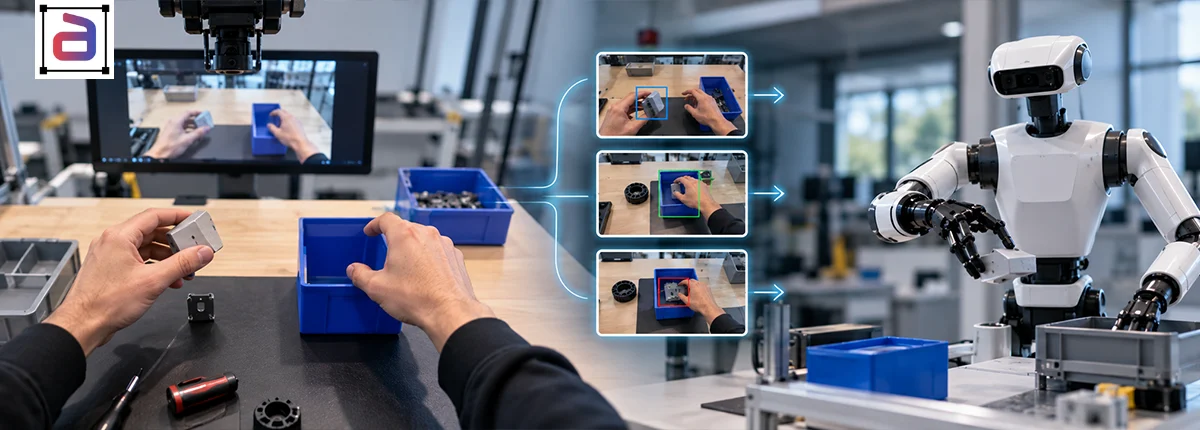
Physical AI is changing what robots are expected to do. Tomorrow’s robots will not simply execute a fixed sequence of programmed commands. They will need to observe people, interpret their actions, understand object interactions, learn from demonstrations, and respond appropriately to constantly changing environments. That requires a fundamental shift in how robots are trained. Instead of teaching machines only what objects look like, developers increasingly need training data that captures how humans interact with objects, perform tasks, and navigate physical environments. This is where egocentric video annotation becomes a powerful component of the Physical AI data pipeline. By transforming first-person video into structured information about actions, hands, objects, interactions, and task sequences, annotation can help robots move closer to understanding the physical world from a human perspective.
“Data is the food for AI.” — Andrew Ng
For Physical AI, however, the quality and structure of that data matter just as much as its volume.
Key Points
- Egocentric video annotation helps robots understand human actions by capturing and labeling hand movements, object interactions, task sequences, and physical behaviors from a first-person perspective.
- High-quality training data is essential for Physical AI, enabling robots to move beyond object recognition and develop a deeper understanding of actions, interactions, and real-world context.
- Data annotation outsourcing provides scalability for robotics companies handling large volumes of complex video while allowing internal teams to focus on AI development and model performance.
- Annotera transforms human demonstrations into robot-ready training data through specialized robotics annotation workflows, quality assurance, and scalable data annotation capabilities.
What Is Egocentric Video Annotation?
Egocentric video is captured from a first-person perspective, often using wearable cameras, head-mounted devices, or robotic systems. Rather than observing a person from across a room, the footage captures what the person sees while performing an activity. This perspective provides valuable information about human behavior and physical interaction. Egocentric video annotation adds structured labels to that footage so AI models can learn what is happening and when. Depending on the application, annotations can capture:
- Human actions and activities
- Hand and finger movements
- Hand-object interactions
- Objects being grasped or manipulated
- Object affordances
- Task stages
- Action start and end points
- Spatial relationships
- Before-and-after scene states
- Environmental context
For example, consider a person preparing a cup of coffee. A conventional object-detection dataset might identify a cup, coffee container, spoon, and machine. An action-oriented dataset can go much further: Reach → Grasp → Lift → Pour → Stir → Place This sequence provides a robot with information about how objects are used, not merely what they are. That distinction is critical for embodied intelligence.
Why Human Actions Are Essential to Physical AI
Robots increasingly need to operate in environments designed for humans. Homes, hospitals, factories, warehouses, restaurants, and offices are dynamic spaces where objects move, people change their behavior, and tasks rarely unfold identically twice. A robot working alongside humans must therefore answer questions such as:
- What is the person doing?
- Which object are they interacting with?
- What action is likely to happen next?
- Has the task already been completed?
- How should the robot respond?
- What changed in the environment after the action?
These are not purely object-recognition problems. They are action-understanding and temporal-reasoning problems. Annotera’s robotics annotation workflows are designed around this broader physical context, including first-person video, hand and gripper positioning, object affordances, and scene-state changes.
“A robot that can see an object is not necessarily a robot that understands how that object is used.”
From Raw Video to Robot-Ready Knowledge
Raw video contains enormous amounts of information, but machine-learning systems need structured signals to learn effectively. Annotation creates that structure. Suppose a robot observes someone opening a drawer. Simply labeling the drawer does not tell the model what happened. Action-level annotation can identify the sequence: Approach → Reach → Grasp Handle → Pull → Open This transforms passive visual information into a representation of physical behavior. For robotics developers, such structured datasets can support applications including:
- Imitation learning
- Robot manipulation
- Human-robot collaboration
- Humanoid robot training
- Household robotics
- Industrial automation
- Assistive robotics
- Embodied AI foundation models
Annotera specifically supports first-person human and robot POV datasets with labels for object affordances, hand and gripper positions, spatial relationships, and scene states.
The Critical Role of Hand-Object Interaction
Human hands provide some of the most important signals in physical task execution. A robot does not simply need to know that a bottle exists. It may need to understand whether a person is reaching for it, grasping it, lifting it, rotating it, pouring from it, or placing it somewhere. This makes hand-object interaction annotation particularly valuable. Detailed annotation can capture:
- Hand location and movement
- Finger or grasp positions
- Object contact
- Object movement
- Manipulation stages
- Interaction points
- Changes in object state
Such information can help models learn the relationship between perception and physical action. For dexterous robotics, that relationship is fundamental.
Why Annotation Quality Matters
More data does not automatically mean better robot intelligence. If annotation guidelines are inconsistent, temporal boundaries are inaccurate, or important interactions are missed, the resulting dataset can introduce noise into model training. A robust annotation program should therefore include:
- Clearly defined taxonomies
- Domain-specific annotation guidelines
- Trained annotators
- Temporal consistency checks
- Multi-stage quality assurance
- Edge-case identification
- Continuous taxonomy refinement
Annotera operates with dedicated annotation specialists and a multi-layer quality framework designed to produce production-grade AI training datasets. Its broader operation includes more than 1,500 trained annotators and supports video, image, audio, text, and robotics data workflows.
The Case for Data Annotation Outsourcing
Building an internal annotation operation can become difficult as robotics datasets grow. Physical AI projects may generate thousands of hours of demonstrations and first-person video. Processing that volume requires trained personnel, quality-control infrastructure, annotation tools, project management, and the ability to scale quickly. This is where data annotation outsourcing can provide a strategic advantage. Instead of diverting robotics engineers toward repetitive labeling operations, companies can work with a specialized partner that manages annotation capacity while internal teams concentrate on model architecture, experimentation, deployment, and evaluation. However, outsourcing robotics data requires more than finding a vendor that can draw boxes around objects. Physical AI datasets contain complex temporal and physical relationships. The annotation partner needs to understand the difference between seeing an object and understanding an interaction with that object.
Why a Specialized Data Annotation Company Matters
Choosing the right data annotation company can directly influence the usefulness of a robotics training dataset. A general-purpose labeling provider may be capable of basic image annotation, but Physical AI requires a deeper understanding of manipulation, motion, affordances, task segmentation, and human-object relationships. Annotera approaches robotics annotation as data infrastructure rather than simple labeling. Its robotics offering spans egocentric video, teleoperation data, manipulation semantics, multi-sensor data, simulation-to-real validation, and other Physical AI workflows. This specialization helps ensure that annotations are designed around the eventual behavior the model is expected to learn.
Building the Data Flywheel for Smarter Robots
The most effective Physical AI programs will not treat annotation as a one-time project. As robots enter real environments, they encounter new objects, unfamiliar behaviors, unusual task sequences, and unexpected failure modes. Those experiences create new data. That data can be collected, annotated, evaluated, and fed back into training. This creates a continuous data flywheel: Deploy → Collect → Annotate → Train → Evaluate → Identify Gaps → Collect Again Annotera supports this continuous approach by helping robotics teams process new deployment footage, label edge cases, refine taxonomies, and generate model-ready datasets. The result is a training pipeline capable of evolving alongside the robot.
Annotera: Turning Human Behavior Into Training Intelligence
The future of Physical AI depends on robots learning from the complexity of the real world. Human demonstrations provide one of the richest sources of that knowledge. But raw demonstrations are only the starting point. To make them useful for machine learning, developers need structured, consistent, high-quality annotations that capture the relationships between people, objects, actions, and environments. That is where Annotera can make a difference. With specialized robotics annotation workflows, dedicated annotation teams, scalable delivery capabilities, and quality-focused processes, Annotera helps AI and robotics companies convert complex visual data into actionable training datasets.
“Robots don’t learn from code alone—they learn from the data we feed them.”
As Physical AI moves from laboratories into homes, factories, warehouses, healthcare environments, and other real-world settings, the ability to understand human actions will become increasingly important.
Conclusion: Teaching Robots More Than What They See
The next generation of robots must do more than recognize objects. They need to understand actions, intentions, interactions, sequences, and physical context. Egocentric video offers a valuable window into how humans perform tasks. When that footage is systematically annotated, it can become a powerful source of training intelligence for embodied AI systems. For robotics companies, the opportunity is clear: build datasets that teach machines not only what is in the world, but what is happening in the world and how humans interact with it. Annotera brings the annotation expertise, operational scale, and robotics-focused workflows needed to help turn that vision into production-ready training data.
Ready to Build Smarter Physical AI?
Your robot’s intelligence begins with its training data. Partner with Annotera to transform egocentric video, human demonstrations, and real-world robotics data into high-quality datasets built for the next generation of intelligent machines. Get in touch with Annotera today and start building the data foundation for more capable, adaptable, and human-aware robots.
A closely related read: Annotating First-Person (Egocentric) Video: Techniques for Wearable and AR/VR Applications.
Must Read : In-Cabin Video Annotation for Driver Monitoring Systems: Drowsiness, Distraction, and Gaze