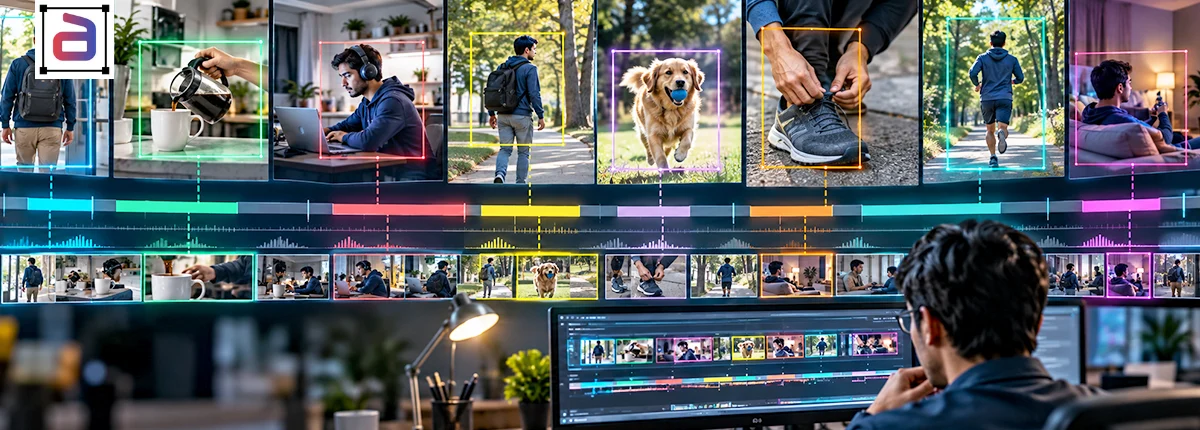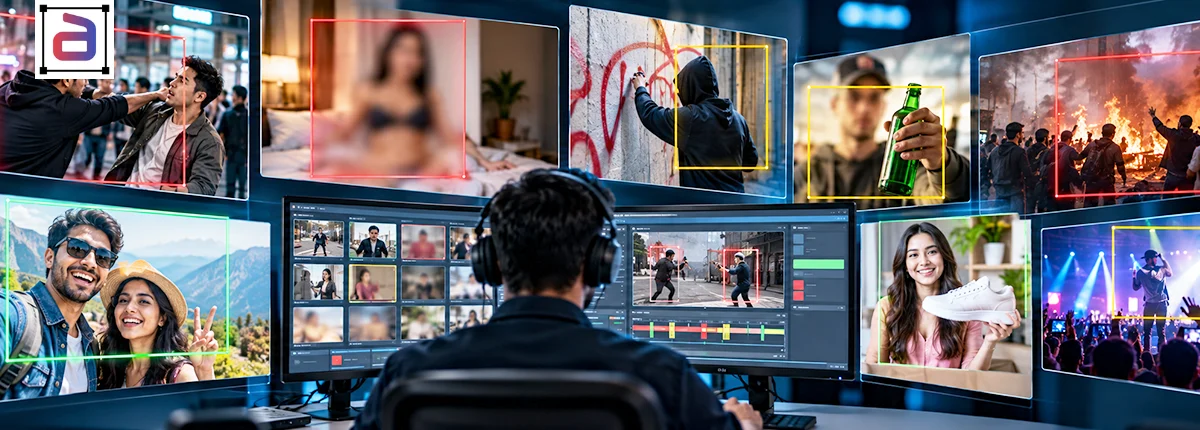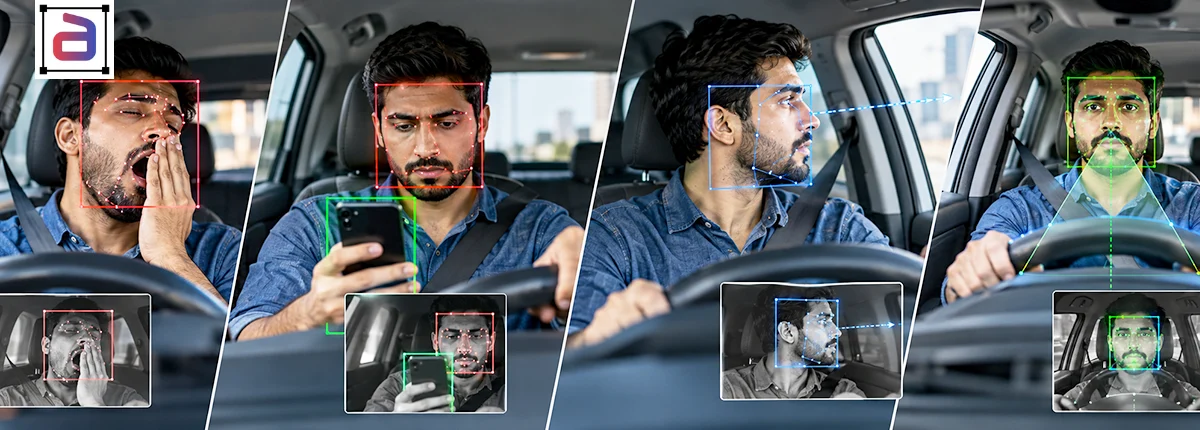
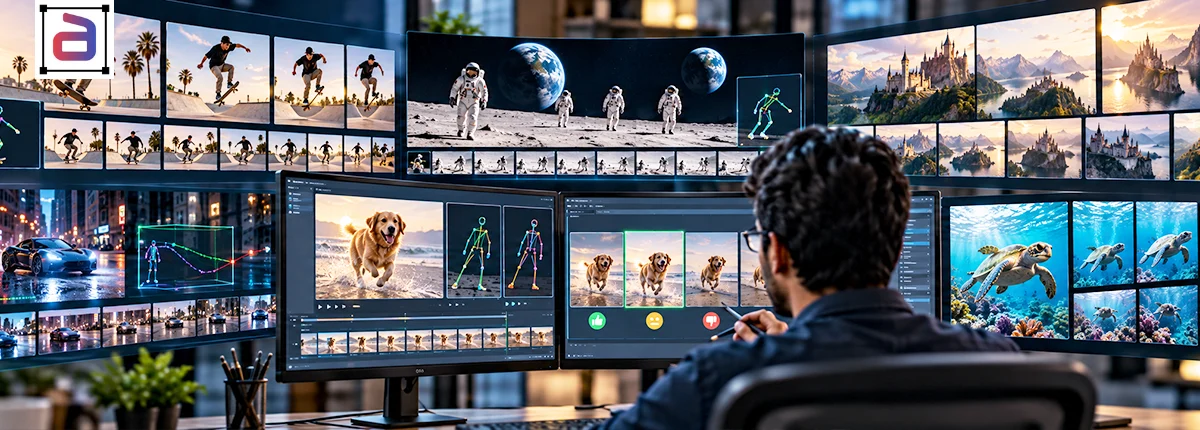
Imagine generating a video from a simple prompt: “A cyclist rides through a busy city street as sunlight reflects off the buildings.” The resulting video may look impressive at first glance, but closer inspection could reveal unnatural movement, disappearing vehicles, inconsistent lighting, or actions that do not match the description. These challenges highlight a fundamental requirement of generative AI: text-to-video models need high-quality, precisely annotated training data to produce coherent, realistic, and prompt-aligned videos.
Unlike text-to-image systems, text-to-video models must understand how scenes evolve over time. They need to interpret natural language, represent objects accurately, generate plausible motion, and maintain visual consistency across consecutive frames. Achieving these capabilities requires specialized annotation strategies covering video captions, motion quality assessment, and human preference ranking. At Annotera, we help AI teams strengthen their data pipelines through structured video annotation workflows designed to support generative AI training, evaluation, and continuous improvement.
“A convincing video is not simply a collection of realistic frames; it is a sequence of events that makes sense over time.”
Key Points
- Caption Annotation for Contextual Understanding: Helps text-to-video models understand objects, actions, spatial relationships, and event sequences for accurate prompt-to-video generation.
- Motion Quality and Temporal Consistency: Evaluates motion smoothness, physical realism, visual artifacts, and consistency across consecutive frames to improve video quality.
- Multi-Object Tracking and Preference Ranking: Maintains object identity across frames and uses human feedback to rank generated videos based on prompt adherence, motion quality, and visual appeal.
- Scalable Video Annotation with Annotera: Annotera provides structured video annotation workflows, quality assurance, and scalable annotation support to help AI teams build reliable training datasets for generative AI models.
1. Caption Annotation: Teaching Models to Understand Video Context
Caption annotation connects language with visual information, enabling text-to-video models to learn how objects, actions, environments, and interactions relate to one another. However, effective video captioning goes beyond describing what appears in a frame. It must communicate what happens, how events unfold, and how different elements interact. For example, consider the prompt: “A golden retriever runs across a grassy field, jumps into the air, and catches a red ball.” A useful annotation should identify the dog and the ball, describe the running and jumping actions, and capture the sequence of events. If the video contains several stages, segment-level captions can describe the dog’s initial movement, the ball’s trajectory, and the moment of interaction. High-quality caption annotation typically includes:
- Object identification: Recognizing relevant people, animals, vehicles, and environmental elements.
- Action descriptions: Recording observable movements, gestures, and interactions.
- Spatial relationships: Describing the positions and relationships between objects.
- Temporal context: Capturing event order, transitions, and action duration.
- Prompt alignment: Ensuring descriptions accurately represent the intended scene without introducing unsupported details.
For longer or more complex videos, combining global captions with timestamped, segment-level descriptions can provide richer supervision. Annotera emphasizes consistent annotation guidelines and context-aware labeling to help AI teams build descriptive, reliable datasets for video generation and understanding.
2. Motion Quality Annotation: Evaluating Realism Beyond Individual Frames
A generated video may contain visually appealing frames but still appear artificial when played. Motion quality annotation helps identify these inconsistencies by evaluating how objects and scenes change over time. This process is particularly important for models expected to generate realistic human actions, vehicle movements, product demonstrations, and complex environmental interactions.
Key dimensions of motion quality
- Motion smoothness: Evaluates whether movements appear continuous or contain abrupt jumps, unnatural acceleration, or inconsistent transitions.
- Temporal consistency: Checks whether object identities, shapes, clothing, lighting, and background elements remain stable across frames.
- Physical plausibility: Examines whether actions follow reasonable physical behavior, including gravity, momentum, collisions, and object interactions.
- Camera movement: Assesses the coherence of camera pans, zooms, tracking shots, and changes in perspective.
- Visual artifact detection: Identifies flickering, ghosting, warped objects, duplicated elements, and distorted body structures.
For example, a video showing a person opening a door should maintain consistent hand positioning, door geometry, and movement throughout the interaction. If the hand changes shape or the door shifts unnaturally between frames, the annotation should capture the relevant defect. A structured rating system can classify motion as acceptable, moderately inconsistent, or severely flawed. Detailed guidelines and representative examples help annotators apply these ratings consistently.
“Motion realism is measured not only by how an object moves, but also by whether that movement remains coherent from one moment to the next.”
3. Multi-Object Tracking: Maintaining Identity Across Frames
Scenes involving multiple moving objects introduce additional complexity. A text-to-video model may generate a busy intersection, a crowded shopping mall, or a sports match in which several entities move simultaneously. In these scenarios, multi-object tracking helps evaluate whether objects maintain consistent identities and trajectories throughout a video sequence. Although multi-object tracking is traditionally used in computer vision applications, its underlying principles can also support the assessment of generated videos. Annotation teams can examine whether:
- Vehicles maintain consistent identities as they move through a scene.
- People remain visually distinguishable during interactions.
- Objects disappear or reappear without a plausible explanation.
- Movement trajectories remain consistent across consecutive frames.
- Interactions between multiple entities follow the described action.
For instance, if a red car turns left at an intersection, its identity should remain consistent before, during, and after the turn. An unexplained change into another vehicle or an abrupt trajectory discontinuity indicates a potential temporal inconsistency. When combined with motion quality assessment, multi-object tracking provides valuable signals for identifying weaknesses in video generation pipelines. Annotera can support structured video labeling and tracking-related annotation workflows that help AI teams assess object continuity, scene dynamics, and temporal coherence.
4. Preference Ranking: Using Human Judgment to Improve Video Generation
Even when two videos accurately represent the same prompt, one may be more realistic, visually appealing, or contextually appropriate than the other. Preference ranking helps capture these differences. In this approach, annotators compare multiple model-generated videos and rank them according to predefined criteria. These comparisons can provide training signals for preference optimization and reinforcement learning from human feedback (RLHF), depending on the model’s training methodology. Consider two outputs generated from the prompt: “A red sports car drives along a coastal road at sunset.” One video may demonstrate accurate road movement but contain flickering backgrounds. The other may offer smoother motion, consistent vehicle geometry, and stronger visual alignment with the prompt. Annotators evaluate both outputs using a structured rubric.
What should preference ranking measure?
- Prompt adherence: Does the video accurately represent the requested scene and actions?
- Motion quality: Are movements smooth, plausible, and consistent?
- Visual aesthetics: Are composition, lighting, and colors appropriate?
- Temporal coherence: Do objects and environments remain stable over time?
- Overall usefulness: Which output better satisfies the intended application?
Preference ranking becomes more reliable when annotators receive clear instructions, calibration examples, and guidance for handling conflicting criteria. For example, a video with excellent visual aesthetics but poor prompt adherence should not automatically outrank a less stylized video that follows the prompt accurately. The ranking framework must reflect the model’s actual objectives. Annotera helps AI teams establish consistent evaluation criteria so that human feedback can become a more dependable component of generative AI development.
5. Quality Assurance: Turning Annotations Into Reliable Training Signals
Even sophisticated annotation methods can produce inconsistent results without a robust quality assurance framework. Differences in captioning style, motion ratings, or preference judgments may introduce noise into training datasets. A reliable quality control process should include:
- Standardized guidelines: Define annotation categories, rating scales, and edge-case procedures.
- Annotator calibration: Align interpretations through training exercises and reference examples.
- Inter-annotator agreement: Measure consistency using metrics appropriate to each annotation task.
- Expert review: Escalate ambiguous cases, complex motion defects, and conflicting preferences.
- Continuous auditing: Identify recurring errors and refine annotation protocols as models evolve.
Quality assurance should also verify timestamp accuracy, caption fidelity, object identity consistency, and the rationale behind preference decisions. By combining human expertise with measurable quality controls, organizations can build datasets that are more suitable for model training, benchmarking, and iterative improvement.
6. Why Choose Annotera for Video Annotation Outsourcing Services?
Developing reliable text-to-video datasets requires a combination of linguistic precision, visual understanding, temporal reasoning, and human evaluation. Scaling these capabilities internally can become expensive and operationally demanding as dataset volumes increase. Annotera supports AI developers and enterprises with structured annotation workflows designed for complex video data requirements. As a video annotation company, Annotera can support projects involving video captioning, temporal event descriptions, motion quality assessment, object tracking, and preference-based evaluation. Our approach focuses on:
- Task-specific annotation guidelines aligned with project objectives.
- Consistent labeling practices and structured quality checks.
- Scalable workflows for growing generative AI datasets.
- Annotation processes designed around measurable evaluation criteria.
Choosing video annotation outsourcing services can help AI organizations access specialized annotation resources, manage growing workloads, and allow internal teams to concentrate on model architecture, experimentation, and deployment. The objective is not simply to label more videos. It is to develop training data that provides meaningful supervision for increasingly capable generative models.
Conclusion: Building Better Text-to-Video Models Starts With Better Data
The future of text-to-video generation depends on more than producing visually impressive clips. Models must understand language, generate plausible movement, preserve object identities, and deliver results that align with human expectations. Caption annotation provides semantic context. Motion quality annotation evaluates realism and temporal consistency. Multi-object tracking helps assess identity continuity, while preference ranking captures comparative human judgments. Together, these methods create a stronger foundation for training and evaluating next-generation video generation systems. At Annotera, we recognize that dependable AI begins with dependable data. Our video annotation capabilities are designed to help organizations build structured, quality-focused datasets that support the evolving demands of generative AI. Ready to improve the quality of your text-to-video training data? Partner with Annotera to explore scalable video annotation solutions for captioning, motion evaluation, tracking, and preference ranking. Contact Annotera today to discuss your project requirements and build a stronger foundation for your next-generation video AI models.
A closely related read: Handling Motion Blur in Video Annotation: Strategies for High-Speed Computer Vision Datasets.