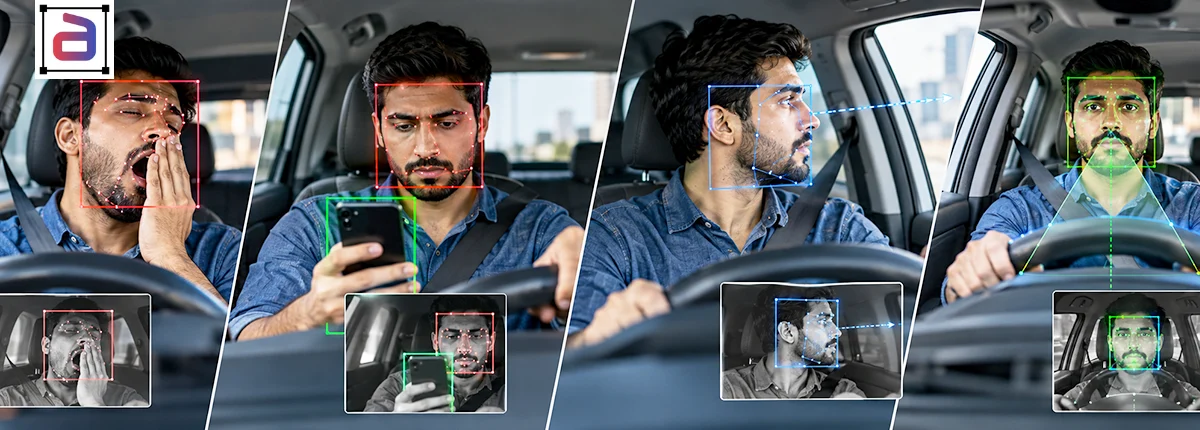
What if a vehicle could recognize when its driver is losing focus before a dangerous situation develops? This is one of the critical objectives of modern Driver Monitoring Systems (DMS), which use computer vision and artificial intelligence (AI) to analyze driver behavior and identify potential safety risks. As automotive technology advances, monitoring driver alertness is becoming increasingly important for passenger vehicles, commercial fleets, and vehicles equipped with advanced driver assistance systems (ADAS). However, even sophisticated AI models depend on one essential foundation: high-quality, accurately annotated training data.
In-cabin video annotation transforms raw footage into structured datasets that help AI models recognize drowsiness, detect distraction, and estimate gaze direction. From identifying prolonged eye closure to tracking a driver’s interaction with a mobile phone, every annotation contributes to a model’s understanding of real-world driving behavior. As the National Highway Traffic Safety Administration (NHTSA) explains, driver monitoring research focuses on identifying and mitigating impairment and inattention using data collected inside vehicles. For automotive AI developers, Annotera provides a pathway to building structured, reliable video datasets that support the development and evaluation of driver monitoring technologies.
Key Points
- Drowsiness Detection: In-cabin video annotation helps AI models identify fatigue-related cues, including prolonged eye closure, repeated yawning, and changes in head posture.
- Distraction and Gaze Analysis: Accurate annotations enable Driver Monitoring Systems to recognize distracted behaviors and estimate gaze direction across different in-cabin scenarios.
- Multi-Object Tracking: Tracking hands, mobile phones, and other objects across video frames helps AI models understand driver interactions and behavioral patterns over time.
- High-Quality Training Data with Annotera: Annotera delivers scalable video annotation solutions that support consistent labeling, rigorous quality assurance, and the development of reliable automotive AI models.
What Is In-Cabin Video Annotation for Driver Monitoring Systems?
In-cabin video annotation involves labeling visual information captured by driver-facing cameras to identify driver behavior, facial movements, gaze patterns, and interactions with objects inside a vehicle. Unlike conventional object detection, driver monitoring requires an understanding of both individual frames and changes in behavior over time. A brief blink, for example, differs significantly from prolonged eye closure, while a glance toward a mirror may be normal driving behavior rather than distraction. Accurate annotation can include:
- Drowsiness detection: Labeling prolonged eye closure, repeated yawning, drooping eyelids, and fatigue-related head movements.
- Distraction detection: Identifying phone use, looking away from the road, reaching for objects, and interacting with infotainment controls.
- Gaze estimation: Annotating eye direction, head pose, and predefined visual attention zones.
- Facial landmark annotation: Marking eye corners, pupils, eyebrows, and mouth landmarks to support facial behavior analysis.
- Object tracking: Following hands, phones, and other relevant objects across consecutive video frames.
Together, these annotations provide the structured supervision required to train AI models that interpret driver behavior more consistently.
1. Drowsiness Annotation: Recognizing Early Signs of Fatigue
Driver fatigue can reduce alertness, delay reactions, and impair decision-making. Consequently, DMS models must learn to identify visual indicators that may signal declining attention. However, drowsiness annotation involves more than assigning a simple “awake” or “sleepy” label. It requires identifying individual cues and their temporal relationships. For example, annotators may mark the start and end of eye-closure events, distinguish ordinary blinking from prolonged closure, and identify repeated yawning or changes in head posture.
When these labels are synchronized across video frames, AI models can learn patterns associated with fatigue. The key challenge is context. A single yawn does not necessarily indicate drowsiness, and a brief blink is a normal physiological response. Therefore, annotation guidelines should define event boundaries and distinguish observable behavior from assumptions about the driver’s condition. Datasets should also represent challenging conditions, including nighttime driving, infrared illumination, sunglasses, facial occlusion, and varying camera angles. These variations help developers evaluate whether models can generalize beyond controlled environments. As a guiding principle for DMS dataset development: Reliable fatigue detection begins with precise behavioral labels, not assumptions based on isolated visual cues.
2. Distraction Annotation: Identifying Unsafe Behavioral Patterns
Distraction can occur when drivers divert their attention from driving to secondary activities. Examples include using a mobile phone, interacting with a touchscreen, reaching for an object, or turning toward a passenger. For AI models to distinguish these behaviors accurately, annotation teams must use clearly defined categories. Consider a driver looking toward the center console. The movement could indicate an ordinary interaction with vehicle controls or a prolonged diversion of attention. The annotation should capture the observable action and its duration rather than automatically classifying every glance as dangerous. Useful annotation categories include:
- Eyes directed away from the forward road view.
- Mobile phone handling and active phone interaction.
- Reaching for objects within the cabin.
- Interactions with dashboard and infotainment systems.
- Head turns toward passengers or side windows.
- Hand positions and interactions with the steering wheel.
The National Highway Traffic Safety Administration highlights the importance of evaluating how in-vehicle technologies affect driver attention and performance. For developers, carefully annotated distraction datasets can help train models to recognize meaningful behavioral patterns while reducing false positives caused by routine driving actions.
3. Gaze Annotation: Understanding Where Drivers Look
Gaze estimation provides valuable information about where drivers direct their visual attention. By combining eye direction, head orientation, and spatial context, DMS models can estimate whether a driver is looking toward the road, mirrors, instrument cluster, center console, or passenger area. Accurate gaze annotation may involve marking eye landmarks, estimating head pose, and assigning gaze zones based on a project-specific taxonomy. For example, annotators can label a sequence in which a driver looks forward, glances toward a side mirror, and returns attention to the road.
Temporal consistency allows models to learn the progression of these movements instead of treating each frame as an independent observation. Nevertheless, gaze annotation becomes more difficult when eyes are partially obscured by sunglasses, reflections, shadows, or poor illumination. Annotation protocols should therefore define how to handle uncertain gaze directions and frames where the eyes cannot be reliably identified.
Precision matters: Incorrect gaze labels can teach models misleading visual patterns, potentially affecting downstream estimates of driver attention.
4. How Multi-Object Tracking Strengthens Driver Monitoring Data
Driver behavior is dynamic. A mobile phone moves between the driver’s hand and the center console, while head position and gaze direction change throughout a journey. This is where multi-object tracking becomes valuable. It associates detected objects across consecutive frames, helping maintain consistent identities and capture movement over time. For instance, an annotation workflow may track a mobile phone, the driver’s hands, and other relevant objects throughout a phone-interaction event. The resulting labels can help AI models learn relationships between object movement and observable driver behavior. However, occlusion, rapid movement, and temporary disappearance can complicate tracking. Clear rules for object identity, reappearance, track termination, and ambiguous frames are essential to maintaining consistency. When combined with temporal event labels, multi-object tracking creates richer datasets for training models that need to understand how driver actions unfold over time.
5. Best Practices for High-Quality In-Cabin Video Annotation
Building dependable DMS datasets requires a systematic approach to annotation and quality assurance. Standardize annotation guidelines. Define behavioral categories, gaze zones, event boundaries, and object-tracking rules before production begins. Represent real-world diversity. Include different lighting conditions, camera positions, eyewear, cabin layouts, and driver characteristics. Prioritize temporal consistency. Ensure that events and object identities remain consistent across video sequences. Implement multi-stage quality assurance. Combine annotator reviews, independent validation, disagreement resolution, and targeted reannotation. Protect driver privacy. Apply appropriate access controls, secure data handling, retention policies, and privacy safeguards for identifiable in-cabin footage. These practices help produce datasets that are more consistent, representative, and suitable for model training and evaluation.
6. How Annotera Supports Driver Monitoring AI Development
Developing reliable driver monitoring technology requires annotation workflows that can handle complex visual behaviors without compromising consistency or scalability. As a specialized video annotation company, Annotera supports AI data preparation through structured workflows that can be tailored to project-specific requirements. Relevant applications include driver behavior classification, facial landmark labeling, gaze estimation, object tracking, and temporal event annotation.
For automotive manufacturers, ADAS developers, and mobility technology companies, video annotation outsourcing services can help scale dataset production while allowing internal teams to focus on model development, validation, and deployment. Annotera’s approach emphasizes clearly defined annotation taxonomies, quality-focused workflows, and datasets aligned with the intended AI application. By capturing subtle behavioral differences and maintaining consistency across frames, annotation teams can help create training data that better reflects the complexity of real-world driving. The objective is straightforward: turn raw in-cabin footage into meaningful, structured data that supports the next generation of driver monitoring AI.
Conclusion: Building Safer AI Starts With Better Data
Drowsiness detection, distraction recognition, and gaze estimation are essential capabilities for modern Driver Monitoring Systems. Yet their effectiveness depends on the quality of the data used to train and evaluate them. Precise behavioral labels, consistent temporal annotations, robust multi-object tracking, and rigorous quality assurance provide the foundation for developing more reliable computer vision models. As automotive AI continues to evolve, investing in high-quality annotation is not simply a data preparation decision. It is a strategic step toward building technology that can interpret driver behavior more effectively under diverse conditions. Ready to strengthen your driver monitoring AI with high-quality training data? Partner with Annotera to explore scalable video annotation solutions for drowsiness detection, distraction analysis, gaze estimation, and multi-object tracking. Contact Annotera today to discuss your dataset requirements and build an annotation workflow aligned with your automotive AI objectives.