Imagine a robot that can watch a person pick up a cup, open a cabinet, or assemble a component and then learn how to perform the same task. Achieving this level of adaptability requires more than recognizing objects in a video. Robots must understand how human hands interact with objects, how actions unfold over time, and what visual cues indicate successful manipulation. This is where hand-object interaction annotation in egocentric video becomes critical. By labeling first-person video recordings of human activities, AI developers can transform everyday demonstrations into structured training data for robotic perception, manipulation, and embodied AI applications. As robotics moves beyond controlled industrial environments into homes, warehouses, laboratories, and dynamic workplaces, high-quality training datasets are becoming increasingly important. Annotera helps AI teams organize complex visual data through structured video annotation workflows, supporting the development of more capable and reliable AI systems.
Key Points
- Human Demonstration Learning: Hand-object interaction annotation helps robots learn manipulation skills by identifying hand movements, object contact, and action sequences in egocentric videos.
- Precise Interaction Labeling: Hand localization, object identification, contact-state recognition, and temporal action segmentation provide structured training data for robotic perception.
- Reliable Multi-Object Tracking: Tracking object identities across video frames helps AI models understand object movement, manipulation sequences, and hand-object relationships.
- High-Quality Training Data with Annotera: Annotera’s video annotation solutions help AI teams develop structured datasets through consistent labeling workflows and quality assurance for robotics and embodied AI applications.
What Is Hand-Object Interaction Annotation in Egocentric Video?
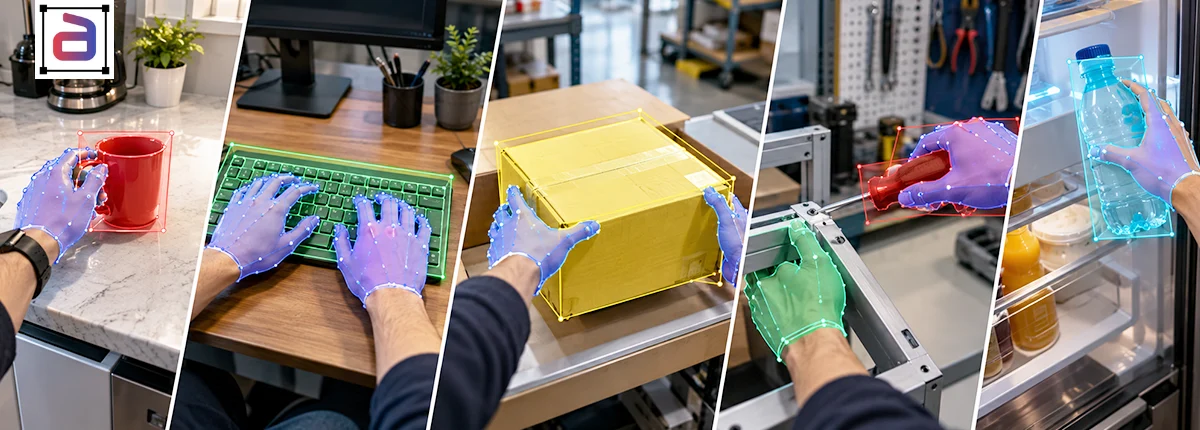
Egocentric video captures activities from the first-person perspective, typically using head-mounted cameras, wearable devices, or other forward-facing recording systems. Unlike conventional surveillance or third-person footage, these videos reveal what a person sees while performing a task. Hand-object interaction annotation identifies and labels the relationship between human hands and the objects they manipulate. It captures not only the presence of a hand or object but also the nature, timing, and progression of the interaction. For example, when a person picks up a screwdriver, an annotated dataset may identify the hand approaching the tool, the moment of contact, the grasp, the subsequent movement, and the eventual release. Key annotation elements include:
- Hand localization: Identifying visible hands using bounding boxes, keypoints, or segmentation masks.
- Object identification: Labeling relevant objects, including tools, containers, utensils, and machine components.
- Contact-state recognition: Distinguishing between reaching, touching, grasping, holding, and releasing.
- Action segmentation: Marking the temporal boundaries of activities such as lifting, rotating, opening, and placing.
- Hand-object relationships: Identifying which hand interacts with which object and how the interaction changes.
- Object tracking: Maintaining consistent object identities across consecutive frames, even when objects move or become partially occluded.
Together, these annotations convert unstructured visual observations into machine-readable information that can support robot learning.
Why Egocentric Video Is Valuable for Robot Learning
1. Learning Manipulation Through Human Demonstrations
Human demonstrations offer valuable insights into how objects are handled in real-world situations. A seemingly simple task, such as placing a glass on a shelf, involves several coordinated actions: locating the glass, reaching toward it, establishing a stable grip, lifting it, transporting it, and releasing it carefully. Annotated egocentric videos help AI models identify these action sequences and the visual cues associated with each stage. When combined with suitable robot demonstrations, action labels, and control signals, this information can support imitation learning and manipulation-policy development. Robots can learn from examples of human behavior rather than relying exclusively on manually programmed instructions. As robotic systems become more adaptable, such datasets can help bridge the gap between observing a task and learning how to execute it.
2. Understanding Object Affordances
An object’s affordances describe the actions it enables. A handle provides a gripping opportunity, a button can be pressed, and a container lid may be lifted or rotated. Hand-object interaction annotation helps models associate object characteristics with observed manipulation behaviors. For instance, repeated examples of people grasping handles from different angles can provide useful evidence for learning grasp-related visual patterns. This capability is particularly valuable when robots encounter unfamiliar objects or environments. Instead of depending solely on predefined object categories, models can use visual context and learned interaction patterns to identify plausible actions.
3. Improving Performance in Dynamic Environments
Real-world manipulation rarely happens under perfect conditions. Hands obscure objects, lighting changes, surfaces create reflections, and objects move unexpectedly. Egocentric datasets expose models to these challenges from the perspective of the person performing the task. Annotated examples can help distinguish actual contact from visual overlap and preserve interaction information across changing viewpoints. However, annotation alone cannot guarantee robust robot behavior. Its effectiveness depends on dataset diversity, label quality, model architecture, and validation under real operating conditions.
Essential Annotation Techniques for Hand-Object Interaction
Building a useful training dataset requires spatial labels, temporal information, and consistent relationships between interacting entities.
Frame-Level Hand and Object Annotation
Annotators identify hands and relevant objects in individual frames using bounding boxes, keypoints, or segmentation masks. Bounding boxes are useful for object localization, while keypoints can represent hand-joint positions. Segmentation masks provide more detailed boundaries when precise object shapes or hand-object overlap matter. The annotation method should reflect the intended learning objective rather than adding unnecessary labeling complexity.
Contact-State and Action Annotation
Physical interaction involves more than visual proximity. A hand near an object may be preparing to grasp it, attempting a failed grasp, or simply passing nearby. A well-defined annotation taxonomy distinguishes states such as approaching, touching, grasping, holding, manipulating, and releasing. These labels can help models learn meaningful interaction transitions. For example, recognizing the transition from grasping to lifting may provide a more useful training signal than labeling every frame simply as “hand near object.”
Temporal Action Segmentation
Many everyday tasks consist of multiple connected actions. Temporal annotation identifies when each action begins and ends, creating a structured timeline of the activity. Consider a person using a measuring cup to transfer ingredients. The sequence may involve reaching, grasping, lifting, pouring, returning the cup, and releasing it. Labeling these stages allows models to learn action order, duration, and transitions. It also supports the analysis of task completion and unsuccessful manipulation attempts.
Multi-Object Tracking
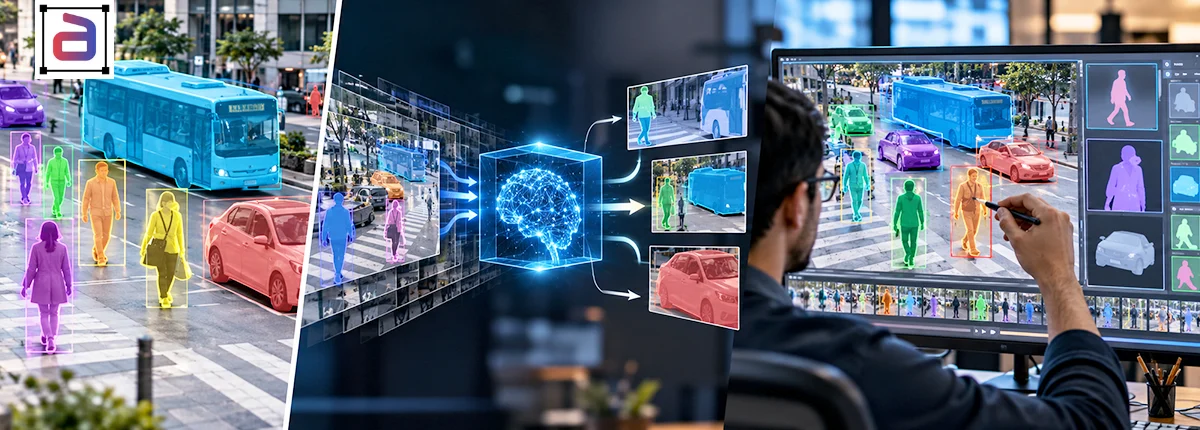
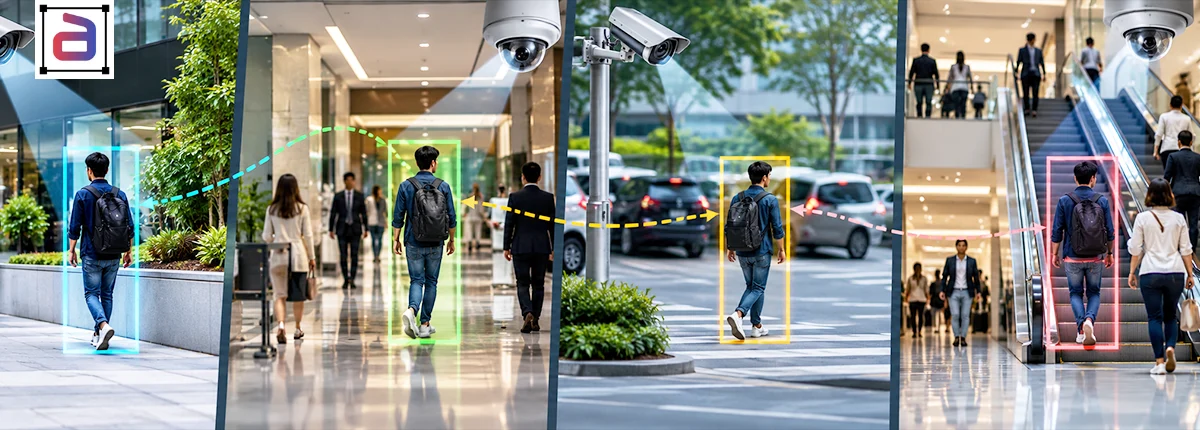
In complex scenes, several objects may appear simultaneously, move independently, or become temporarily hidden behind a hand. Multi-object tracking helps maintain consistent identities for visible objects across frames. For example, a robot learning from a video of a person transferring tools between workstations needs to distinguish the moving tool from other similar objects in the scene. Reliable tracking preserves object continuity throughout the interaction. When combined with hand-object relationship labels, it helps reconstruct which objects were manipulated, when they moved, and where they ended up.
Common Challenges in Egocentric Video Annotation
Despite its value, first-person footage presents several technical challenges that can affect dataset quality.
- Frequent occlusions: Hands often cover the objects they manipulate, making object boundaries and contact points difficult to identify.
- Motion blur and viewpoint changes: Rapid head movements can reduce visual clarity and complicate frame-to-frame annotation consistency.
- Ambiguous interaction states: Visual proximity does not always indicate contact, and brief interactions may be difficult to classify accurately.
- Complex object relationships: Both hands may interact with different objects or manipulate different parts of the same object, requiring precise relationship labels.
- Inconsistent action boundaries: Annotators may disagree about when an action begins or ends unless clear definitions are established.
To address these issues, robotics teams should establish standardized annotation guidelines, use representative pilot datasets, conduct expert reviews, and implement quality assurance checks. Difficult frames and ambiguous interactions should receive targeted review to improve consistency.
Best Practices for Building High-Quality Robot Learning Datasets
A reliable dataset requires a systematic approach to annotation design and validation.
- Develop a clear annotation taxonomy: Define object classes, hand states, contact events, and action categories before large-scale labeling begins.
- Maintain temporal consistency: Ensure that object identities and interaction labels remain consistent across video frames.
- Include diverse scenarios: Capture variations in lighting, object orientation, hand visibility, environments, and manipulation speeds.
- Implement multi-stage quality assurance: Combine automated validation, manual inspection, and expert review to identify labeling errors.
- Align annotations with learning objectives: Select bounding boxes, segmentation masks, keypoints, or temporal labels according to the intended model application.
- Evaluate difficult edge cases: Include failed grasps, interrupted actions, temporary occlusions, and incomplete interactions when relevant to the use case.
These practices help reduce annotation noise and make training datasets more useful for developing and evaluating robotic perception systems.
How Annotera Supports Video Annotation for Robot Learning
Developing advanced robotics systems requires more than collecting large volumes of video. AI teams need structured annotations that consistently represent objects, interactions, and actions across diverse real-world scenarios. Annotera supports AI development through video annotation workflows designed around project-specific labeling requirements, including object localization, temporal action labeling, and tracking-related tasks. For organizations evaluating video annotation outsourcing services, a specialized partner can help scale labeling operations, establish consistent annotation standards, and manage quality assurance as dataset requirements grow. Choosing an experienced video annotation company can also allow robotics teams to focus internal resources on model development, experimentation, and deployment while external annotation workflows support the preparation of training data. For hand-object interaction projects, the appropriate annotation strategy depends on the target application, dataset complexity, required label granularity, and evaluation criteria. Annotera works toward transforming raw visual recordings into structured datasets that support research and development across robotics, computer vision, and embodied AI. The goal is simple: make visual data more useful for teaching machines how humans interact with the physical world.
Conclusion
Hand-object interaction annotation in egocentric video is an important component of building robots that can learn from human demonstrations. By capturing hand movements, object identities, contact states, and temporal action sequences, annotation provides structured information that can support manipulation learning and robotic perception. Nevertheless, the value of a dataset depends on more than its size. Precise labels, consistent tracking, representative scenarios, and rigorous quality control determine how effectively annotated data can support model training and evaluation. As embodied AI continues to evolve, organizations that invest in well-structured training datasets will be better positioned to develop systems capable of understanding complex physical interactions. Ready to turn first-person video into actionable training data? Partner with Annotera to explore scalable video annotation solutions for hand-object interaction, multi-object tracking, and robot learning. Connect with our team to discuss your dataset requirements and build an annotation workflow aligned with your AI objectives.