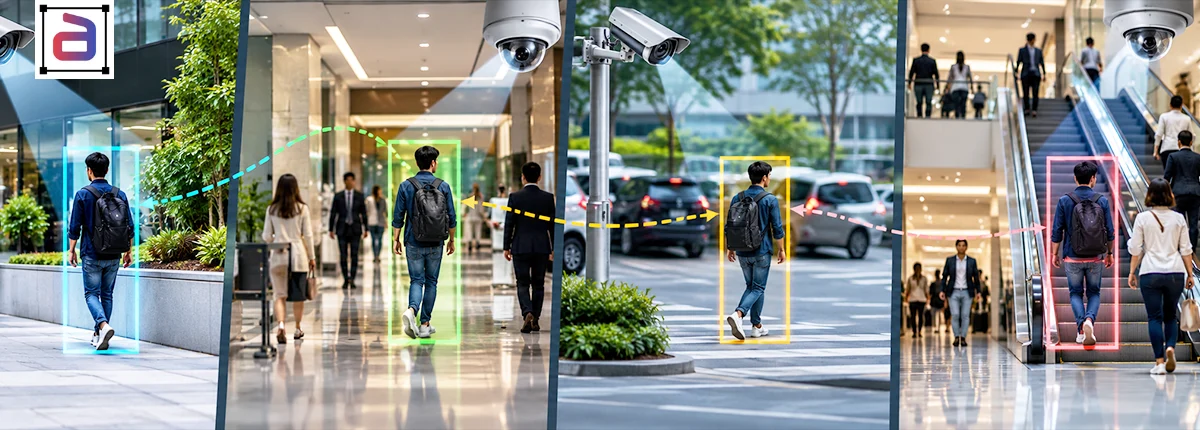
A person enters a shopping mall through the main entrance, walks past several corridors, and eventually reaches a checkout counter. Multiple cameras capture this journey, but each camera records a different perspective, lighting condition, and field of view. How can an AI system determine that these separate observations belong to the same individual? This is the challenge addressed by cross-camera re-identification (Re-ID), a critical capability in modern computer vision that enables AI models to associate the same person or vehicle across multiple camera streams.
From intelligent surveillance and retail analytics to traffic monitoring and smart infrastructure, reliable re-identification helps transform disconnected video feeds into meaningful visual intelligence. However, even sophisticated AI models depend on accurate, consistent training data. Incorrect identity labels, fragmented trajectories, and inconsistent object tracking can compromise model performance. This makes high-quality video annotation a foundational requirement for building dependable cross-camera Re-ID systems. At Annotera, we recognize that effective computer vision begins with well-structured data. Through systematic video annotation workflows and quality-focused labeling practices, Annotera helps AI teams develop datasets that support reliable identity association, multi-object tracking, and real-world visual recognition.
Key Points
- Cross-Camera Re-Identification: Enables AI models to recognize and associate the same person or vehicle across multiple camera streams despite changes in viewing angles, lighting, and visibility.
- Accurate Video Annotation: Consistent identity labels, bounding boxes, and global IDs are essential for building reliable re-identification datasets and reducing labeling errors.
- Multi-Object Tracking Integration: Combining multi-object tracking with cross-camera identity association helps maintain trajectory continuity and improve computer vision model development.
- Scalable Annotation with Annotera: Annotera provides structured video annotation solutions and quality assurance workflows to support accurate, scalable, and dependable AI training data.
What Is Cross-Camera Re-Identification?
Cross-camera re-identification is the process of determining whether an entity detected in one camera view corresponds to the same entity observed in another camera view. Unlike conventional object detection, which identifies objects within individual frames, Re-ID focuses on establishing identity consistency across different locations and video streams. For example, a vehicle captured at one intersection may appear minutes later on another road monitored by a different camera. A Re-ID model attempts to associate both observations with the same vehicle despite changes in viewing angle, illumination, distance, and image quality. The technology supports several important applications:
- Intelligent surveillance: Connecting observations across distributed camera networks.
- Retail analytics: Understanding customer movement between store entrances, aisles, and checkout areas.
- Traffic monitoring: Associating vehicle appearances across road networks.
- Smart cities: Analyzing movement patterns across connected public spaces.
- Transportation security: Supporting authorized monitoring and incident investigation.
The accuracy of these applications depends heavily on the quality of the annotated data used to train and evaluate the underlying models.
Why High-Quality Video Annotation Matters for Re-ID
Cross-camera re-identification requires AI models to distinguish genuine identity similarities from superficial visual differences. A person may appear different across cameras because of changes in posture, clothing visibility, camera elevation, shadows, or partial occlusion. Annotation teams must therefore establish consistent identity relationships without introducing incorrect associations. As a guiding principle for Re-ID dataset development:
“Reliable re-identification begins with consistent identity labels, not simply more labeled video.”
This is an original guiding statement, not a quotation attributed to an external researcher. Three annotation challenges are particularly important.
1. Maintaining Identity Consistency Across Cameras
Different cameras typically generate independent detection or tracking IDs. The same person might be labeled Person_012 in Camera A and Person_046 in Camera B. Annotators must determine whether both tracks represent the same individual and, when supported by sufficient evidence, associate them with a shared global identity ID. Incorrect matches create false-positive identity associations, while missed matches fragment a single identity into multiple records. Both can weaken model training and evaluation. Annotera’s structured annotation approach emphasizes clearly defined labeling rules, consistent identity references, and review procedures designed to minimize these inconsistencies.
2. Handling Occlusion and Visual Variations
Real-world video rarely provides perfect visibility. People may disappear behind vehicles, move through crowded spaces, or appear in low-resolution footage. Vehicles may be partially obscured, while changing weather and lighting can affect their appearance. Annotation guidelines should specify how to handle partial visibility, temporary disappearance, track termination, and uncertain identity matches. When the evidence is insufficient, annotators should flag the case for review rather than force an unreliable association. Including such challenging scenarios helps create datasets that better reflect actual deployment conditions.
3. Distinguishing Similar-Looking Objects
Two individuals may wear similar clothing, or multiple vehicles may share the same color and model. Visual similarity alone does not establish identity. A reliable annotation workflow considers the available visual evidence, temporal context, and approved camera-transition information. Clear decision rules and escalation procedures help reduce mistaken identity assignments, particularly in crowded environments.
The Role of Multi-Object Tracking in Cross-Camera Re-Identification
Multi-object tracking (MOT) identifies multiple objects and maintains their trajectories across consecutive video frames. It generally assigns a track ID to each detected object within a camera’s field of view. Although MOT and Re-ID complement one another, their objectives differ. Multi-object tracking maintains continuity within a video stream, whereas cross-camera Re-ID associates observations across separate camera views. A reliable annotation pipeline connects these tasks through five stages:
- Object detection: Identify relevant people, vehicles, or other objects in each frame.
- Bounding-box annotation: Mark object locations consistently across video sequences.
- Local tracking: Assign track IDs and preserve trajectory continuity within individual camera streams.
- Cross-camera identity association: Link local tracks to a common global identity when the evidence supports the match.
- Quality assurance: Review identity switches, duplicate assignments, fragmented trajectories, and uncertain associations.
This layered structure helps machine learning teams develop datasets for training and evaluating detection, tracking, and re-identification models.
Best Practices for Annotating Cross-Camera Re-ID Datasets
Creating reliable training data requires standardized annotation policies, skilled reviewers, and repeatable quality checks. Establish clear ID hierarchies. Maintain separate local track IDs and global identity IDs. This distinction helps prevent camera-specific tracking decisions from creating inconsistencies in cross-camera identity labels. Develop standardized annotation guidelines. Define how annotators should handle occlusion, missed detections, reappearing objects, uncertain matches, and overlapping trajectories. Consistent rules are essential when multiple teams work on the same dataset. Include diverse environmental conditions. Incorporate variations in lighting, camera angles, resolution, crowd density, weather, and object appearance.
Diverse examples help expose weaknesses that may remain hidden in controlled datasets. Implement multi-layer quality assurance. Combine automated checks with human review. Validation should identify conflicting global IDs, duplicated assignments, broken trajectories, and inconsistencies between camera streams. Document uncertain associations. Not every observation can be matched confidently. Establish an uncertainty policy that allows ambiguous cases to be flagged, reviewed, or excluded according to project requirements. Protect sensitive video data. Apply appropriate access controls, secure data handling, retention policies, and privacy safeguards throughout annotation and delivery. Together, these practices improve annotation consistency and create a stronger foundation for reliable Re-ID model development.
How Video Annotation Outsourcing Services Improve Re-ID Development
Cross-camera Re-ID projects can involve thousands of video hours, multiple camera configurations, complex identity relationships, and strict quality requirements. Managing these workloads internally can divert valuable engineering resources from model development and evaluation. Specialized video annotation outsourcing services can help AI organizations scale labeling operations while maintaining consistent annotation standards. A qualified provider can support object detection labels, trajectory annotation, identity association, quality control, and project-specific labeling requirements.
When selecting a video annotation company, organizations should evaluate its experience with multi-object tracking, cross-camera identity labeling, annotation quality assurance, data security, and large-scale video workflows. Equally important is collaboration between annotation specialists and machine learning engineers. Model evaluation can reveal recurring annotation errors, enabling teams to refine labeling guidelines and improve dataset quality over time. Annotera helps organizations approach video annotation as a structured data-quality process rather than a volume-driven labeling exercise. By emphasizing clear annotation protocols and systematic validation, Annotera supports AI teams working toward more consistent and dependable visual training datasets.
How Annotera Supports Cross-Camera Re-Identification Projects
Developing robust Re-ID systems requires a combination of accurate labels, consistent identity relationships, and annotation workflows aligned with specific model requirements. Annotera supports computer vision initiatives through structured video annotation services designed to help teams organize object-level labels, maintain track continuity, and establish reliable identity associations across video sequences. Our approach emphasizes:
- Consistent object and identity labeling across video frames.
- Annotation workflows aligned with multi-object tracking requirements.
- Quality checks to identify labeling conflicts and inconsistencies.
- Scalable annotation support for complex computer vision datasets.
- Collaboration that helps align annotation guidelines with project objectives.
Whether your team is developing intelligent surveillance, retail analytics, or transportation monitoring systems, Annotera can help you build a more dependable foundation for visual AI.
Conclusion
Cross-camera re-identification enables AI systems to connect observations across distributed video networks, but its success depends on more than model architecture alone. Accurate identity associations, consistent tracking labels, diverse training examples, and rigorous quality assurance are essential to building reliable Re-ID datasets. By integrating cross-camera identity annotation with multi-object tracking and structured validation, organizations can reduce avoidable labeling inconsistencies and improve the quality of their computer vision development process. Annotera helps turn complex video streams into structured, AI-ready training data.
Ready to Strengthen Your Computer Vision Pipeline?
Partner with Annotera to explore scalable video annotation outsourcing services tailored to your cross-camera re-identification, multi-object tracking, and computer vision requirements. Contact Annotera today to discuss your project and build a stronger foundation for your next-generation visual AI models.