AI can identify a person. It can recognize a chair, a cup, a vehicle, or a machine. But can it understand what the person is doing with that object? That is a much harder problem. A person reaching toward a cup, picking it up, drinking from it, and placing it back involves several connected actions. To humans, the sequence is obvious. For an AI model, however, understanding these relationships requires carefully structured visual data. This is where video annotation for Human-Object Interaction (HOI) becomes critical. By labeling people, objects, movements, interactions, action sequences, and temporal relationships across video frames, high-quality annotation helps AI systems progress from simply seeing a scene to understanding what is happening within it. As the researchers behind the HOI4D dataset explain, human-object interaction research requires rich visual information covering elements such as action segmentation, motion segmentation, hand pose, object pose, and scene understanding. For organizations developing computer vision, robotics, surveillance, retail intelligence, and embodied AI systems, this distinction can make the difference between a model that recognizes objects and one that understands activities.
Key Points
- AI Needs More Than Object Detection – Human-object interaction annotation helps AI understand who is interacting with what, what action is taking place, and how the interaction unfolds.
- Contextual Video Labels Improve AI Understanding – Temporal, spatial, action, and hand-object annotations enable AI models to interpret complex activities rather than isolated video frames.
- High-Quality Annotation Is Critical for Model Performance – Consistent labeling, clear taxonomies, trained annotators, and multi-stage quality assurance help reduce data noise and improve training reliability.
- Video Annotation Outsourcing Enables Scalable AI Development – Video annotation outsourcing services can help robotics, retail, surveillance, and other AI teams build large, accurate HOI datasets without scaling internal annotation operations.
What Is Human-Object Interaction in AI?
Human-Object Interaction refers to the relationship between a person and an object during an activity. Consider a warehouse worker interacting with a package. An AI system may first detect: Person + Package But that alone provides limited intelligence. Is the worker:
- Picking up the package?
- Opening it?
- Moving it?
- Inspecting it?
- Placing it on a shelf?
- Passing it to another person?
Each represents a different interaction. The goal of HOI annotation is to teach AI not just what is present in a video, but what those elements are doing in relation to one another. This requires combining spatial information with temporal and contextual information.
Why Video Annotation Is Essential for HOI Understanding
A photograph captures a moment. A video captures a process. That difference is fundamental. When an AI model analyzes video, it needs to understand how an interaction evolves from one frame to the next. A person’s hand may move toward an object, make contact, grasp it, and then move it somewhere else. Each stage provides information about the overall activity. Research datasets demonstrate just how detailed this information can become. HOI4D, for example, contains 2.4 million RGB-D frames across more than 4,000 sequences, with annotations covering action segmentation, motion segmentation, panoptic segmentation, 3D hand pose, and object pose. This highlights an important principle:
Better interaction understanding starts with better-structured training data.
For AI teams, video annotation therefore needs to capture much more than object presence.
Key Elements of Human-Object Interaction Annotation
1. Person and Object Detection
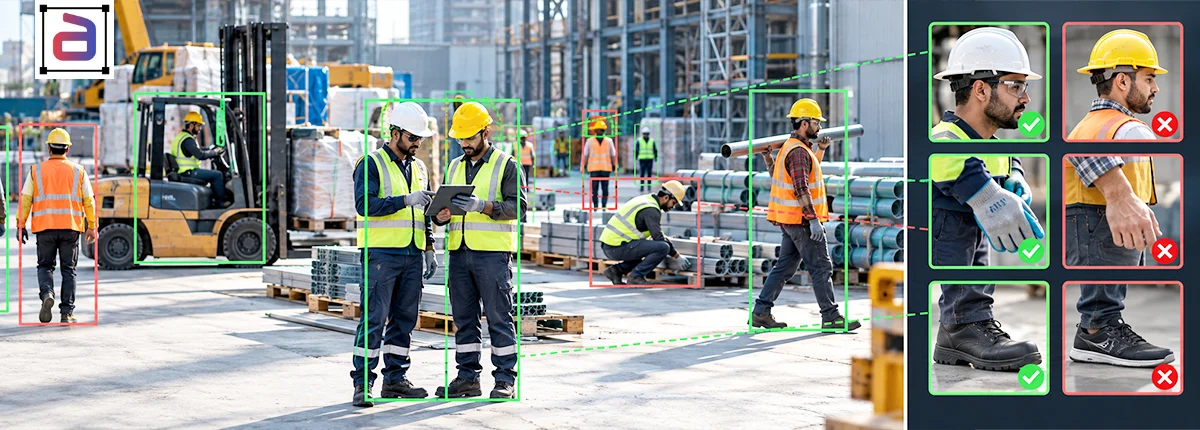
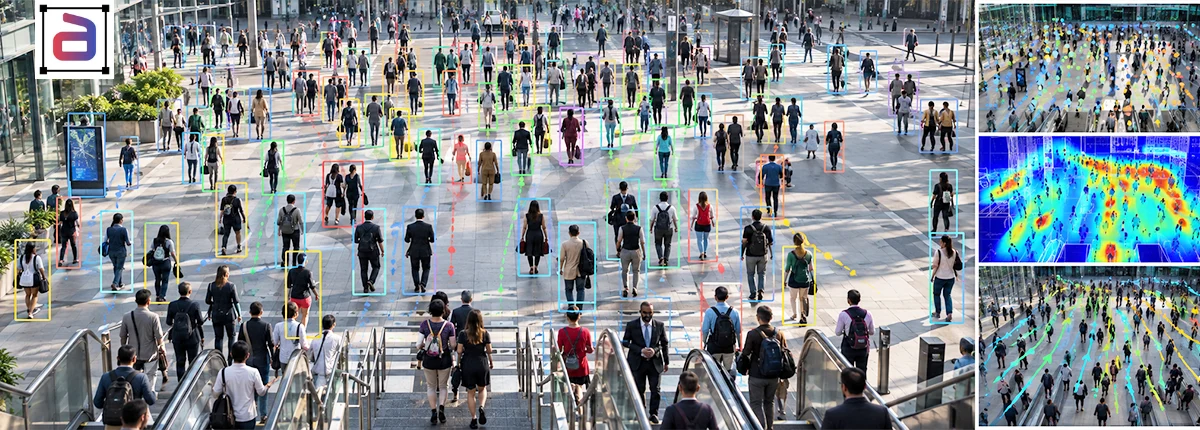
The first step is identifying the entities involved in an interaction. Annotators can use bounding boxes, polygons, or segmentation masks to identify people, hands, tools, products, vehicles, machines, and other relevant objects. Consistent object identification enables models to track entities throughout a video sequence.
2. Action Annotation
Once the entities are identified, annotators can describe what is happening. Common action labels include:
- Holding
- Picking
- Carrying
- Opening
- Closing
- Pushing
- Pulling
- Operating
- Placing
- Moving
The annotation taxonomy should reflect the specific requirements of the AI application. For example, a robotics dataset may require extremely fine-grained manipulation labels, while a retail analytics system may focus more heavily on product pickup, shelf interaction, and customer movement.
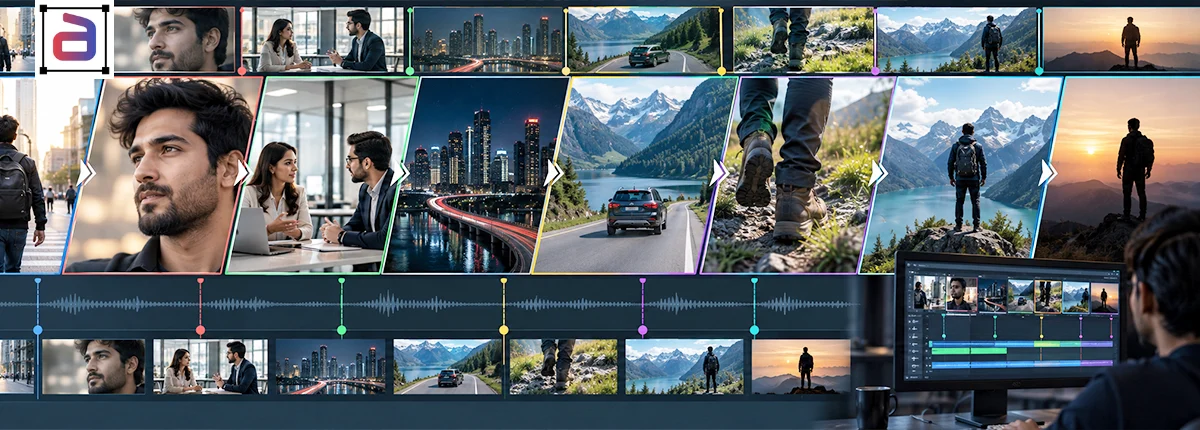
3. Temporal Annotation
An interaction does not happen in a single instant. Annotators can identify the start and end points of an activity, allowing models to learn the temporal structure of events. A simple interaction could therefore be represented as: Reach → Contact → Grasp → Lift → Move → Place → Release This transforms raw video into a structured representation of an activity. The HOI4D research specifically identifies action segmentation as a core task and provides per-frame action information for studying fine-grained interactions.
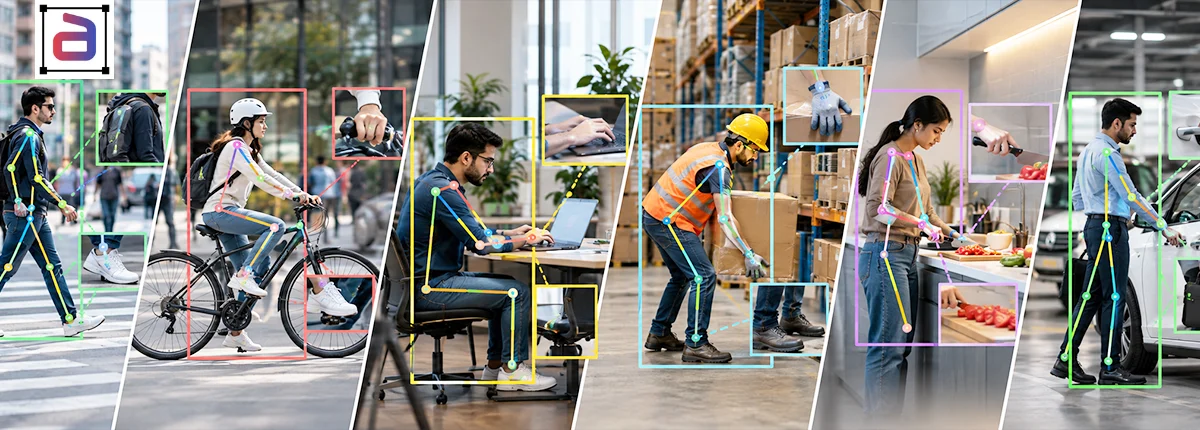
4. Hand-Object Interaction
Hands often provide the strongest visual evidence of an interaction. A model may need to distinguish between a hand:
- Approaching an object
- Touching an object
- Holding an object
- Manipulating an object
- Releasing an object
Fine-grained hand and object annotation can therefore be particularly valuable for robotics, AR/VR, human activity recognition, and embodied AI.
5. Spatial Relationships
The position of objects relative to people also matters. Annotations can capture relationships such as:
- Person → holding → tool
- Person → opening → door
- Person → carrying → box
- Person → operating → machine
These relationships help models learn the difference between objects that are merely visible and objects that are actively involved in an event.
Teaching AI to Understand Context
Context is what gives an action its meaning. Imagine a video showing someone standing beside a laptop. Simply detecting person + laptop tells an AI very little. Now consider a sequence where the person sits down, opens the laptop, places their hands on the keyboard, types, and closes the device. The sequence provides contextual meaning. This is why effective HOI datasets should capture actions, objects, participants, temporal sequences, and surrounding scene information together. The V-HICO dataset, for instance, was developed specifically for human-object interaction in videos and contains action-object pairings designed to evaluate interaction recognition and generalization.
Where HOI Video Annotation Is Making an Impact
Robotics and Embodied AI
Robots operating alongside humans need to understand how people interact with objects. Annotated demonstrations can help models learn activities such as grasping, lifting, placing, opening, and manipulating objects. For embodied AI, this information can contribute to models that connect visual perception with action and decision-making.
Retail Intelligence
Retail systems can analyze customer-product interactions, including product pickup, inspection, movement, and placement. Such datasets can support applications involving shopper behavior analysis and intelligent store environments.
Workplace Safety
Industrial environments contain complex interactions between workers, tools, machinery, and safety zones. HOI annotation can help train models to identify activities that require attention, such as unsafe proximity or improper equipment handling.
Smart Surveillance
Instead of detecting only who or what appears in a scene, AI can be trained to identify meaningful activities and interactions. This can make video intelligence more context-aware.
Healthcare and Assisted Living
Human-object interaction datasets can also support activity recognition involving everyday actions, medical equipment, mobility aids, and household objects.
The Challenge: Annotation Quality at Scale
Creating an HOI dataset is not simply a matter of drawing boxes around objects. Complex interactions introduce challenges such as:
- Occlusion
- Motion blur
- Multiple interacting people
- Overlapping objects
- Ambiguous actions
- Rapid movements
- Long activity sequences
- Similar-looking actions
- Inconsistent temporal boundaries
Poorly defined labels can introduce noise into training data. Inconsistent annotations can make it difficult for a model to learn reliable relationships. That is why organizations need a combination of clear annotation guidelines, trained annotators, multi-stage quality assurance, temporal consistency checks, and domain-specific taxonomies.
How Video Annotation Outsourcing Helps AI Teams Scale
Developing a large HOI dataset internally can consume significant time and resources. This is where video annotation outsourcing services can provide a strategic advantage. An experienced annotation partner can support large-scale workflows involving:
- Bounding box annotation
- Polygon and semantic segmentation
- Object tracking
- Action recognition
- Temporal action segmentation
- Human-object relationship labeling
- Hand-object interaction annotation
- Keypoint annotation
- Video classification
- Quality assurance
With video annotation outsourcing, AI companies can expand annotation capacity without building an equally large internal labeling operation. More importantly, the right partner can align annotation workflows with project-specific ontologies, quality thresholds, and model objectives.
Why Choose Annotera for Video Annotation?
At Annotera, we understand that AI models are only as reliable as the data used to train them. Our video annotation workflows are designed to help organizations transform complex video content into structured, model-ready training datasets. From object detection and tracking to action recognition and human-object interaction, Annotera supports annotation requirements across demanding computer vision applications. Our approach emphasizes scalability, consistency, domain-specific annotation guidelines, and quality control—because successful AI development requires more than large datasets. It requires dependable data.
“The quality of the data is often the limiting factor in the quality of the model.”
For HOI applications, that principle is especially relevant. If an AI system must understand actions and relationships, the training data must represent those relationships accurately.
Conclusion
The next generation of computer vision will need to do more than recognize objects. It will need to understand actions, relationships, sequences, and context. Human-object interaction is at the center of that transition. High-quality video annotation gives AI systems the structured visual information required to understand who is interacting with what, how the interaction unfolds, and what the activity means within its surrounding context. Whether you are developing robotics systems, intelligent surveillance, retail analytics, workplace safety solutions, or embodied AI, the quality of your HOI training data matters. Annotera helps turn complex video into structured intelligence. Ready to build a high-quality dataset for your next computer vision project? Talk to Annotera today to explore scalable video annotation outsourcing services tailored to your AI training requirements.
A closely related read: Scene Parsing: How Semantic Segmentation Trains AI.