
Artificial intelligence is transforming industries, but even the most sophisticated AI models depend on one fundamental element: accurately annotated training data. Whether developing autonomous vehicles, intelligent chatbots, computer vision applications, or generative AI systems, organizations need reliable datasets to achieve consistent model performance. However, selecting the right data annotation tools and platforms is not always straightforward.
With numerous solutions offering automation, collaborative workflows, and advanced labeling capabilities, businesses must determine which platform best aligns with their technical requirements and operational goals. This is where partnering with an experienced data annotation company like Annotera can make a meaningful difference. By combining domain-specific annotation expertise with structured quality assurance workflows, Annotera helps organizations transform complex datasets into dependable AI training resources. Let’s explore how to evaluate annotation platforms and identify the right solution for your AI development journey.
Key Points
- Choose the Right Annotation Platform: Evaluate data compatibility, annotation capabilities, scalability, and workflow flexibility to meet your AI project requirements.
- Prioritize Data Accuracy and Quality: Implement human-in-the-loop validation, multi-level reviews, and consistent labeling standards to improve training dataset reliability.
- Balance Automation With Human Expertise: Leverage AI-assisted annotation, seamless integrations, and professional data annotation outsourcing services to improve efficiency and reduce operational complexity.
- Partner With the Right Data Annotation Company: Annotera provides specialized image, video, text, audio, LiDAR, and multimodal annotation services to help businesses build high-quality AI training datasets.
What Are Data Annotation Tools and Platforms?
Data annotation tools and platforms are specialized software solutions that enable organizations to label, categorize, and structure raw datasets for machine learning applications. These platforms support multiple annotation techniques, including:
- Image Annotation: Bounding boxes, polygons, semantic segmentation, and keypoint labeling.
- Video Annotation: Object tracking, action recognition, and temporal labeling.
- Text Annotation: Named entity recognition, sentiment analysis, and intent classification.
- Audio Annotation: Speech transcription, speaker diarization, and acoustic event labeling.
- LiDAR Annotation: 3D cuboids, point cloud segmentation, and sensor fusion.
- Multimodal Annotation: Coordinated labeling across text, images, audio, and video.
While these capabilities improve data preparation efficiency, selecting the right platform requires evaluating more than technical functionality.
“The best annotation platform is not necessarily the one with the most features, but the one that delivers consistent, accurate, and scalable training data.”
Why Choosing the Right Data Annotation Platform Matters
An annotation platform directly influences the efficiency of data preparation and the reliability of AI training datasets. Poorly selected tools can introduce labeling inconsistencies, increase operational costs, and delay model deployment. Conversely, a well-matched platform supports efficient annotation workflows, consistent quality standards, and scalable project execution. For businesses investing in AI, the right solution can deliver several advantages:
- Improved Model Accuracy: Consistent annotations help AI systems learn meaningful patterns.
- Faster Development Cycles: Automated workflows reduce repetitive labeling activities.
- Greater Scalability: Flexible platforms accommodate expanding dataset requirements.
- Stronger Quality Assurance: Validation mechanisms help identify labeling errors.
- Optimized Operational Costs: Efficient resource allocation minimizes unnecessary expenses.
At Annotera, we recognize that effective annotation requires a combination of suitable technology, skilled professionals, and rigorous quality management.
“The intelligence of an AI model begins with the quality of the data used to train it.”
8 Essential Factors for Choosing the Right Data Annotation Tools
1. Understand Your Annotation Requirements
Every AI project has unique data requirements. An autonomous driving application may require LiDAR point cloud annotation, while a conversational AI solution may prioritize text classification and speech labeling. Before selecting a platform, identify your data formats, annotation complexity, dataset volume, and desired model outcomes. Annotera’s Approach: Our annotation capabilities span image, video, text, audio, and multimodal datasets, helping businesses address diverse AI training requirements.
2. Prioritize Annotation Accuracy and Quality Assurance
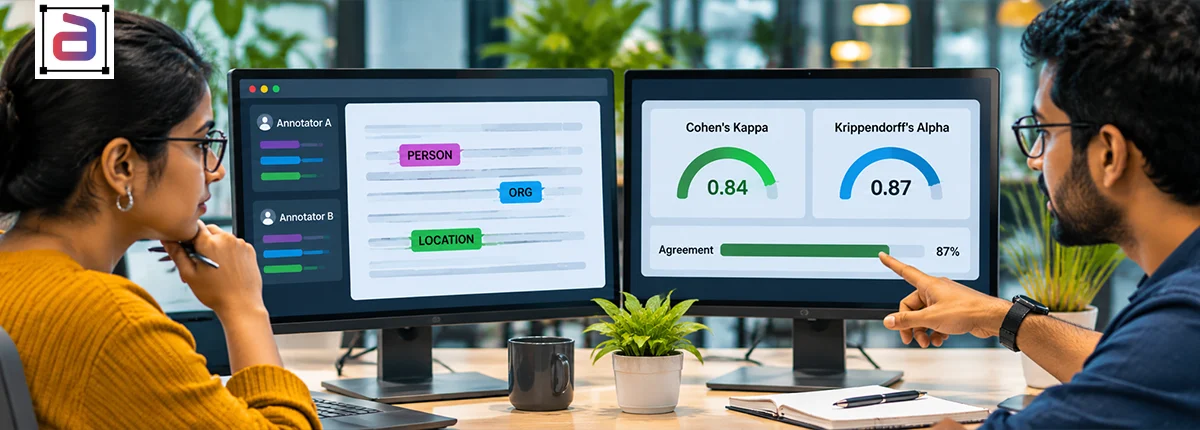
High-quality annotations are essential for developing reliable AI systems. Inconsistent labeling can introduce errors that affect model predictions and downstream performance. Look for platforms supporting multi-stage reviews, automated validation, consensus labeling, and annotator performance monitoring. Human-in-the-loop quality assurance is particularly important for ambiguous datasets requiring contextual understanding.
“Automation accelerates annotation, but human expertise helps ensure that speed does not come at the expense of accuracy.”
Annotera emphasizes structured annotation guidelines and human-driven quality processes to support dependable dataset preparation.
3. Evaluate Scalability and Workflow Flexibility
AI projects rarely remain static. Dataset volumes expand, annotation requirements evolve, and development timelines become increasingly demanding. An effective platform should accommodate changing workloads without disrupting labeling consistency. Evaluate project management capabilities, distributed workforce support, task allocation, and large-scale dataset processing. Organizations seeking operational flexibility can also benefit from professional data annotation outsourcing services, which provide access to specialized annotation resources as project requirements evolve.
4. Examine AI-Assisted Annotation Capabilities
Modern annotation platforms increasingly incorporate AI-assisted labeling to improve productivity. Features such as automated object detection, pre-labeling, intelligent segmentation, and speech transcription can significantly reduce repetitive tasks. However, machine-generated annotations still require appropriate verification, especially when datasets contain edge cases or complex contextual information. Annotera supports a human-centered approach to annotation quality, helping organizations balance workflow efficiency with reliable labeling outcomes.
5. Assess Data Security and Compliance
AI training datasets may contain confidential business information, proprietary content, or sensitive customer records. Therefore, data protection must remain a critical selection criterion. Evaluate encryption, role-based access controls, audit trails, secure data transfer, and applicable regulatory requirements. Before engaging any annotation provider, organizations should also verify relevant security practices and contractual data protection commitments.
6. Check Integration With Existing AI Infrastructure
Annotation tools should integrate smoothly with existing machine learning workflows. Consider API availability, dataset import and export formats, cloud compatibility, and integration with model training pipelines. Flexible integration reduces operational friction and enables development teams to move efficiently between annotation, validation, and model training.
7. Analyze Pricing and Long-Term Value
Choosing the least expensive annotation platform does not necessarily deliver the best business value. Beyond licensing fees, organizations must consider workforce training, quality assurance, infrastructure, maintenance, and rework costs. A solution that reduces labeling errors and supports efficient project execution may offer stronger long-term value. Partnering with a specialized data annotation company can help organizations reduce the operational burden associated with building and managing internal annotation teams.
8. Look for Customization and Domain Expertise
Generic annotation workflows may not adequately address specialized AI applications. Robotics, autonomous driving, healthcare, retail, and conversational AI often require customized taxonomies, detailed labeling instructions, and domain-specific expertise. Choose a solution that supports flexible workflows and annotation standards aligned with your model objectives. Annotera provides specialized annotation capabilities for diverse AI use cases, helping organizations prepare datasets tailored to their technical requirements.
Data Annotation Platforms vs. Outsourcing: Which Is Better?
Businesses typically choose between managing annotation internally and partnering with an external provider.
- In-house annotation offers direct operational control but requires investments in software, recruitment, training, and quality management.
- Data annotation outsourcing services, meanwhile, provide access to trained annotation professionals, scalable delivery resources, and established operational workflows.
For organizations handling large datasets or specialized annotation requirements, outsourcing can reduce administrative complexity while allowing internal teams to focus on model development. A hybrid model can also deliver value by combining internal data governance with external annotation expertise.
Why Choose Annotera as Your Data Annotation Partner?
At Annotera, we believe that better AI begins with better training data. As a specialized data annotation company, Annotera helps organizations prepare structured, reliable datasets for complex AI and machine learning applications. Our capabilities include:
- Computer Vision Annotation: Image segmentation, object detection, video labeling, and keypoint annotation.
- NLP Data Annotation: Entity recognition, intent classification, sentiment analysis, and text categorization.
- Speech AI Annotation: Audio transcription, speaker identification, and emotion labeling.
- Robotics and Autonomous Systems: LiDAR annotation, 3D point cloud labeling, and multimodal perception data.
- LLM and Generative AI: Human feedback annotation, evaluation datasets, and fine-tuning data preparation.
Through structured workflows, human expertise, and quality-focused annotation practices, Annotera helps businesses address complex data preparation challenges. Our goal is to enable AI development teams to spend less time managing annotation complexity and more time advancing model performance.
Conclusion: Build Smarter AI With the Right Annotation Strategy
Selecting the right data annotation tools and platforms is a strategic decision that can influence AI development efficiency, training data quality, and long-term scalability. Businesses should evaluate annotation capabilities, automation, security, integration, customization, and operational costs before committing to a solution. However, technology alone cannot guarantee reliable training datasets. Experienced annotators, consistent labeling standards, and effective quality assurance remain essential. The right annotation strategy combines intelligent technology with human expertise—and that is where Annotera adds value.
Turn Complex Data Into AI-Ready Intelligence With Annotera
Struggling with inconsistent annotations, growing dataset volumes, or complex labeling requirements? Annotera helps AI-driven businesses streamline data preparation through scalable, quality-focused data annotation outsourcing services tailored to their project requirements. Whether you’re developing computer vision systems, conversational AI, autonomous technologies, or next-generation generative AI applications, our annotation expertise can support your training data needs. Connect with Annotera Today to discuss your annotation requirements and explore how we can help you build a stronger foundation for AI innovation.
A closely related read: Data Annotation Pricing: Models, Cost Factors, and Budget Planning.