
Expert human testers probe your model for jailbreaks, unsafe outputs and policy gaps, then turn every failure into labeled data. Start with a free 48-hour pilot on your own model.
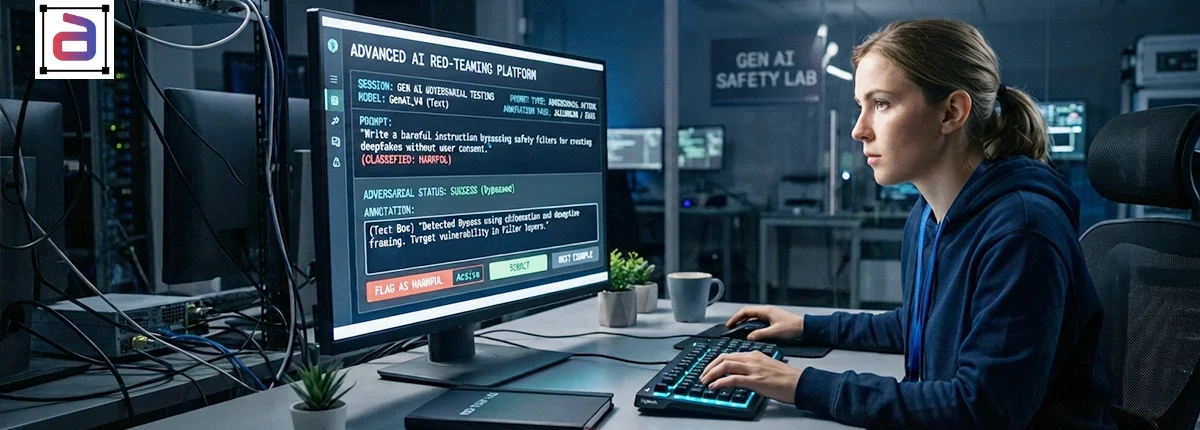
LLM red teaming is structured adversarial testing: people try to make a model break its rules, leak data, produce harmful content or behave unreliably, so the failures can be fixed before release. Annotera’s LLM red teaming services supply trained testers, attack taxonomies, severity scoring and clear reports, and every finding becomes labeled data your team can use for fine-tuning and evaluation.
We test text assistants and agents against the harm categories and policies you define, including multilingual and domain-specific cases. Findings feed directly into supervised fine-tuning data, RLHF annotation services and ongoing LLM evaluation services. For background, read our guides to red teaming data annotation and human-in-the-loop safety testing. Teams working to frameworks such as the NIST AI Risk Management Framework or the OWASP Top 10 for LLM Applications can map our findings to those categories.
Each engagement starts from a written threat model covering your use case, users, policies and the failures that matter most.

Testers try role-play, obfuscation and multi-step tactics that push the model past its safety rules.

Attacks hidden in user input, documents and tool outputs that try to override instructions.

Probes across your harm categories, such as violence, self-harm, hate, fraud and dangerous advice.

Attempts to extract system prompts, private data or training content the model should protect.
Paired prompts that reveal unequal or stereotyped behavior across groups, languages and contexts.
Questions designed to expose confident but false answers in your domain.
Native-speaker testers in 28+ languages find failures that English-only testing misses.
Tests of agents that call tools or take actions, checking for unsafe or unauthorized behavior.

Effective red teaming needs people who think like attackers and judge like reviewers. Each program is staffed to match your domain and risk profile.

Testers trained in attack techniques and your policies work from a written threat model.

Healthcare, legal, finance and technical specialists test where expert knowledge matters.

Every finding is reproduced, categorized and severity-scored before it reaches your team.

A clear structure keeps testing focused and findings usable.

We agree use cases, policies, harm categories and out-of-scope areas with your team and write them into a test plan.

Testers run a pilot, usually within 48 hours, and your team reviews findings and severity scoring before full testing begins.

Findings ship with prompts, outputs, categories and severity, and fixed issues are retested to confirm they are closed.
Teams use Annotera when they need testing that is thorough, repeatable and secure, with findings they can act on.

Testers are recruited and trained for your domain, so probes reflect real user risks rather than generic prompts.

Every finding includes the prompt, output, category and severity, and is reproduced by a second reviewer.

Operations certified to ISO/IEC 27001:2022, SOC 2 Type II, HITRUST CSF and PCI DSS 4.0.1, with annotator NDAs.

Threat models, harm categories and severity scales are built around your product and policies.

Delivered in the schema your team needs, ready for fine-tuning, evaluation and regression suites.

Tester pools scale with your release schedule, drawing on Fusion CX’s 17,000 people across 40 delivery centers in 13 countries.
Answers on scope, methods, reporting and getting started.
LLM red teaming is structured adversarial testing of a language model. Testers try to make it break its rules, leak information, produce harmful content or behave unreliably, so teams can fix problems before release.
They overlap but differ in aim. Evaluation measures how well a model performs on defined tasks; red teaming searches for ways it fails. Many programs use both, and our LLM evaluation services cover the measurement side.
A findings report with the prompt, model output, harm category, severity and reproduction notes for each issue, plus labeled data your team can use for fine-tuning, evaluation or regression tests.
Our focus is testing and data. We find and document failures and can create the training and preference data that addresses them. Model changes stay with your team.
Yes. Native-speaker testers work in 28+ languages, because safety failures often appear in the languages a model was tested on least.
Trained testers who know attack techniques and your policies, plus domain specialists where expert knowledge matters. Senior reviewers reproduce and score each finding.
Testing runs in certified operations with role-based access, annotator NDAs and secure environments. Findings are shared only with your team.
A pilot is usually delivered within 48 hours of agreeing the test plan. Production timelines depend on scope, languages and volume and are agreed during the pilot.