
Generative AI is moving from experimental technology to an integral part of customer service, software development, research, content creation, and enterprise decision-making. But as models become more capable, simply measuring how well they perform on standard datasets is no longer enough. A model may produce impressive answers under normal conditions and still behave unpredictably when confronted with ambiguous instructions, adversarial prompts, manipulative context, or deliberately challenging inputs. This is why red-teaming data annotation is becoming an important component of modern AI development. Red teaming deliberately challenges an AI system to expose weaknesses before those weaknesses become costly or harmful in real-world applications.
When these interactions are systematically captured, classified, and reviewed, they become valuable datasets for safety evaluation, model refinement, and alignment. As the National Institute of Standards and Technology (NIST) states, trustworthy AI should be “valid and reliable, safe, secure and resilient, accountable and transparent, explainable and interpretable, privacy-enhanced, and fair.” For generative AI developers, achieving these characteristics requires more than model training. It requires continuously testing how models behave when conditions become difficult.
Key Points
- Red-teaming data annotation identifies AI vulnerabilities by creating and labeling adversarial prompts that expose unsafe, biased, misleading, or inconsistent model behavior.
- High-quality adversarial datasets improve AI safety by capturing diverse edge cases, evaluating response quality, and turning model failures into structured, actionable data.
- Human expertise strengthens LLM evaluation through detailed annotation guidelines, quality checks, expert review, and contextual assessment of complex model responses.
- Annotera supports safer generative AI development with LLM & GenAI annotation services, including safety evaluation, adversarial data annotation, preference labeling, and RLHF & fine-tuning data preparation.
What Is Red-Teaming Data Annotation?
Red-teaming data annotation combines adversarial testing with structured human labeling. Instead of asking only whether a model generates a correct response, red-team datasets examine questions such as:
- Does the model follow unsafe instructions?
- Does it reveal sensitive information?
- Does it produce biased or discriminatory content?
- Does it hallucinate when challenged?
- Does it respond consistently to similar requests?
- Can contextual manipulation change its safety behavior?
- Does it appropriately refuse requests that violate defined policies?
- Can seemingly harmless prompts be combined to produce an undesirable outcome?
Annotators transform these interactions into structured records by labeling the prompt, response, risk category, severity, policy relevance, and other evaluation attributes. The result is more than a collection of difficult prompts. It is a structured dataset that helps AI teams understand where models fail, how they fail, and under what conditions those failures occur.
Why Adversarial Examples Matter for Generative AI
Traditional benchmarks generally evaluate models against expected inputs. Red teaming takes the opposite approach: it intentionally looks for unexpected behavior. This distinction matters because generative AI systems operate in highly variable environments. Users can phrase the same request in different ways, combine instructions, introduce misleading context, switch languages, or engage in lengthy conversations that gradually change the conditions surrounding a request. An adversarial dataset can therefore include:
- Paraphrased and indirect prompts
- Ambiguous or conflicting instructions
- Multi-turn conversations
- Multilingual and code-switched inputs
- Context manipulation
- Safety-boundary tests
- Bias and fairness scenarios
- Privacy-related scenarios
- Hallucination and factuality challenges
- Instruction-following edge cases
The goal is not to create harmful content for its own sake. The goal is to identify vulnerabilities in a controlled evaluation environment so they can be addressed before deployment. NIST’s AI Risk Management Framework emphasizes that AI risk management should span the AI lifecycle rather than being treated as a one-time activity.
From Red-Team Prompt to High-Value Dataset
Creating adversarial examples is only the beginning. Their real value emerges when they are consistently annotated and converted into usable training and evaluation signals. A robust workflow typically includes five stages.
1. Define the Risk Taxonomy
AI teams first determine what they want to test. Categories might include harmful content, privacy, misinformation, bias, security, instruction following, or application-specific risks. A precise taxonomy gives annotators a common framework for evaluating responses.
2. Create Diverse Adversarial Examples
Red-teamers develop prompts that probe different weaknesses. Diversity is essential because repeatedly testing the same attack pattern can create a narrow dataset that does not adequately represent real-world variation.
3. Annotate Model Responses
Annotators assess the resulting outputs against predefined criteria. Depending on the project, labels may include:
- Risk category
- Severity level
- Policy violation type
- Response appropriateness
- Refusal quality
- Factuality
- Bias indicators
- Safety outcome
- Confidence level
4. Perform Quality Assurance
Adversarial examples can be inherently subjective. Two annotators may interpret the same response differently without clear guidelines. That is why high-quality red-team annotation requires calibration exercises, overlapping annotation, expert review, adjudication, and ongoing guideline refinement.
5. Feed Insights Back Into Development
Validated examples can become part of evaluation benchmarks or, where appropriate, RLHF & fine-tuning data. This creates a feedback loop: Adversarial Testing → Annotation → Analysis → Model Improvement → Retesting The cycle can continue as new failure modes emerge.
How Red-Teaming Supports RLHF and Fine-Tuning
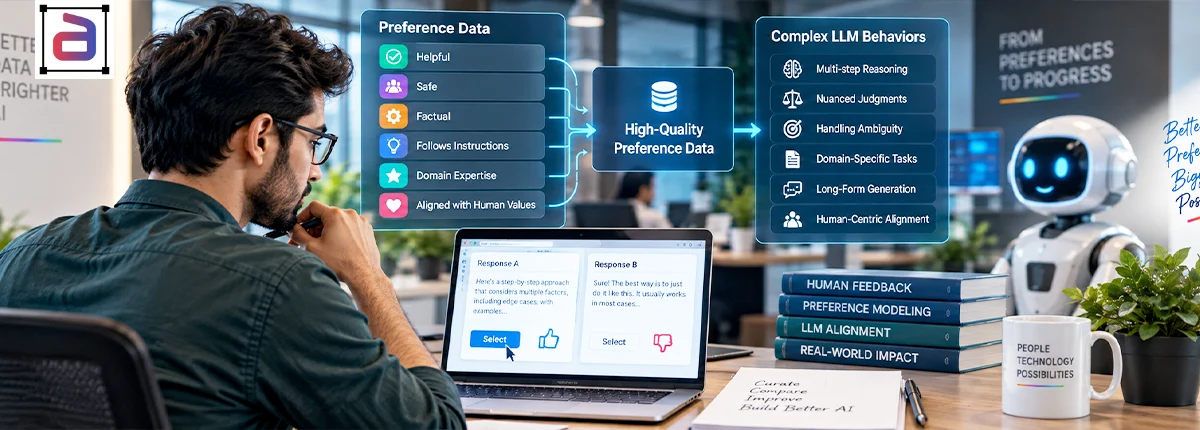
Red-team datasets can provide valuable signals for alignment and model improvement. For example, an AI team may identify two responses to a difficult prompt: one that appropriately handles the request and another that violates the desired safety criteria. Human annotators can compare these responses and provide preference labels or other structured feedback. This information can contribute to RLHF & fine-tuning data, depending on the model-development methodology. However, adversarial examples should not automatically be placed into a training dataset. Each example should be reviewed for relevance, quality, duplication, policy alignment, and potential unintended effects. The objective is not simply to create more data. It is to create better data that communicates the desired model behavior clearly.
The Importance of Human Judgment
Automated testing can dramatically increase the volume and speed of red-team evaluation. Yet human judgment remains critical for nuanced cases. A model response may technically refuse a request while still providing information that undermines the refusal. Another response may contain no obvious policy violation but could still be misleading, biased, or inappropriate for a particular context. Human annotators can evaluate these subtleties using detailed project-specific guidelines. NIST similarly notes that “human judgment should be employed” when determining metrics and thresholds associated with AI trustworthiness. For AI developers, this reinforces an important principle: safety evaluation is not merely a technical classification problem; it is also a context and judgment problem.
Building Better Red-Team Datasets With Annotera
Developing a high-quality adversarial dataset internally can require substantial expertise, time, and operational resources. Teams need people who can understand complex prompts, follow detailed safety taxonomies, evaluate model outputs consistently, and identify subtle failure patterns. This is where Annotera can support the AI development lifecycle. Our LLM & GenAI annotation services can help organizations build structured datasets for model evaluation, safety testing, preference modeling, and generative AI improvement. Annotera’s workflows can support:
- Adversarial prompt annotation
- LLM response evaluation
- Safety and policy classification
- Risk and severity labeling
- Preference annotation
- Bias and toxicity assessment
- Factuality and hallucination evaluation
- Multilingual evaluation
- RLHF dataset preparation
- Fine-tuning dataset curation
- Human-in-the-loop quality assurance
Our approach emphasizes clearly defined annotation guidelines, trained annotators, multi-level quality checks, and consistent labeling standards. The objective is straightforward: turn difficult AI interactions into structured, actionable data.
Red Teaming Should Be Continuous
Generative AI systems do not operate in a static environment. Models change. Applications change. User behavior changes. New attack patterns emerge. Consequently, red teaming should not be treated as a final pre-launch checkbox. It should become part of an ongoing evaluation cycle. NIST describes AI risk management as something that should be performed “throughout the AI system lifecycle.” For AI teams, this means continually expanding adversarial datasets, monitoring emerging failure modes, updating taxonomies, reviewing annotation quality, and retesting models after significant changes. A strong red-team program therefore creates institutional memory: every validated failure can become an opportunity to improve future testing.
Turning Adversarial Data Into Safer AI
The future of generative AI depends not only on making models more capable, but also on making them more predictable, resilient, and responsible under challenging conditions. Red-teaming data annotation provides a practical bridge between AI safety testing and data-driven model improvement. By systematically creating adversarial examples, annotating model behavior, and converting findings into high-quality evaluation and training signals, organizations can gain a deeper understanding of their models’ limitations. At Annotera, we help AI teams transform complex generative AI interactions into structured, reliable datasets. Our LLM & GenAI annotation services support the creation of high-quality safety, evaluation, preference, and RLHF & fine-tuning data designed around specific model-development objectives.
Build Stronger AI With Better Data
Don’t wait for real-world users to discover your model’s edge cases. Partner with Annotera to build high-quality red-teaming and AI evaluation datasets that help your models perform more reliably when it matters most. Contact Annotera today to discuss your generative AI data annotation requirements.
A closely related read: Human-in-the-Loop Safety Testing for Generative AI: Beyond Traditional Red Teaming.