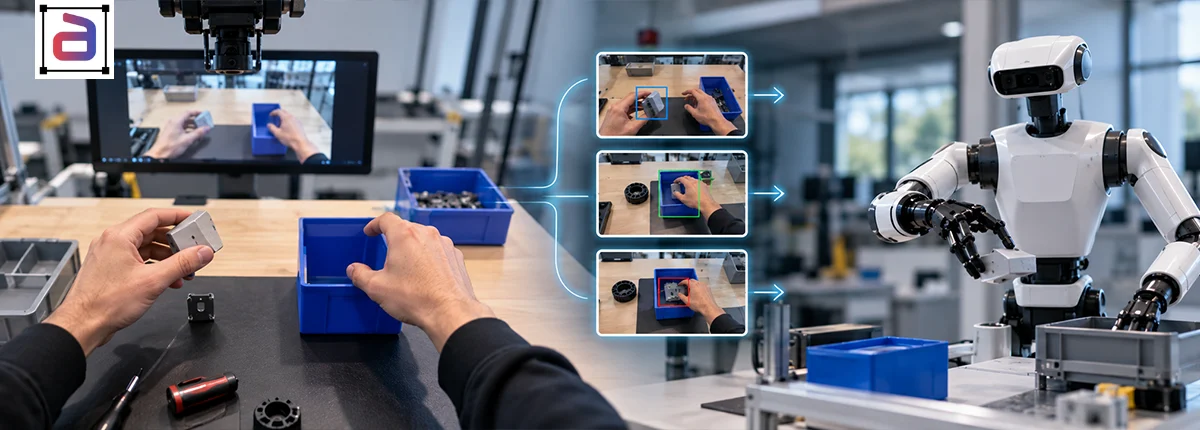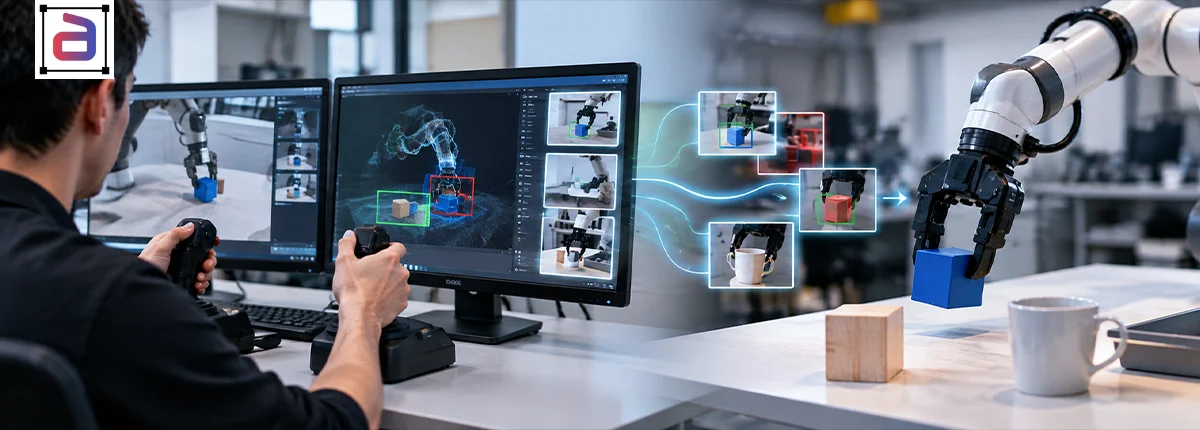






Human evaluators compare and rank robot behavior trajectories on safety, efficiency, and task alignment — the preference data that closes the gap between “mostly works” and production-reliable.
Reinforcement learning from human feedback transformed large language models. The same paradigm is now arriving in robotics. Getting a robot from 80% task success to 99.9% is not a linear problem — the last stretch requires human judgment about which behaviors are safer, smoother, and better aligned with intent. Annotera already runs RLHF for LLMs; we extend that capability to physical AI.
Our evaluators compare pairs of robot behavior trajectories and rank them on safety, efficiency, smoothness, and task alignment, producing the preference datasets that reward models and policy fine-tuning depend on. Annotators are trained to reason about physical risk, contact, and task intent, so rankings reflect what a careful human operator would actually prefer. With 20+ years of outsourcing expertise and 350+ trained specialists, we deliver robot preference annotation at the scale and consistency that policy optimization requires.
This is a natural extension of Annotera’s existing LLM RLHF work and one of the clearest ways to improve robot reliability where it matters most: the difficult final percentage of task success.
Reinforcement learning from human feedback transformed large language models. The same paradigm is now arriving in robotics. Getting a robot from 80% task success to 99.9% is not a linear problem — the last stretch requires human judgment about which behaviors are safer, smoother, and better aligned with intent.
Two robot behavior trajectories are compared, and the better one is selected against defined criteria. As a result, reward models learn human preferences over robot behavior.
Trajectories are ranked on physical safety — collision risk, force, and proximity to people or fragile objects. Therefore, policies are shaped toward safer behavior.
Behaviors are rated on path efficiency, smoothness, and economy of motion. In addition, this rewards policies that are not just successful but graceful.
Evaluators judge how well a behavior matches the intended task and instructions. Consequently, models align with human intent, not just task completion.
Unsafe or failed behaviors are categorized by failure mode. Moreover, this supports targeted policy correction and safety filtering.
For language-conditioned robots, evaluators rank how faithfully behavior follows the instruction. As a result, multimodal policies improve grounding between language and action.
Reinforcement learning from human feedback transformed large language models. The same paradigm is now arriving in robotics. Getting a robot from 80% task success to 99.9% is not a linear problem — the last stretch requires human judgment about which behaviors are safer, smoother, and better aligned with intent.

Annotera’s existing LLM RLHF capability transfers directly to physical AI, giving you a partner who already knows preference-data quality.

Evaluators are trained to assess physical risk and intent, so rankings reflect careful operator judgment, not surface impressions.

Calibration protocols and inter-annotator agreement checks keep preference labels consistent across large datasets and many evaluators.
Reinforcement learning from human feedback transformed large language models. The same paradigm is now arriving in robotics. Getting a robot from 80% task success to 99.9% is not a linear problem — the last stretch requires human judgment about which behaviors are safer, smoother, and better aligned with intent.

Established preference-annotation workflows from LLM RLHF, extended to robotics.

Trained, accountable evaluators rather than anonymous crowdsourcing.

Ranking criteria built around physical risk, intent, and reliability.

Agreement checks and calibration keep rankings stable at scale.

Capacity scales with your reward-model and fine-tuning needs.

SOC-compliant handling with strict access controls and US onshore options.
Here are answers to common questions about text annotation, accuracy, and outsourcing to help businesses scale their NLP projects effectively.
Robot policy RLHF is reinforcement learning from human feedback applied to physical AI. Human evaluators compare and rank robot behavior trajectories, and those preferences train a reward model that guides policy optimization. As a result, robots learn behaviors humans actually prefer.
Reaching very high task success — from roughly 80% to 99.9% — requires human judgment about safety, smoothness, and intent that automated metrics miss. Therefore, human preference data is one of the most effective ways to close the last-mile reliability gap.
The workflow is similar — pairwise comparison and ranking — but the criteria are physical: collision risk, force, motion efficiency, and real-world task alignment. Consequently, evaluators must reason about physical safety and interaction, not just text quality.
We provide trajectory pairwise ranking, safety preference labeling, efficiency and smoothness scoring, task alignment judgment, failure categorization, and instruction-following preference. Moreover, criteria are tailored to each program’s reward model
Yes. With proven RLHF workflows, 350+ trained specialists, and SOC-compliant delivery, we produce calibrated, consistent preference datasets at the volume policy optimization requires.