


Select, filter, and label internet and in-the-wild video for physical plausibility, object permanence, and causal motion — the curated pretraining data behind modern world models.
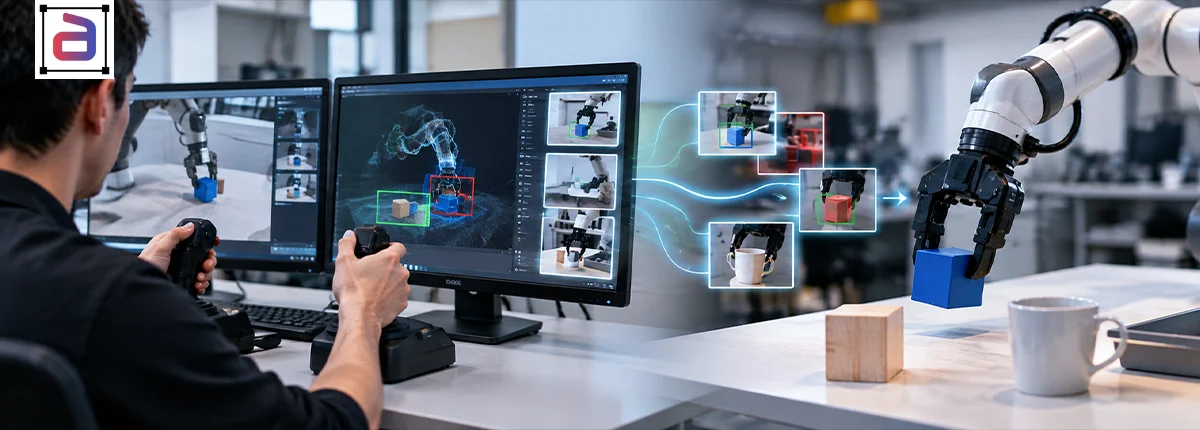
World models learn the physics of the real world from video — and recent results show how powerful that approach is, with models pretrained on large volumes of internet video achieving strong zero-shot performance on real robot arms after only a small amount of robot-specific data. But raw internet video is noisy. To teach a model real physics, the footage has to be curated, filtered, and labeled for physical plausibility. That curation work is exactly what Annotera provides.
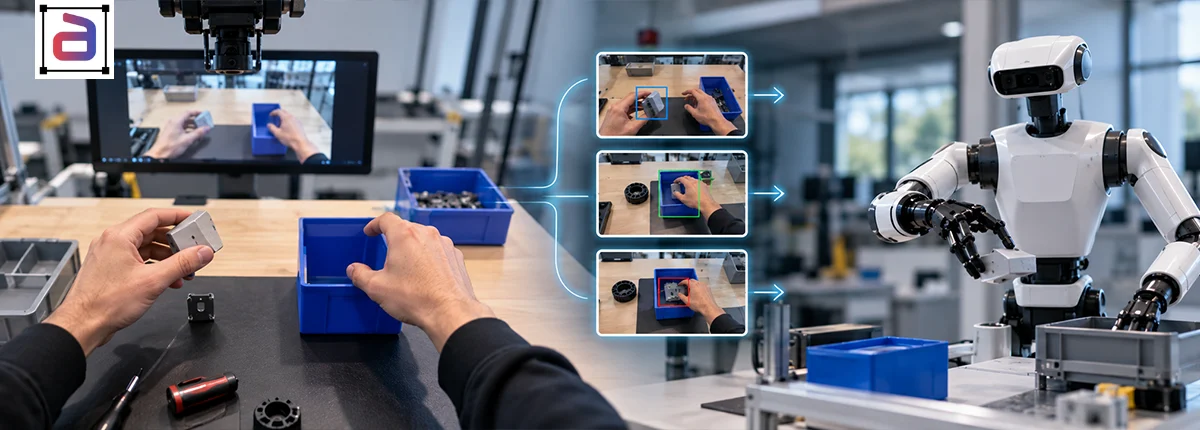
Our annotators select and filter in-the-wild and internet video, then label it for object permanence, causal relationships, physics-consistent motion, and scene-state change. This is adjacent to traditional video annotation but built around physical-world understanding rather than object detection, with a taxonomy designed for world-model pretraining. With 20+ years of outsourcing expertise and 350+ trained specialists, Annotera curates physical-AI pretraining data at the scale modern world models demand.
Curated video is a shortcut to physical intelligence. Annotera helps you turn the open ocean of internet footage into a clean, physics-consistent pretraining corpus.
World models learn the physics of the real world from video — and recent results show how powerful that approach is, with models pretrained on large volumes of internet video achieving strong zero-shot performance on real robot arms after only a small amount of robot-specific data.
Video is screened to keep physically realistic footage and discard artifacts or impossible motion. As a result, the pretraining corpus reflects real-world physics.
Objects are tracked through occlusion and reappearance. Therefore, models learn that objects persist when out of view.
Cause-and-effect interactions between objects and actors are labeled. In addition, this teaches models the consequences of actions.
Motion is labeled for consistency with gravity, momentum, and collision. Consequently, models internalize plausible dynamics.
Before-and-after states of scenes are annotated around key events. Moreover, this captures how actions transform the world.
Clips are scored for quality and relevance to the target domain. As a result, pretraining data is both clean and on-distribution.
World models learn the physics of the real world from video — and recent results show how powerful that approach is, with models pretrained on large volumes of internet video achieving strong zero-shot performance on real robot arms after only a small amount of robot-specific data.

A label set built around plausibility, permanence, and causality — not object detection — produces data suited to world-model pretraining.

Efficient filtering and scoring workflows turn massive raw video collections into clean, usable corpora.

SOC-compliant workflows and flexible capacity scale curation to the million-hour volumes world models consume.
World models learn the physics of the real world from video — and recent results show how powerful that approach is, with models pretrained on large volumes of internet video achieving strong zero-shot performance on real robot arms after only a small amount of robot-specific data.

20+ years of BPO experience applied to large-scale video curation.

Labels designed for physical understanding, the input world models actually learn from.

Workflows tuned to process very large raw video collections efficiently.

Capacity scales to massive pretraining-corpus volumes.

Multi-layer validation keeps curation criteria consistent across huge datasets.

SOC-compliant handling with strict access controls and US onshore options.
Here are answers to common questions about text annotation, accuracy, and outsourcing to help businesses scale their NLP projects effectively.
It is the selection, filtering, and labeling of internet and in-the-wild video for physical plausibility, object permanence, causal relationships, and physics-consistent motion. As a result, world models can learn real-world physics from a clean pretraining corpus.
World models learn physics from video, and large-scale video pretraining has produced strong zero-shot robot performance with minimal robot-specific data. Therefore, curating that video for physical plausibility makes pretraining far more effective than using raw, noisy footage.
Standard video annotation centers on detecting and tracking objects. World model curation, however, labels physical understanding — permanence, causality, and plausible motion — and requires a taxonomy built for pretraining rather than perception alone.
We filter for physical plausibility and relevance, then label object permanence, causal relationships, physics-consistent motion, and scene-state change. Moreover, the taxonomy is tailored to each world-model program.
Yes. With high-throughput workflows, 350+ trained specialists, and SOC-compliant delivery, we curate very large video collections while keeping criteria consistent and data secure.