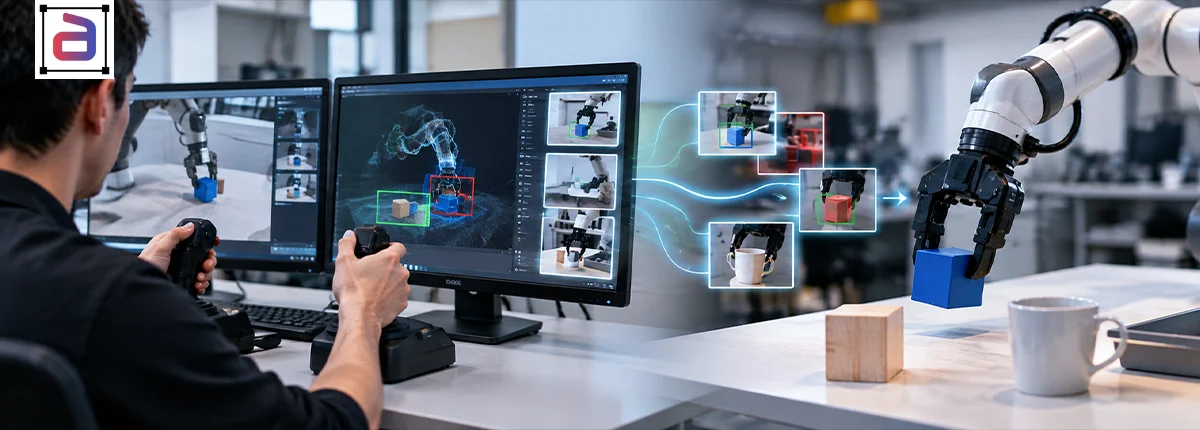
Robots can move with remarkable precision. But precision is not the same as dexterity. A robot may successfully execute a programmed trajectory in a controlled environment, yet struggle when an object shifts, a grasp becomes unstable, or the task requires a sequence of subtle physical interactions. Teaching robots to handle these situations requires more than sophisticated hardware or algorithms. It requires high-quality training data that captures how manipulation actually happens in the physical world. This is where teleoperation becomes transformative. Through teleoperation, human operators can demonstrate how a robot should approach, grasp, move, manipulate, and release objects. These demonstrations contain valuable information about movement, timing, contact, object interaction, and task outcomes. However, raw demonstrations are only the beginning.
Teleoperation data annotation transforms those demonstrations into structured learning signals that robotic AI systems can interpret and learn from. As a specialized robotics data annotation provider, Annotera helps organizations turn complex teleoperation recordings into structured, training-ready datasets designed to support the next generation of intelligent robots.
Key Points
- Human-guided demonstrations capture real-world manipulation strategies that robots can learn from.
- Robot demonstration labeling identifies actions, objects, grasp states, temporal events, and task outcomes, making data more useful for AI training.
- Precise timing of reaching, grasping, lifting, transporting, and releasing helps models learn sequential manipulation behaviors.
- Annotera provides specialized teleoperation annotation services and supports data annotation outsourcing to help robotics teams build high-quality, training-ready datasets.
Why Teleoperation Matters for Robot Manipulation
Learning from demonstration has become an important approach to teaching robots manipulation skills. Instead of manually programming every movement, developers can provide examples of how a task should be performed and allow learning algorithms to identify useful patterns. Research has described learning from demonstration as a promising direction for manipulation skill acquisition and generalization, particularly when combined with immersive teleoperation. The value of teleoperation lies in its ability to capture human expertise directly through the robot’s action space. Consider a simple pick-and-place task. An experienced operator does not merely move a robotic arm toward an object. They continuously make adjustments based on the object’s position, orientation, visual appearance, and perceived stability. They may approach from a particular angle, alter the gripper position, establish contact, adjust the grip, and modify the trajectory during transport. Every one of those decisions can become useful training information.
“Learning from demonstration” provides a way for robots to acquire manipulation behaviors from human demonstrations.
But for an AI model to benefit from those demonstrations, the underlying data needs structure.
From Raw Demonstration to Structured Training Data
A teleoperation recording may contain synchronized video, robot trajectories, joint states, gripper information, timestamps, depth data, and other sensor streams. Without annotation, these signals can be difficult to connect to specific task events. This is where robot demonstration labeling becomes essential. Annotators can transform a continuous demonstration into meaningful events and phases, such as:
- Reach
- Approach
- Contact
- Grasp
- Lift
- Transport
- Placement
- Release
- Task completion
- Failure or recovery
Additional labels can capture object identity, object position, gripper state, interaction points, grasp quality, and success or failure conditions. Annotera’s teleoperation annotation workflow specifically addresses episode segmentation, gripper and end-effector states, grasp quality, object affordances, metadata, and success or failure categorization. The result is a dataset that describes not only what the robot did, but also when it happened, what it interacted with, and what the outcome was.
Why Temporal Annotation Improves Dexterity
Robot manipulation is fundamentally sequential. A robot must often perform actions in the correct order and within the correct temporal window. Closing a gripper before establishing contact can produce a failed grasp. Releasing an object too early can cause it to fall. Moving before achieving stable contact can destabilize the interaction. Temporal labels help models understand these relationships. For example, instead of treating a 30-second recording as one continuous demonstration, annotation can divide it into specific phases:
- 0–5 seconds: approach
- 5–8 seconds: alignment
- 8–10 seconds: grasp
- 10–18 seconds: transport
- 18–22 seconds: placement
- 22–24 seconds: release
- 24–30 seconds: task verification
This structure gives machine-learning systems a much clearer representation of the task. Modern robotics workflows increasingly recognize annotation as an explicit stage between demonstration collection and dataset generation. For example, NVIDIA’s Isaac Lab documentation includes a dedicated demonstration-annotation step before generating additional training demonstrations.
Learning From Success—and Failure
Dexterity is not learned exclusively from perfect movements. Failures can be equally valuable. Suppose a robot attempts to pick up a cup but approaches at the wrong angle. The gripper makes contact but fails to establish a stable grasp. If the dataset only records that the demonstration “failed,” valuable information is lost. Detailed annotation can identify the failure mode:
- Incorrect approach trajectory
- Poor gripper alignment
- Insufficient contact
- Object slippage
- Premature release
- Collision
- Failed placement
This allows robotics teams to distinguish successful behaviors from ineffective ones and potentially use failure data for error-aware imitation learning, recovery-policy development, and targeted dataset expansion. Research on imitation learning from teleoperation data has specifically examined the challenges associated with high-quality human demonstrations and deployment-related distribution shifts.
Scaling Robotics Data With Data Annotation Outsourcing
As robotics programs progress from research prototypes toward production, the volume of teleoperation data can grow rapidly. Reviewing and labeling every demonstration internally can consume valuable engineering resources. This is where data annotation outsourcing can provide a strategic advantage. Instead of requiring robotics engineers to manually process every recording, organizations can partner with specialized annotation teams that understand task segmentation, object interaction, temporal events, and robotic states. However, robotics annotation should not be treated like generic image labeling. The annotation team needs to understand the task ontology and follow precise guidelines developed around the robot, policy architecture, and training objective. Annotera builds annotation taxonomies in collaboration with ML teams so that labels align with the requirements of the specific robotics program.
What to Look for in a Data Annotation Company
Choosing the right data annotation company is particularly important for robotics applications because annotation inconsistencies can introduce noise into training datasets. Organizations should evaluate a provider based on:
- Robotics and video annotation expertise
- Temporal and sequential labeling capabilities
- Understanding of object interactions and grasp states
- Robust quality-control procedures
- Scalability for large demonstration datasets
- Secure data-handling practices
- Custom annotation taxonomies
- Human-in-the-loop review
Annotera combines specialized robotics annotation workflows with scalable production capabilities. Its teleoperation offering is designed to support robotics AI projects from pilot datasets through production-scale annotation.
The Role of Teleoperation Annotation Services
The future of robot manipulation will depend increasingly on the ability to convert human expertise into machine-learning supervision. That makes teleoperation annotation services an important component of the robotics data pipeline. High-quality annotation can help robotics teams transform demonstrations into structured examples of perception, action, interaction, timing, and outcome. These datasets can then support imitation learning, behavior cloning, reinforcement learning from demonstrations, and other approaches to robotic skill acquisition. The broader objective is straightforward: Capture human expertise. Structure it intelligently. Make it learnable by machines. That is the path from demonstration to dexterity.
Why Choose Annotera?
At Annotera, we understand that robotics data requires more than simply drawing boxes around objects. Physical interaction is contextual, sequential, and highly dependent on timing. Our approach focuses on creating annotation workflows around the actual requirements of robotic learning—whether that means episode segmentation, action labeling, gripper-state annotation, object-interaction labeling, grasp assessment, or success/failure classification. As robotics moves toward increasingly capable manipulation systems, training data quality will become a critical differentiator. Better demonstrations create better supervision. Better supervision creates better learning opportunities. And better learning data can help robots become more capable in the physical world.
Turn Teleoperation Data Into High-Value Training Data With Annotera
Your teleoperation recordings contain more than robot movements. They contain demonstrations of human decision-making, physical interaction, timing, and task execution. The challenge is extracting that intelligence systematically. Annotera helps robotics companies transform raw teleoperation demonstrations into structured, high-quality datasets built for AI training. Ready to make your robot demonstrations more useful? Partner with Annotera for scalable teleoperation data annotation and robot demonstration labeling. Contact our team today to discuss your robotics training-data requirements and build an annotation workflow aligned with your model, robot, and task objectives.