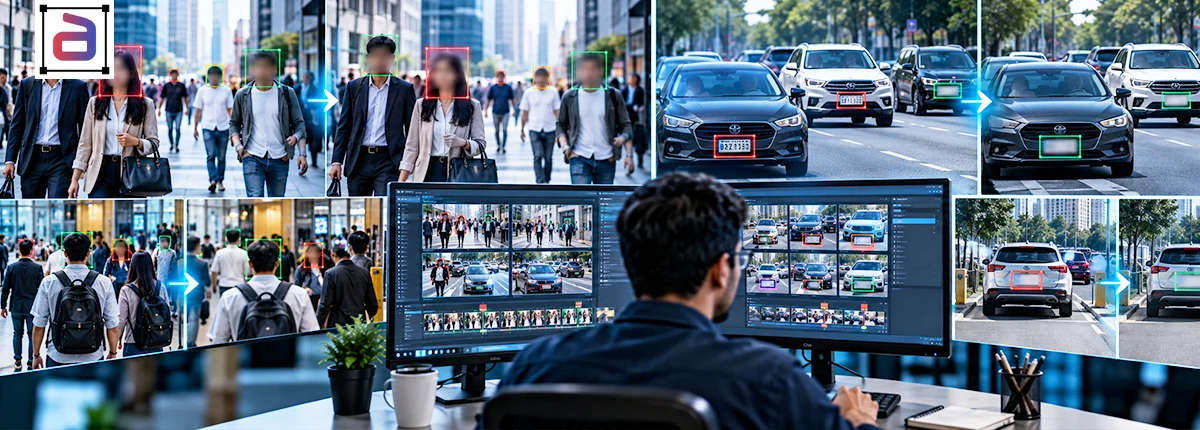
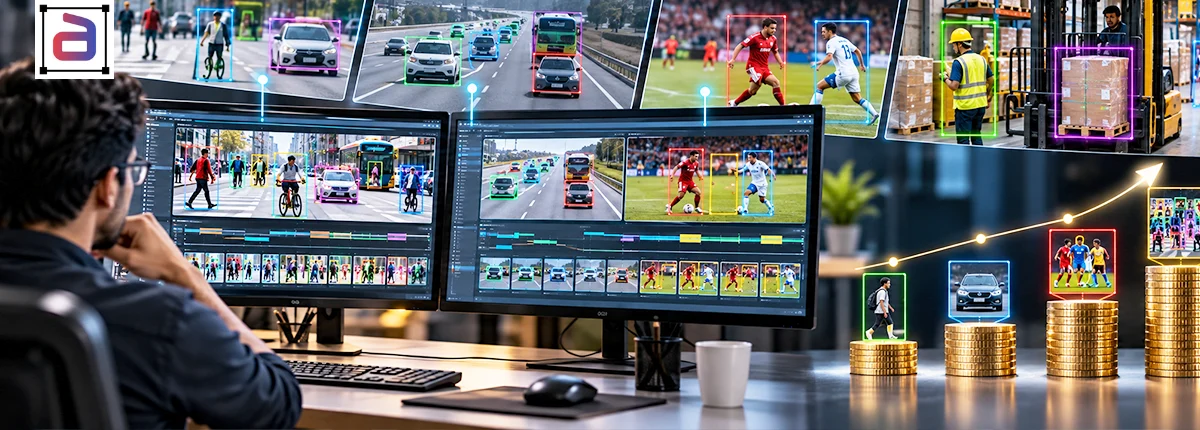
Video annotation is a critical component of computer vision development, enabling AI systems to detect objects, understand movement, recognize activities, and interpret real-world environments. From autonomous vehicles and retail analytics to security surveillance and robotics, accurately labeled video data plays a fundamental role in building reliable AI models.
But before investing in a video annotation project, businesses need answers to an important question: How much does video annotation cost? The answer depends on several factors, including the number of frames, video duration, object density, annotation complexity, and quality assurance requirements. Choosing the right pricing model can help businesses control costs without compromising the accuracy of their training datasets. In this guide, Annotera explains the most common video annotation pricing models, the factors influencing project costs, and practical strategies for optimizing annotation budgets.
Key Points
- Video Annotation Pricing Models: Costs vary based on per-frame, per-minute, and object-density pricing, depending on project requirements and complexity.
- Factors Influencing Costs: Object density, annotation type, video quality, multi-object tracking, and quality assurance significantly impact the final budget.
- Cost Optimization Strategies: Strategic frame sampling, standardized guidelines, automation-assisted workflows, and pilot projects help reduce expenses without compromising annotation quality.
- Scalable Video Annotation with Annotera: Annotera provides tailored video annotation outsourcing services to help businesses build accurate, high-quality AI training datasets cost-effectively.
What Is the Average Cost of Video Annotation?
Video annotation costs vary significantly depending on the task, dataset complexity, and expected quality standards. Labeling a few clearly visible vehicles is generally less demanding than tracking hundreds of objects across crowded traffic footage. For preliminary budgeting, businesses may encounter the following illustrative pricing ranges:
- Per-frame annotation: $0.02–$0.15 per frame for relatively straightforward tasks.
- Per-minute annotation: $1–$10 per minute for selected standard annotation workflows.
- Per-object or per-track annotation: From a few cents to several dollars, depending on object complexity, tracking requirements, and labeling scope.
These figures are indicative examples for planning purposes, not verified industry averages or fixed quotations. Actual costs may be substantially higher for pixel-level segmentation, complex multi-object tracking, 3D annotation, or safety-critical applications. As a result, the most effective way to estimate video annotation costs is to evaluate the annotation workload rather than video duration alone.
1. Per-Frame Pricing: Paying for Individual Frames
In the per-frame pricing model, businesses pay for each video frame that requires annotation. This model is particularly useful for object detection, bounding box labeling, instance segmentation, and keypoint annotation. For example, an autonomous driving dataset may require vehicles, pedestrians, cyclists, and traffic signs to be labeled in selected frames. A surveillance dataset may focus on identifying people and tracking their positions at specific intervals.
How does per-frame pricing work?
Suppose a project requires 20,000 frames to be annotated at an illustrative rate of $0.05 per frame. Estimated cost = 20,000 × $0.05 = $1,000. This estimate covers the assumed per-frame annotation charge only. Additional services, including quality assurance, complex attribute labeling, and project management, may increase the total cost.
What influences per-frame costs?
Several factors determine the amount of effort required for each frame:
- Number of objects appearing in the frame.
- Visibility, occlusion, and overlap between objects.
- Annotation type, such as bounding boxes versus segmentation masks.
- Image quality, motion blur, and challenging lighting conditions.
- Complexity of labeling guidelines and quality requirements.
Per-frame pricing provides clear cost visibility. However, annotating every frame is not always necessary. Strategic frame sampling can reduce annotation expenses when the application does not require continuous frame-level labels.
2. Per-Minute Pricing: Paying for Video Duration
Per-minute pricing calculates annotation costs according to the duration of the video being processed. It is often convenient for projects involving activity recognition, event detection, video captioning, and temporal segmentation. However, the quoted rate must clearly specify what the annotation includes. Two projects involving the same video duration may require very different amounts of manual effort.
How does per-minute pricing work?
Consider a dataset containing 500 minutes of video with an illustrative annotation rate of $4 per minute. Estimated cost = 500 × $4 = $2,000. This approach makes budgeting relatively straightforward when video duration and annotation requirements are consistent. However, the price may change when a project requires dense object labeling, detailed temporal boundaries, identity tracking, or multiple rounds of review.
When is per-minute pricing suitable?
This model is particularly useful when:
- Video duration is known in advance.
- Annotation requirements remain consistent across clips.
- Businesses need predictable project budgets.
- The task involves activities, events, or temporal labels.
Before selecting this model, confirm whether the rate covers every frame, sampled frames, or only selected events. Clarifying these details prevents unexpected costs during production.
3. Object-Density Pricing: Why Complex Scenes Cost More
Object density is one of the most important factors affecting video annotation costs. It refers to the number of objects that must be identified and labeled within a frame or video sequence. Consider two videos of equal duration. One shows a single vehicle moving along an empty road, while the other captures a crowded intersection containing cars, motorcycles, pedestrians, cyclists, and partially obscured vehicles. Although both videos may be ten minutes long, the second dataset can require significantly more annotation effort.
How does object density affect pricing?
Dense scenes demand greater attention to object boundaries, overlapping instances, visibility, and classification accuracy. Annotators must also ensure that objects are not missed or assigned incorrect labels. For multi-object tracking, the complexity increases further because each object must maintain a consistent identity across consecutive frames. Annotators may need to resolve occlusions, temporary disappearances, object re-entry, and identity switches. A video annotation company may therefore use complexity-based pricing tiers or combine a base per-minute rate with additional charges for dense scenes and advanced tracking requirements. This approach can provide a more realistic estimate than duration-based pricing alone.
4. How Annotation Types Influence the Final Cost
The annotation technique directly affects the time, expertise, and quality checks required for a project.
| Annotation type | Cost considerations |
|---|---|
| Bounding box annotation | Object count, visibility, and box-placement accuracy |
| Semantic segmentation | Pixel-level labeling and complex scene boundaries |
| Instance segmentation | Precise masks for individual object instances |
| Multi-object tracking | Identity consistency across frames and occlusion handling |
| Action recognition | Activity classification and temporal boundaries |
| Keypoint annotation | Precise landmark placement and pose complexity |
Projects combining several annotation types typically require more resources than those involving a single, straightforward labeling task.
For example, labeling a vehicle with a bounding box is different from segmenting its exact shape and tracking its identity across hundreds of frames. Defining the required output before production helps prevent unnecessary annotation work and budget overruns.
5. Additional Factors That Affect Video Annotation Costs
Beyond frames, duration, and object density, several operational factors influence the final quotation.
- Quality assurance: Independent reviews, consensus labeling, and adjudication add effort but can improve consistency.
- Video quality: Low-resolution footage, motion blur, and poor lighting can make object identification more difficult.
- Turnaround time: Expedited projects may require additional staffing or production capacity.
- Annotation guidelines: Complex taxonomies and frequently changing instructions can increase training time and rework.
- Security requirements: Privacy controls, restricted-access environments, and specialized data-handling procedures may affect project costs.
- Project scale: Large projects with consistent guidelines may benefit from standardized workflows, although actual savings depend on complexity and operational requirements.
A realistic budget should account for the complete delivery process, including annotation, validation, and quality control.
6. How to Reduce Video Annotation Costs Without Sacrificing Quality
Reducing annotation expenditure should not mean compromising training data quality. Instead, businesses should focus on eliminating unnecessary work and improving workflow efficiency. Here are five practical strategies:
- Use strategic frame sampling. Annotate selected frames when continuous labeling is not required.
- Prioritize difficult scenarios. Focus additional annotation effort on occlusions, unusual movements, and challenging environmental conditions.
- Standardize annotation guidelines. Clear instructions reduce ambiguity, inconsistent labels, and costly rework.
- Leverage automation-assisted workflows. Model-generated pre-labels can accelerate annotation when human reviewers can reliably verify and correct them.
- Run a pilot project. Test a representative sample to evaluate annotation complexity, quality expectations, and realistic production costs before scaling.
As the saying goes, “Measure twice, cut once.” The same principle applies to video annotation: defining requirements and validating assumptions early can prevent expensive corrections later.
How Annotera Helps Businesses Optimize Video Annotation Costs
At Annotera, we understand that successful AI development requires more than large volumes of labeled data. Businesses need annotation workflows that balance accuracy, scalability, turnaround time, and cost efficiency. Our video annotation outsourcing services support AI teams working across autonomous driving, retail analytics, security surveillance, robotics, and other computer vision applications. Whether your project requires bounding boxes, segmentation masks, activity recognition, or multi-object tracking, our approach emphasizes clearly defined labeling requirements, structured workflows, and appropriate quality assurance. By aligning annotation methods with specific model objectives, organizations can avoid unnecessary labeling effort and make more informed investment decisions. Rather than relying on a generic price per minute, Annotera can help businesses assess the factors that influence their project requirements, including video duration, frame sampling, object density, annotation complexity, and validation needs.
Conclusion
Video annotation pricing depends on the nature of the task, the volume of data, and the complexity of the scenes being labeled. Per-frame pricing offers granular cost control, per-minute pricing simplifies duration-based budgeting, and object-density pricing accounts for the additional effort required in crowded or complex environments. The right pricing model should reflect your actual annotation requirements while maintaining the quality needed to train reliable AI systems. By defining requirements early, testing workflows through pilot projects, and working with an experienced video annotation company such as Annotera, businesses can manage costs more effectively and build high-quality datasets that support long-term AI performance.
Looking for cost-effective, high-quality video annotation services? Annotera delivers scalable annotation solutions tailored to your dataset complexity, object density, and AI training goals. Contact Annotera today to discuss your project requirements and request a customized quote.