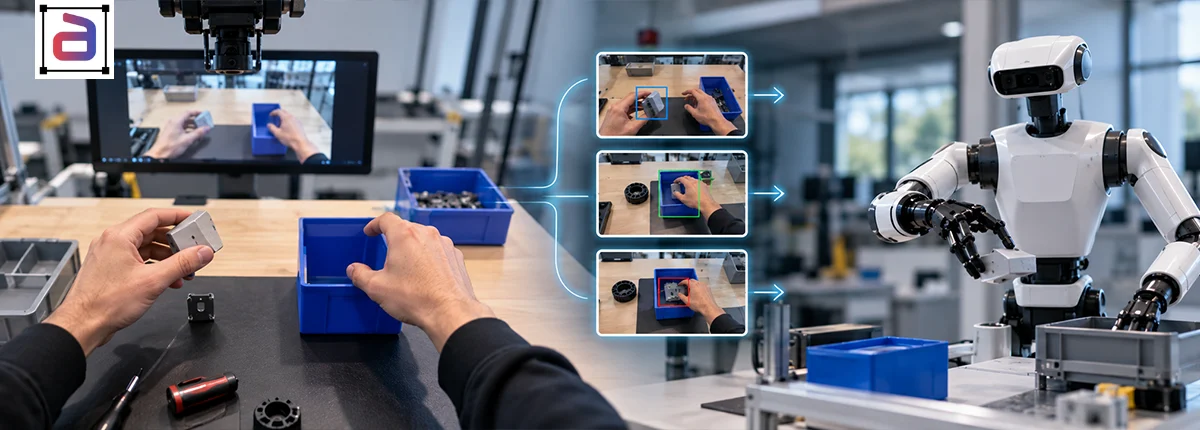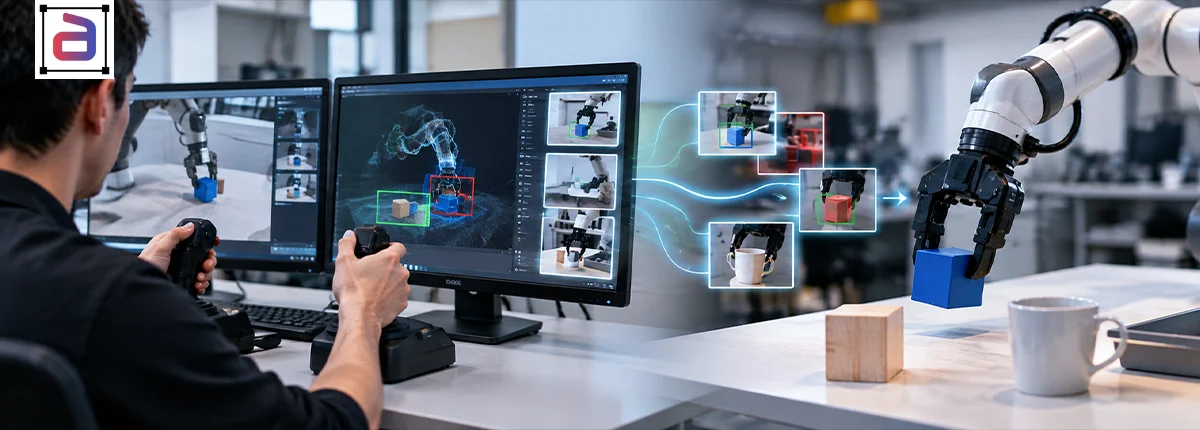





Annotators compare simulated robot behavior against real-world counterparts and flag discrepancies in physics, contact, and object interaction — so you know where your simulator falls short before it costs you.
Simulation-to-real transfer works well for locomotion, but manipulation is much harder. How a hand interacts with a soft object, how fabric slides between fingers, how liquids behave — these demand a fidelity current simulators do not reliably achieve. Sim-to-real for manipulation is an open research problem, and teams need a clear, human-validated view of where their simulation diverges from reality. Annotera provides exactly that.
Our annotators place simulated robot behavior side by side with its real-world counterpart, label discrepancies in physics fidelity, contact dynamics, and object interaction, and categorize the sim-to-real gaps that matter. This gives robotics teams an actionable map of where their simulation pipeline is failing — before those failures show up in a deployed robot. With 20+ years of outsourcing expertise and 350+ trained specialists, Annotera delivers sim-to-real validation at the scale and rigor research and deployment programs require.
Better validation means fewer surprises in the real world. Annotera helps you close the reality gap with structured, human-in-the-loop comparison.
Simulation-to-real transfer works well for locomotion, but manipulation is much harder. How a hand interacts with a soft object, how fabric slides between fingers, how liquids behave — these demand a fidelity current simulators do not reliably achieve.
Simulated and real trajectories of the same task are compared frame by frame. As a result, divergences between simulation and reality are made explicit.
Discrepancies in dynamics — momentum, friction, deformation — are flagged where simulation departs from real behavior. Therefore, teams can prioritize simulator fixes.
Mismatches in lighting, materials, and scene conditions between sim and real are annotated. Consequently, domain-randomization and rendering gaps become visible.
Cases where a sim-trained policy fails in reality are categorized by cause. Moreover, this directs targeted retraining and simulator improvement.
Each gap is scored by impact on task success. As a result, teams fix the discrepancies that matter most first.
Simulation-to-real transfer works well for locomotion, but manipulation is much harder. How a hand interacts with a soft object, how fabric slides between fingers, how liquids behave — these demand a fidelity current simulators do not reliably achieve.

Annotators trained in dynamics and contact reason about why sim and real diverge, not just that they look different.

A consistent taxonomy of physics, contact, and environment gaps turns ad-hoc observations into actionable engineering signal.

SOC-compliant workflows and flexible capacity scale validation across large sim-and-real datasets without compromising security.
Simulation-to-real transfer works well for locomotion, but manipulation is much harder. How a hand interacts with a soft object, how fabric slides between fingers, how liquids behave — these demand a fidelity current simulators do not reliably achieve.

20+ years of BPO experience applied to an open robotics research problem.

Structured, prioritized gap reports your simulation team can act on directly.

Special attention to contact and soft-object cases where sim-to-real is hardest.

Capacity scales with your simulation and deployment programs.

Calibrated rubrics and multi-layer review keep validation reliable at scale.

SOC-compliant handling with strict access controls and US onshore options.
Here are answers to common questions about text annotation, accuracy, and outsourcing to help businesses scale their NLP projects effectively.
It is the human-in-the-loop process of comparing simulated robot behavior against real-world behavior and labeling the discrepancies in physics, contact, and environment. As a result, teams get a clear map of where their simulation pipeline diverges from reality.
Sim-to-real transfer works for locomotion but remains an open problem for manipulation, where contact and soft-object dynamics are hard to simulate. Therefore, validating where simulation fails — before deployment — prevents costly real-world surprises.
We flag physics fidelity gaps, contact and interaction discrepancies, environmental condition mismatches, and real-world failure cases, each scored by severity. Moreover, output is structured so your simulation team can act on it directly.
Rather than labeling objects, sim-to-real validation requires reasoning about dynamics and contact to judge why simulated and real behavior differ. Consequently, it needs physics-literate reviewers and a structured gap taxonomy.
Yes. With 350+ trained specialists and SOC-compliant, flexible delivery, we validate large simulation-and-real datasets while keeping output consistent and secure.