Artificial intelligence is no longer confined to recognizing a single object in an image. Today’s AI systems must understand complex, dynamic environments where dozens—or even hundreds—of objects move simultaneously. Whether it’s autonomous vehicles navigating city streets, security systems monitoring crowded public spaces, or warehouse robots coordinating inventory movement, the ability to accurately perform multi-object tracking (MOT) is becoming a defining capability of high-performance computer vision models. However, even the most advanced AI algorithms cannot compensate for poor-quality training data. Multi-Object Tracking Annotation enables AI models to consistently identify and track multiple moving objects across video frames, improving accuracy for autonomous vehicles, surveillance, robotics, retail analytics, and other computer vision applications.
The success of multi-object tracking depends on meticulously annotated video datasets that preserve object identities across every frame. This is why organizations increasingly partner with a trusted data annotation company and leverage data annotation outsourcing to obtain scalable, high-quality datasets through expert video annotation services. At Annotera, we believe that exceptional AI begins with exceptional data. Our human-in-the-loop annotation workflows help enterprises build production-ready computer vision models with the precision, consistency, and scalability today’s AI applications demand.
Key Points
- High-quality multi-object tracking annotation is essential for training accurate computer vision models, ensuring consistent object identities across video frames for reliable real-world AI performance.
- Following annotation best practices—including identity consistency, precise bounding boxes, occlusion handling, comprehensive frame-by-frame labeling, and rigorous quality assurance—significantly improves model accuracy and robustness.
- Industries such as autonomous driving, robotics, surveillance, retail, and sports analytics rely on professional video annotation services to build scalable AI systems capable of tracking multiple moving objects in dynamic environments.
- Partnering with an experienced data annotation company like Annotera enables organizations to accelerate AI development through expert data annotation outsourcing, delivering high-quality, human-in-the-loop annotation services that reduce time-to-market and enhance model performance.
Understanding Multi-Object Tracking
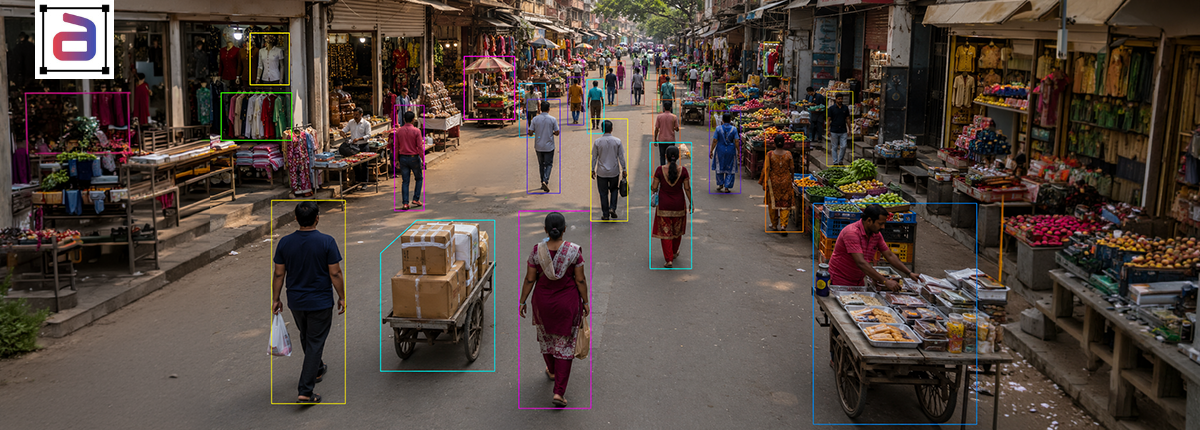
Multi-object tracking (MOT) is a computer vision technique that detects, identifies, and continuously tracks multiple moving objects across video frames while maintaining unique identities. It enables AI systems to accurately interpret motion, interactions, and dynamic scenes in real-world environments.
Unlike object detection, which identifies objects independently within a single image, multi-object tracking continuously detects and follows multiple objects across a sequence of video frames while maintaining a unique identity for each object. Multi-object tracking (MOT) is a computer vision technique that detects, identifies, and continuously tracks multiple objects across video frames while preserving their unique identities. It enables AI systems to understand movement, interactions, and object behavior in dynamic real-world environments. For example, an AI system may need to simultaneously track:
- Hundreds of vehicles in urban traffic
- Pedestrians crossing intersections
- Players and referees during live sporting events
- Robots and workers inside fulfillment centers
- Customers moving through retail environments
The objective is simple but technically challenging: every object must retain its identity despite changes in speed, lighting, camera angle, partial occlusions, or temporary disappearance. This level of intelligence is only possible when training data has been accurately annotated from beginning to end.
Why Annotation Quality Defines Model Performance
Data quality is one of the strongest predictors of AI performance. Regardless of model architecture, inconsistent annotations introduce errors that directly impact prediction accuracy. The performance of any multi-object tracking model depends on the quality of its training data. Accurate, consistent annotations help AI correctly identify and follow objects across frames, reducing errors, improving reliability, and enhancing real-world decision-making. Common annotation issues include:
- Identity switching between objects
- Missing object trajectories
- Inaccurate bounding boxes
- Poor handling of occlusions
- Inconsistent labeling standards
These errors lead to unstable tracking performance and unreliable real-world deployments. As Andrew Ng, Founder of DeepLearning.AI, famously observed:
“Rather than focusing solely on improving algorithms, many AI teams will achieve greater gains by systematically improving the quality of their data.”
This philosophy has become increasingly relevant as enterprises scale AI into production. The global computer vision market size was valued at USD 23.6 billion in 2025 and is projected to grow from USD 28.2 billion in 2026 to USD 101.5 billion by 2033, at a CAGR of 20.1% from 2026 to 2033.
Best Practices for Multi-Object Tracking Annotation
Building high-performance AI models requires more than collecting video data—it demands precise, consistent annotation practices. Following proven multi-object tracking annotation best practices improves data quality, strengthens model accuracy, and ensures reliable performance across real-world computer vision applications.
1. Preserve Identity Consistency Across Frames
Identity consistency is the foundation of multi-object tracking. Every tracked object should maintain the same ID throughout the video—even if it temporarily disappears behind another object or exits the camera view before reappearing. Changing identities midway through a sequence teaches models incorrect tracking behavior and significantly reduces performance. At Annotera, our annotation specialists follow strict identity management protocols to ensure uninterrupted object tracking across entire video sequences. Maintaining consistent object identities throughout a video sequence is fundamental to multi-object tracking. Preserving the same ID across frames, even during temporary occlusions, helps AI models learn accurate tracking patterns and reduces identity-switching errors.
2. Annotate Every Relevant Frame
Skipping frames may speed up annotation, but it creates fragmented object trajectories that negatively affect model learning. Annotating every relevant video frame ensures continuous object trajectories and captures subtle movement patterns. Complete frame-by-frame labeling enables AI models to better understand motion, direction changes, interactions, and behavior in dynamic environments. Professional video annotation services perform frame-by-frame annotation to capture:
- Direction changes
- Speed variations
- Object interactions
- Acceleration patterns
- Entry and exit events
This comprehensive approach enables AI models to learn smooth temporal relationships rather than isolated detections.
3. Handle Occlusions Intelligently
Real-world environments are filled with temporary occlusions. Vehicles disappear behind buses. Pedestrians walk behind trees. Warehouse robots pass behind shelving. Rather than assigning a new identity after reappearance, annotators must preserve the original object ID whenever possible. Effective occlusion handling dramatically improves long-term tracking accuracy. Objects in real-world videos are often temporarily hidden behind other objects or obstacles. Handling occlusions intelligently by preserving object identities helps AI models maintain accurate tracking and improves performance in complex, dynamic scenes.
4. Maintain Precise Bounding Boxes
Bounding boxes should consistently align with the visible boundaries of each object throughout every frame. Poorly aligned boxes introduce unnecessary background information and confuse detection models. High-quality annotations ensure:
- Tight object localization
- Stable object positioning
- Consistent sizing
- Minimal overlap with adjacent objects
These seemingly small improvements collectively lead to substantial gains in model precision.
5. Include Diverse Real-World Scenarios
AI systems rarely operate under perfect conditions. Training datasets should include diverse real-world conditions such as varying weather, lighting, traffic density, and camera angles. Exposure to these scenarios helps multi-object tracking models generalize better and perform reliably across different operational environments. Training datasets should include:
- Nighttime environments
- Rain and fog
- Motion blur
- Heavy traffic
- Dense pedestrian crowds
- Construction zones
- Low-light surveillance footage
- Moving camera perspectives
Exposure to diverse conditions helps AI models generalize effectively beyond controlled environments.
6. Standardize Annotation Guidelines
Large-scale annotation projects require detailed documentation. Clear annotation protocols reduce subjectivity and ensure consistency across distributed annotation teams. Standardized annotation guidelines ensure consistency across large labeling teams by defining clear rules for object classes, identities, occlusions, and edge cases. This minimizes variability and improves the overall quality of training datasets. Best practice guidelines should define:
- Object classes
- Identity assignment rules
- Occlusion handling
- Truncation policies
- Ignore regions
- Lost object behavior
- New object initialization
At Annotera, standardized workflows ensure every annotator follows identical quality benchmarks regardless of project size.
7. Implement Multi-Level Quality Assurance
Quality assurance is not a final checkpoint—it’s a continuous process. Multi-level quality assurance combines peer reviews, expert validation, and automated checks to identify and correct annotation errors. This layered approach ensures accurate, consistent datasets that improve AI model performance and reliability. Leading data annotation companies combine human expertise with automated validation through:
- Peer reviews
- Senior quality audits
- Random sampling
- Automated consistency checks
- Human-in-the-loop verification
This layered approach minimizes annotation errors before datasets reach AI development teams. As computer scientist W. Edwards Deming famously said:
“Quality is everyone’s responsibility.”
That principle remains just as relevant in AI data annotation today.
Industries Driving Demand for Multi-Object Tracking
The growing adoption of AI has made multi-object tracking essential across numerous industries. As AI adoption accelerates, multi-object tracking is becoming indispensable across industries that rely on intelligent video analysis. Accurate tracking enables businesses to improve automation, enhance operational efficiency, and make faster, data-driven decisions in dynamic environments.
Autonomous Vehicles
Tracking pedestrians, vehicles, cyclists, traffic signals, and road hazards simultaneously for safer autonomous navigation. Autonomous vehicles rely on multi-object tracking to continuously monitor pedestrians, vehicles, cyclists, traffic signals, and road obstacles. Accurate annotation enables AI models to make safer navigation decisions in complex, fast-changing driving environments.
Intelligent Surveillance
Furthermore, intelligent surveillance systems use multi-object tracking to monitor people and vehicles across multiple video feeds while maintaining consistent object identities. As a result, they can detect suspicious activities more accurately and support reliable monitoring over extended periods. Accurate annotation improves threat detection, crowd monitoring, and real-time security decision-making in dynamic environments.
Retail Analytics
Understanding customer movement, dwell time, shopping behavior, and store optimization. Retail analytics leverages multi-object tracking to analyze customer movement, dwell time, and in-store behavior. High-quality annotation helps AI generate actionable insights that improve store layouts, customer experiences, and overall operational efficiency.
Warehouse Robotics
Helping autonomous mobile robots detect workers, forklifts, pallets, and inventory for efficient navigation. Warehouse robotics depends on multi-object tracking to identify and monitor robots, workers, pallets, and inventory in real time. Accurate annotation enables safer navigation, efficient task coordination, and improved automation across warehouse operations.
Sports Analytics
Tracking athletes, officials, and equipment to generate tactical insights and performance metrics. Each application requires scalable, accurate video annotation services capable of producing production-grade datasets. Sports analytics uses multi-object tracking to follow players, officials, and the ball throughout a game. Accurate annotation enables AI to generate performance metrics, tactical insights, and real-time analysis for teams, coaches, and broadcasters.
Why Businesses Choose Data Annotation Outsourcing
Developing high-quality tracking datasets internally requires significant investment in infrastructure, workforce, training, and quality control. That is why many enterprises choose data annotation outsourcing. As AI projects grow in complexity, many organizations turn to data annotation outsourcing to access skilled annotators, scalable resources, and consistent quality. This approach accelerates dataset creation while reducing operational costs and time-to-market. Partnering with an experienced data annotation company offers several advantages:
- Faster project turnaround
- Access to trained annotation specialists
- Scalable production capacity
- Lower operational costs
- Flexible workforce expansion
- Enterprise-grade quality assurance
- Secure data handling
- Faster AI deployment
As a result, rather than managing annotation internally, engineering teams can remain focused on building and optimizing AI models, while experienced annotation specialists handle the creation of high-quality training datasets efficiently and at scale.
Why Annotera Is the Right Annotation Partner
At Annotera, we combine domain expertise, scalable operations, and rigorous quality control to deliver annotation datasets that power enterprise AI. Our specialized video annotation services support complex multi-object tracking projects across autonomous driving, robotics, surveillance, retail analytics, logistics, and smart manufacturing. Our human-in-the-loop workflows ensure every annotation undergoes multiple quality checks, delivering highly accurate datasets that improve model precision, reduce identity switches, and accelerate production deployment. Whether you require millions of annotated frames or highly customized tracking workflows, Annotera provides the expertise and scalability needed to support AI innovation at every stage. As a result, you can accelerate AI development, improve model accuracy, and confidently deploy production-ready computer vision solutions. Choosing the right annotation partner is critical to AI success. Annotera combines experienced human annotators, rigorous quality assurance, and scalable workflows to deliver high-quality video annotation services that power accurate, production-ready computer vision models.
Conclusion
As AI applications become increasingly dynamic and data-intensive, multi-object tracking has evolved from a niche capability into a critical requirement for modern computer vision systems. While advances in model architectures continue to improve performance, the true differentiator remains the quality of the training data behind them. Ultimately, organizations that invest in high-quality annotation are better positioned to build accurate, reliable, and scalable AI solutions. High-quality annotations, consistent object identities, robust quality assurance, and expertly labeled video datasets enable AI models to perform reliably in real-world environments. By partnering with a trusted data annotation company like Annotera and leveraging professional data annotation outsourcing and video annotation services, organizations can build high-performance AI solutions faster, more accurately, and at scale.
Ready to Build Better AI with Annotera?
From autonomous driving and robotics to surveillance and retail analytics, Annotera delivers precision-driven annotation services that help organizations develop smarter, more reliable computer vision models. Partner with Annotera today to access scalable, human-in-the-loop video annotation services tailored for high-performance AI. Let’s transform your raw video data into production-ready training datasets that power the next generation of intelligent systems.
To go deeper on this topic, please check the future of AI video annotation .