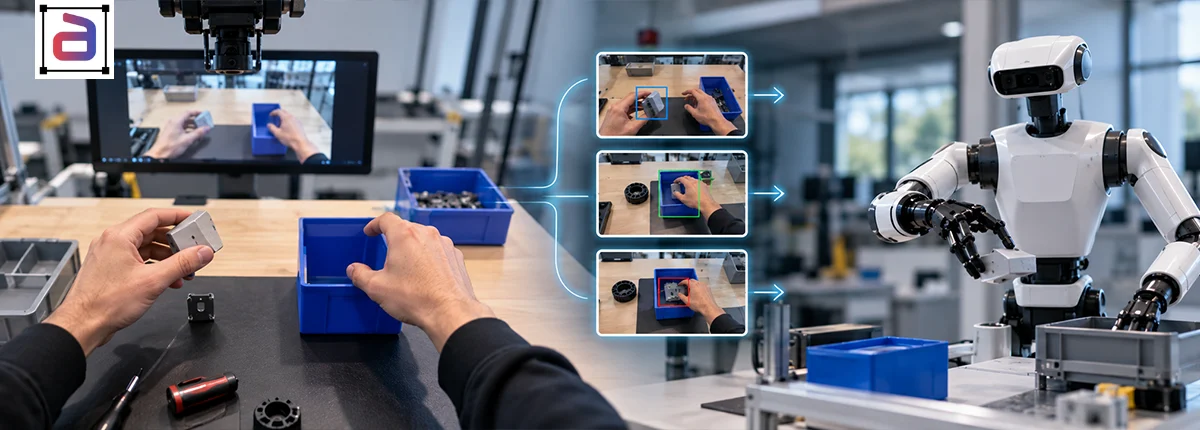

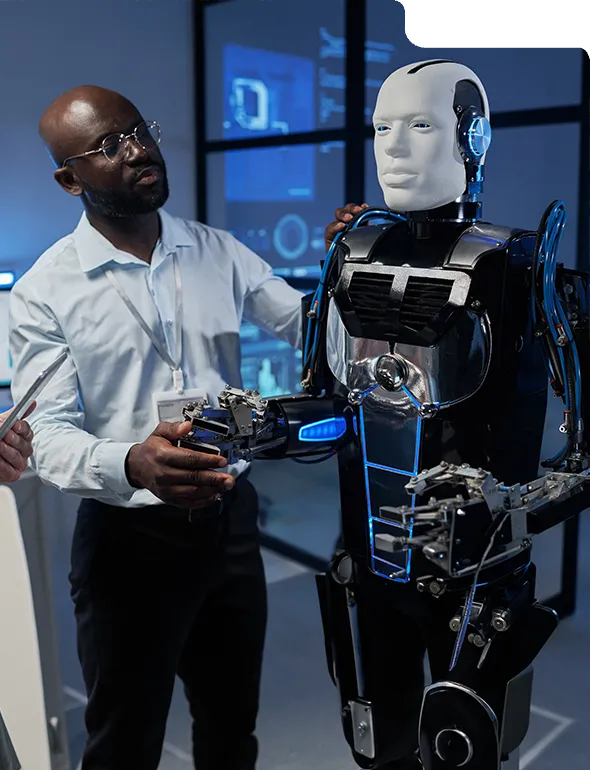
Label teleoperation footage with gripper state, task segmentation, and success/failure outcomes so manipulation policies learn from clean, structured demonstration episodes.
Teleoperation is how most high-quality manipulation data is created: a human guides a robot through a task, and every demonstration becomes a potential training example. But raw teleoperation footage is not training data until it is labeled — segmented into episodes, tagged for gripper and contact state, and scored for success or failure. Annotera turns those demonstration logs into structured, model-ready datasets.
Our annotators are trained in grasp quality, object-interaction semantics, and the physics of manipulation, so labels reflect what the robot is actually doing — not just what is visible on screen. With 20+ years of outsourcing expertise, a secure global delivery model, and 350+ trained specialists, Annotera scales teleoperation annotation from pilot datasets to continuous production volume for manipulation, humanoid, and industrial robotics programs.
Real robot manipulation data is one of the scarcest resources in AI, and the cost of collecting it is significant. Every demonstration you capture should yield maximum training value. Annotera makes that possible by labeling teleoperation episodes accurately, consistently, and at scale.
Teleoperation is how most high-quality manipulation data is created: a human guides a robot through a task, and every demonstration becomes a potential training example. But raw teleoperation footage is not training data until it is labeled
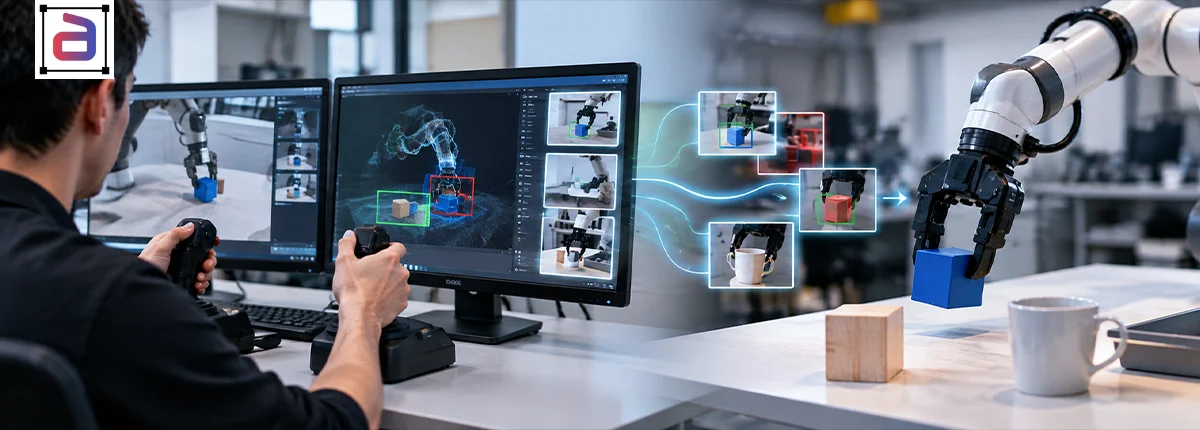
Demonstration footage is split into discrete task episodes with clear start and end boundaries. As a result, policies train on well-defined, reusable units of behavior.
Open, closed, and contact states of the gripper or end-effector are labeled frame by frame. Therefore, models learn precise timing of grasp and release.
Multi-step manipulation tasks are broken into sub-steps such as reach, grasp, move, and place. In addition, this supports hierarchical and long-horizon policy learning.
Each demonstration attempt is labeled as a success or failure, with failure modes categorized. Consequently, teams can filter, weight, and learn from imperfect data.
Grasps are rated on stability and contact quality against object geometry. Moreover, this gives manipulation models a richer signal than binary pick/place.
Manipulated objects are labeled with type, pose, and interaction affordances. As a result, policies generalize across objects and grasp strategies.
Teleoperation is how most high-quality manipulation data is created: a human guides a robot through a task, and every demonstration becomes a potential training example. But raw teleoperation footage is not training data until it is labeled

Annotators trained in manipulation physics capture grasp, contact, and interaction events accurately, producing labels that improve real-world policy performance.

Standardized segmentation and scoring rubrics keep labels consistent across thousands of demonstration episodes and multiple annotators.

SOC-compliant workflows and a flexible workforce scale teleoperation annotation to production volume without compromising accuracy or data security.
Teleoperation is how most high-quality manipulation data is created: a human guides a robot through a task, and every demonstration becomes a potential training example. But raw teleoperation footage is not training data until it is labeled

20+ years of BPO experience applied to the specific demands of robot demonstration data.

Trained, accountable annotators — the quality model robotics programs need for safety-relevant data.

Grasp, contact, and success/failure standards built for manipulation, not generic video tagging.

Clean segmentation and scoring extract maximum training value from every expensive demonstration.

Workforce scales from pilot batches to continuous capture pipelines.

SOC-compliant handling with strict access controls and US onshore options.
Here are answers to common questions about text annotation, accuracy, and outsourcing to help businesses scale their NLP projects effectively.
It is the process of labeling robot demonstration footage captured through teleoperation — segmenting episodes, tagging gripper and contact state, and scoring task success or failure. As a result, raw demonstrations become structured training data for manipulation models.
Teleoperation is one of the few ways to collect high-quality, real-world manipulation data, and that data is extremely scarce relative to internet text or video. Therefore, every demonstration should be labeled to extract maximum training value, which is exactly what high-quality annotation enables.
Common labels include episode boundaries, gripper and end-effector state, task sub-steps, grasp quality, success or failure outcomes, and object affordances. Moreover, Annotera tailors the taxonomy to each program’s policy architecture.
Standard video annotation tracks objects on screen. Teleoperation annotation, however, captures the physics of manipulation — grasp, contact, and task outcome — and requires annotators trained in object interaction rather than visual tagging alone.
Yes. With 350+ trained annotators and SOC-compliant, flexible delivery, we scale from pilot datasets to continuous, high-volume capture pipelines while maintaining consistency and security.