A conversation with an AI rarely ends after one question. Users ask follow-ups, change requirements, correct themselves, refer to information mentioned several turns earlier, and expect the AI to remember what has already been established. For generative AI systems, this creates a fundamental challenge: understanding language is not enough; models must understand conversational context.
A user saying, “Yes, use the second option,” provides little meaning without the preceding discussion. Similarly, “Can you make it shorter?” requires the AI to understand exactly what “it” refers to. This is why high-quality multi-turn conversation annotation has become an increasingly important component of modern LLM development. As research has demonstrated, models can perform substantially worse in multi-turn interactions than in single-turn scenarios. One 2025 study found an average performance drop of 39% across six generation tasks when moving from single-turn to multi-turn conversations. The message for AI developers is clear: context needs to become part of the training data.
Key Points
- Context is critical: Multi-turn annotation helps AI models understand references, evolving instructions, user preferences, and conversation history.
- Better conversational consistency: Structured dialogue annotation helps identify context drift, contradictions, repeated questions, and incorrect intent interpretation.
- Essential for RLHF & fine-tuning: High-quality conversational preference data enables models to improve instruction following, response relevance, error recovery, and task completion.
- Annotera enables scalable AI data quality: Annotera’s LLM & GenAI annotation services help organizations build structured, high-quality datasets for context-aware conversational AI.
What Is Multi-Turn Conversation Annotation?
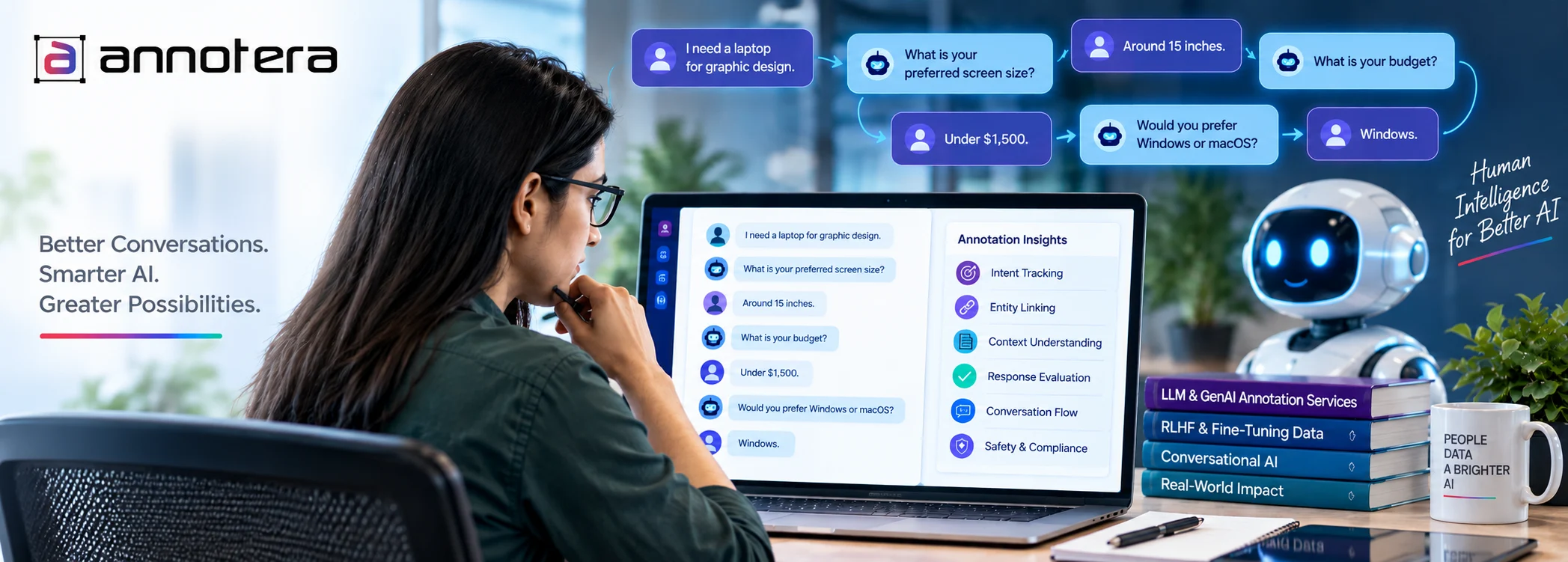
Multi-turn conversation annotation involves labeling and evaluating dialogue while preserving the relationships between individual turns. Traditional annotation may evaluate a single question and answer independently. Multi-turn annotation takes a broader view. It examines how each response relates to what came before—and how it influences what comes next. For example:
- User: I need a laptop for graphic design.
- AI: What is your preferred screen size?
- User: Around 15 inches.
- AI: What is your budget?
- User: Under $1,500.
- AI: Would you prefer Windows or macOS?
- User: Windows.
The final response cannot be accurately interpreted without the preceding conversation. The annotation process therefore needs to capture the evolving user requirements, references, entities, intent, and conversational state.
Typical annotation dimensions include:
- User intent and evolving intent
- Dialogue acts
- Entity and attribute relationships
- Coreference and contextual references
- User preferences
- Conversation state
- Sentiment and emotional cues
- Response relevance
- Instruction adherence
- Factual consistency
- Safety and policy compliance
- Task completion
- Conversational coherence
The objective is not simply to label words. It is to represent the logic and progression of the conversation.
Why Context-Aware Annotation Matters for Generative AI
Modern AI assistants are expected to behave less like search boxes and more like collaborative partners. A customer may begin by asking about a product, request pricing, compare alternatives, change a requirement, and finally ask to purchase. An enterprise employee might ask an AI assistant to analyze a report, request a summary, ask for revisions, and then instruct it to convert the findings into an email. Every subsequent instruction can depend on information from previous turns. Recent ACL research emphasizes this challenge, noting that multi-turn datasets can contain “topic drift, repetitive chitchat, and mismatched answer formats across turns.” The researchers argue for evaluating whole conversations rather than isolated turns. For AI teams, this distinction is crucial. A response can be grammatically perfect and factually correct in isolation while still being wrong for the conversation.
The Core Challenges of Multi-Turn Conversation Annotation
1. Understanding Context-Dependent References
Human conversations are full of shorthand. Users say:
- “That one.”
- “Use the previous version.”
- “Can you change it?”
- “I meant the other option.”
- “Make it more formal.”
These expressions cannot be reliably interpreted without conversational history. Annotators need to identify what each reference points to and determine whether the AI correctly resolved the underlying context.
2. Tracking Evolving User Intent
Intent is not necessarily static. A conversation may begin with: “Tell me about your enterprise plan.” It can evolve into: “How much does it cost?” Then: “Can I speak with someone about implementation?” Each turn represents a different conversational objective while remaining connected to the original interaction. High-quality annotation captures these transitions instead of forcing an entire conversation into one intent label.
3. Identifying Context Drift
Context drift occurs when an AI gradually loses track of the established conversation. Research published in 2025 found that LLMs can make incorrect assumptions early in a conversation and then continue relying on those assumptions rather than recovering from them. The researchers summarized the problem succinctly: “when LLMs take a wrong turn in a conversation, they get lost and do not recover.” Annotation can help identify these failure patterns by labeling where the conversation diverges from the user’s actual intent.
4. Maintaining Consistency Across Turns
A strong conversational model should remember relevant information and use it appropriately. If a user previously specifies a $1,500 budget, an AI should not suddenly recommend a $3,000 product without explaining the change. Annotators can evaluate:
- Contradictions
- Repeated questions
- Forgotten preferences
- Unsupported assumptions
- Incorrect references
- Inconsistent recommendations
- Failure to follow earlier instructions
This makes conversation-level quality measurable.
How Annotera Builds Context-Rich Conversational Datasets
At Annotera, we approach multi-turn annotation as a conversation-level data problem—not simply a sequence of independent labeling tasks. Our workflows can be structured to preserve relevant conversational history while annotators evaluate individual turns in relation to the broader dialogue. A typical workflow includes:
Conversation Segmentation
Identify complete dialogue sessions and logically distinct conversational episodes.
Intent Annotation
Label the user’s primary intent and capture meaningful intent changes throughout the conversation.
Entity & Reference Resolution
Link phrases such as “that product,” “the previous answer,” or “the second option” to the correct entities or earlier statements.
Dialogue-Act Annotation
Classify conversational functions such as questioning, requesting, confirming, correcting, rejecting, clarifying, providing information, or changing direction.
Response Quality Evaluation
Assess whether AI-generated responses are relevant, accurate, coherent, contextually appropriate, and aligned with the user’s requirements.
Preference & Safety Annotation
Evaluate alternative responses based on helpfulness, instruction adherence, safety, consistency, and overall conversational quality.
Multi-Level Quality Assurance
Use calibration, overlapping annotation, reviewer validation, disagreement analysis, and adjudication to improve consistency across complex dialogue datasets. This structured approach helps AI teams transform raw conversations into datasets that are suitable for training, fine-tuning, evaluation, and preference optimization.
Multi-Turn Annotation for RLHF & Fine-Tuning Data
Context-rich conversations are particularly valuable for developing RLHF & fine-tuning data. For supervised fine-tuning, complete dialogue trajectories can teach models how to respond when instructions evolve. Reviewers can compare responses based not only on individual answer quality but also on their impact on the overall conversation. For example, two responses might both answer the current question correctly. However, one may contradict information established earlier, while the other maintains continuity and moves the task forward. That distinction matters. Recent research into multi-turn preference evaluation has explored the use of dialogue acts and conversational principles to improve judgments of preference pairs containing complex conversational context. This makes contextual preference annotation particularly useful for improving:
- Instruction following
- Context retention
- Response consistency
- Clarification behavior
- Error recovery
- Conversational relevance
- Task completion
- Safety-aware responses
Why Annotation Quality Directly Impacts Model Quality
The quality of a conversational model is influenced by the quality and structure of the data used to train and evaluate it. If annotation ignores conversational dependencies, models may learn undesirable patterns:
- User changes requirement → AI continues with the old requirement
- User corrects information → AI ignores the correction
- User references previous content → AI interprets it incorrectly
- Conversation becomes longer → AI loses important context
These are not merely annotation problems. They become model behavior problems. Research in 2026 continues to show that multi-turn evaluation can expose vulnerabilities that remain hidden in single-turn testing. For this reason, AI organizations need datasets that represent realistic conversational trajectories—not just collections of disconnected prompts and answers.
Annotera: Turning Conversations Into Training-Ready Intelligence
Annotera helps organizations build structured, high-quality datasets for the next generation of conversational AI. Our LLM & GenAI annotation services can support multi-turn intent annotation, dialogue classification, response evaluation, preference labeling, entity and relationship annotation, sentiment analysis, safety annotation, and human-in-the-loop quality assurance. Whether you are developing an AI customer service agent, enterprise copilot, conversational search system, RAG application, virtual assistant, or domain-specific LLM, Annotera can help convert complex dialogue into reliable training and evaluation data. Our expertise also supports the development of RLHF & fine-tuning data, helping AI teams evaluate responses according to the contextual requirements that matter in real-world interactions.
Conclusion: Context Is the Foundation of Better Conversations
Generative AI is moving from answering isolated prompts to participating in ongoing conversations. That transition changes the data requirement. Models must understand what users said earlier, what they mean now, how their requirements have changed, and how the next response should fit into the broader interaction. As the research increasingly demonstrates, multi-turn behavior can reveal model weaknesses that single-turn evaluation misses. Better conversations begin with better conversational data. At Annotera, we combine structured annotation methodologies, human expertise, rigorous quality control, and scalable workflows to help AI teams build context-aware datasets for today’s most demanding generative AI applications. Ready to build conversational AI that understands more than the latest prompt? Partner with Annotera for scalable LLM & GenAI annotation services and high-quality RLHF & fine-tuning data tailored to your model’s requirements.
A closely related read: How RLHF Works: Human Feedback Loops that Make LLMs Safer.