Large language models are becoming increasingly capable—but capability alone does not guarantee reliability. An LLM can produce fluent, well-structured responses while still presenting inaccurate facts, missing important context, or failing to follow a user’s instructions precisely. For enterprises deploying AI in customer service, knowledge management, healthcare, finance, research, and other high-value applications, these seemingly small failures can have significant consequences. That is why LLM evaluation needs to go beyond automated benchmarks and surface-level quality checks. Expert human annotation provides the context, judgment, and domain understanding required to determine whether an AI response is genuinely accurate, helpful, and aligned with the user’s request.
Key Points
- Expert Annotation Improves LLM Accuracy – Human experts can identify factual errors, unsupported claims, hallucinations, and domain-specific inaccuracies that automated evaluation may overlook.
- Context Matters for Helpfulness – Expert annotators assess whether an AI response genuinely addresses the user’s intent, provides relevant information, and offers practical value—not just whether it is factually correct.
- Precise Instruction-Following Evaluation – Annotation helps determine whether LLMs follow complex prompts, formatting requirements, content constraints, tone guidelines, and other explicit instructions.
- High-Quality Data Drives Model Improvement – Structured expert feedback can support RLHF & fine-tuning data, helping AI teams identify failure patterns and continuously improve LLM performance.
Why Expert Annotation Matters for LLM Evaluation
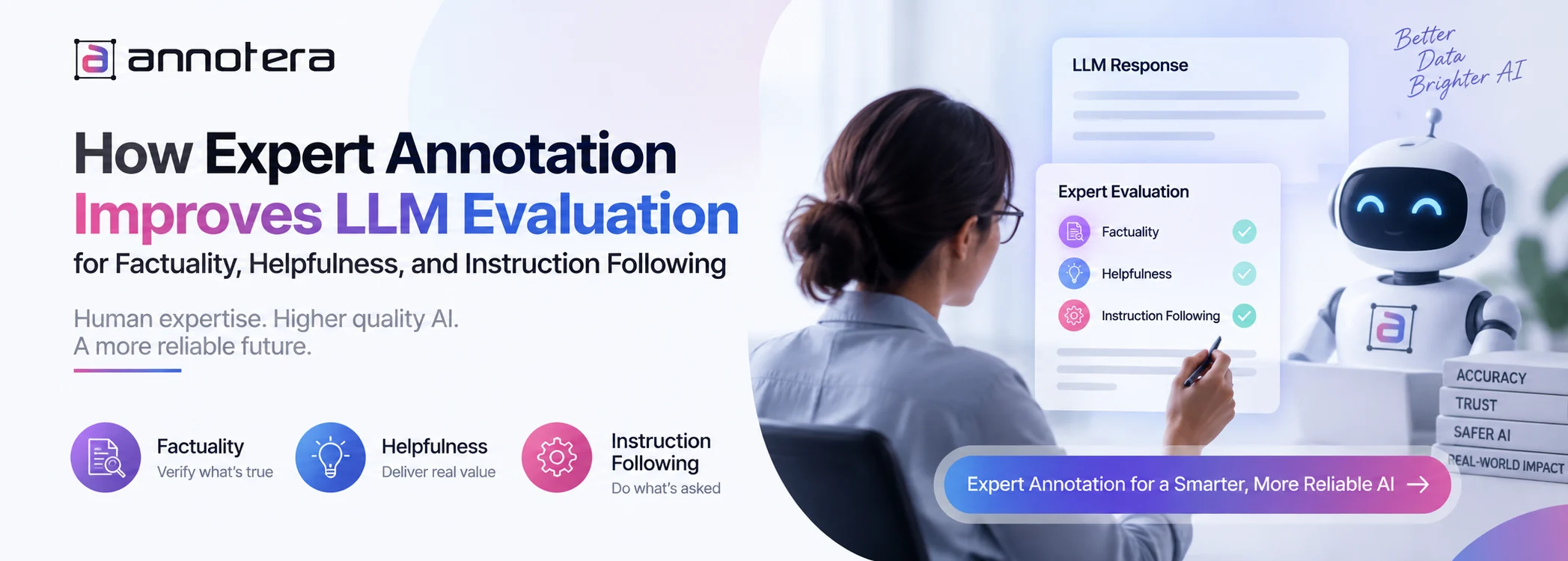
Traditional evaluation metrics can measure characteristics such as similarity, relevance, or task completion. However, many real-world LLM failures are contextual. For example, an AI assistant might answer a question confidently but invent a supporting statistic. Another model might provide correct information but ignore a formatting requirement. A third might answer the question literally while failing to understand what the user actually needs. Expert annotation helps distinguish these different failure modes. Instead of assigning a single broad quality score, trained annotators can evaluate responses across dimensions such as:
- Factual accuracy
- Evidence and claim support
- Helpfulness and relevance
- Completeness
- Instruction adherence
- Contextual appropriateness
- Clarity and coherence
- Domain-specific correctness
This creates evaluation data that is considerably more actionable for AI development teams. At Annotera, we help AI teams turn these complex evaluation requirements into structured, high-quality data that can support model testing, fine-tuning, and continuous improvement.
“A language model’s fluency is not the same thing as factual accuracy.”
1. Improving LLM Factuality Evaluation
One of the most persistent challenges in generative AI is hallucination—the generation of information that appears credible but is unsupported or incorrect. Factuality evaluation therefore requires more than asking whether an entire response is “correct.” Expert annotators can break a response into individual claims and determine whether those claims are supported by the available evidence. For instance, an AI-generated business report might contain five factual statements. Four could be supported by the source material while the fifth contains an invented statistic. A binary response-level evaluation could overlook this distinction. Claim-level annotation exposes exactly where the model failed. Expert reviewers can assess:
- Whether claims are factually accurate
- Whether statements are supported by provided sources
- Whether information has been fabricated
- Whether the response confuses facts with assumptions
- Whether important qualifiers have been omitted
- Whether conflicting information has been handled appropriately
This is particularly important for specialized AI applications where evaluators need familiarity with technical or industry-specific terminology. As AI systems increasingly operate as knowledge interfaces, expert annotation becomes a critical quality-control layer between model output and user trust.
2. Measuring Helpfulness in the Real World
Factuality is only one dimension of response quality. An answer can be completely accurate and still be unhelpful. Imagine a user asking an AI assistant how to troubleshoot a software problem. The model provides technically correct background information but never explains the steps needed to resolve the issue. The content is accurate, yet the response does not accomplish the user’s objective. Expert annotation allows AI teams to evaluate helpfulness in context. Annotators can determine whether a response:
- Directly addresses the user’s question
- Provides sufficient information
- Prioritizes the most relevant details
- Avoids unnecessary information
- Uses understandable language
- Recognizes the user’s context
- Provides practical next steps
- Appropriately communicates uncertainty
This contextual judgment is difficult to capture through simple automated metrics.
“The best AI response is not necessarily the longest or most sophisticated—it is the one that effectively solves the user’s problem.”
For enterprise AI, this distinction matters enormously. A customer-support assistant, research assistant, or internal knowledge bot must provide information that is not merely plausible but genuinely useful.
3. Evaluating Instruction Following
Modern LLM prompts can contain multiple requirements. A user may ask an AI model to summarize a document in 100 words, use bullet points, mention three key findings, and maintain a professional tone. An answer that satisfies only two of those requirements should not receive the same evaluation as one that satisfies all four. Expert annotation enables granular instruction-following evaluation. Annotators can check whether the model:
- Understood the primary task.
- Followed explicit constraints.
- Used the requested format.
- Included required information.
- Avoided prohibited content.
- Maintained the requested style or tone.
- Asked for clarification when instructions were genuinely ambiguous.
This type of evaluation is particularly valuable for enterprise workflows, where prompts may contain detailed operational requirements. Rather than simply asking, “Was the response good?”, annotation guidelines can ask, “Which instructions did the model follow, which did it miss, and why?” That difference produces much more useful training and evaluation signals.
Building High-Quality Evaluation Rubrics
Expert annotation is only as reliable as the evaluation framework behind it. At Annotera, evaluation workflows can be structured around detailed annotation guidelines that define what constitutes factual, helpful, and instruction-following behavior. For example:
| Evaluation Area | What Annotators Assess |
|---|---|
| Factuality | Accuracy, evidence, unsupported claims, hallucinations |
| Helpfulness | Relevance, completeness, clarity, practical usefulness |
| Instruction Following | Compliance with explicit requirements and constraints |
| Context | Understanding of user intent and supplied information |
| Quality | Overall response characteristics based on defined criteria |
Clear rubrics reduce subjectivity and help different annotators make more consistent judgments. Calibration exercises, quality audits, multiple annotations, and adjudication processes can further improve consistency.
Expert Annotation + Automated Evaluation: A Powerful Combination
Human annotation does not need to compete with automated evaluation. The strongest LLM evaluation pipelines can combine both. Automated evaluators can process large volumes of responses rapidly, identify potential problems, and support continuous monitoring. Expert annotators can then assess difficult, ambiguous, or high-impact examples where contextual judgment is essential. This human-in-the-loop approach gives AI teams the scalability of automation while retaining the nuance of expert review. For organizations developing RLHF & fine-tuning data, these human judgments can also provide valuable signals about preferred responses, undesirable behaviors, factual errors, and instruction-following failures.
How Annotera Supports LLM Evaluation
Building an effective evaluation dataset requires more than collecting human opinions. It requires a structured process for converting complex judgments into consistent, machine-readable signals. Annotera’s LLM & GenAI annotation services can support AI teams across key evaluation workflows, including:
- Factuality and hallucination assessment
- Response quality evaluation
- Helpfulness and relevance scoring
- Instruction-following evaluation
- Pairwise response comparison
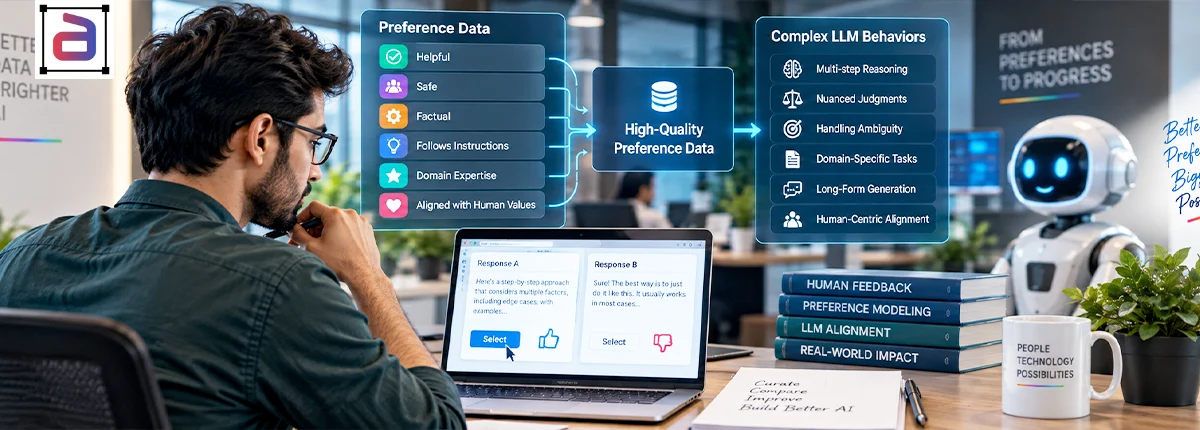
- Preference annotation
- RLHF data preparation
- Fine-tuning dataset creation
- Domain-specific LLM evaluation
- Human-in-the-loop quality assurance
Our approach focuses on creating evaluation data that AI teams can use—not simply producing annotations at scale. For specialized models, expert reviewers can work with domain-specific guidelines and evaluation criteria so that annotation reflects the actual requirements of the application.
From Evaluation Data to Better AI Systems
LLM evaluation should not be treated as a final checkpoint before deployment. It should be part of an ongoing improvement cycle. Model outputs generate evaluation data. Evaluation data reveals failure patterns. Those insights can inform prompt engineering, fine-tuning, model selection, safety improvements, and future dataset development. This creates a continuous feedback loop: Model Output → Expert Evaluation → Structured Feedback → Model Improvement → Re-Evaluation The quality of that loop depends heavily on the quality of its human feedback. As generative AI becomes more deeply integrated into enterprise operations, organizations need evaluation datasets that reflect real user expectations rather than relying exclusively on generic benchmarks.
Build More Reliable LLM Evaluation With Annotera
The next generation of AI systems will be judged not simply by how naturally they communicate, but by whether they can tell the truth, understand context, provide useful answers, and follow instructions consistently. Expert annotation provides the human judgment necessary to measure those qualities with greater precision. With LLM & GenAI annotation services and carefully structured RLHF & fine-tuning data, Annotera helps AI teams build evaluation pipelines designed around the behaviors that matter most. Ready to strengthen your LLM evaluation workflow? Partner with Annotera to build high-quality, expert-annotated datasets for factuality, helpfulness, instruction following, RLHF, and generative AI model improvement. Get in touch with our team today and turn complex model behavior into actionable data.
A closely related read: Synthetic Data vs Human Annotation for LLM Training.