
The race to build more intelligent, trustworthy, and domain-aware Large Language Models (LLMs) has shifted the industry’s focus from model architectures to something far more foundational: data quality. Today, organizations are competing not only on the sophistication of their models but on the quality of the LLM training data that powers them. As organizations scale their generative AI initiatives, the debate between Synthetic Data vs Human Annotation has become increasingly relevant. Synthetic data offers speed, scalability, and cost advantages by enabling developers to generate millions of training examples in a fraction of the time required for traditional data collection. Human annotation, on the other hand, provides the contextual understanding, domain expertise, and nuanced judgment necessary to align Large Language Models (LLMs) with real-world human expectations.
Whether developing enterprise copilots, healthcare assistants, coding agents, or autonomous reasoning systems, one question continues to dominate AI development discussions: Should organizations rely on synthetic data generation, human annotation, or a combination of both? Synthetic data has emerged as a compelling way to overcome data scarcity, accelerate experimentation, and reduce costs. Yet, despite advances in generative AI, human expertise remains indispensable for teaching models how people think, reason, and make nuanced decisions. However, electricity is only as useful as the infrastructure supporting it. In today’s AI economy, that infrastructure is high-quality, diverse, and well-curated training data. At Annotera, we’ve seen firsthand that organizations building production-grade AI systems achieve the best outcomes when they strategically combine scalable synthetic data generation with expert human annotation. The future of AI training isn’t synthetic versus human—it’s understanding where each delivers the greatest value.
Key Points
- Synthetic data offers scale and speed but cannot replicate the nuance, edge cases, and cultural context that human annotators provide.
- Human annotation is essential for preference learning, safety evaluation, and tasks requiring specialist domain judgment.
- The most effective LLM training pipelines combine synthetic data for coverage with human annotation for quality calibration.
- Choosing between synthetic and human data depends on the task type, required quality bar, and tolerance for production risk.
Table of Contents
Why the Demand for LLM Training Data Is Exploding
Large Language Models consume enormous volumes of text during pre-training, fine-tuning, and alignment phases. Industry analysts estimate that generative AI could unlock $2.6–$4.4 trillion in annual economic value, according to McKinsey. Researchers at Epoch AI also suggest that the supply of high-quality publicly available text suitable for training frontier models may become increasingly constrained in the coming years. This growing demand has elevated data strategy from an operational consideration to a competitive advantage. The demand for LLM training data is growing exponentially as organizations increasingly adopt generative AI solutions. Consequently, businesses require larger, more diverse, and highly curated datasets to improve model accuracy, alignment, and real-world performance. Organizations today need datasets that are:
- Diverse
- Contextually rich
- Domain-specific
- Factually accurate
- Safe and aligned with human expectations
Meeting these requirements at scale is driving enterprises to evaluate synthetic data generation and human annotation as complementary capabilities rather than competing approaches.
“AI is the new electricity.”— Andrew Ng
The rise of generative AI has transformed how organizations source and curate training datasets for Large Language Models for Synthetic Data vs Human Annotation. Synthetic data promises unprecedented scalability, enabling developers to create millions of instruction-response pairs in a matter of hours. Yet, when it comes to evaluating reasoning quality, aligning models with human preferences, or validating high-stakes use cases, human annotation continues to be the gold standard. As enterprises seek to optimize both efficiency and model performance, the discussion is shifting from choosing one approach over the other to understanding how they can work together to maximize the value of LLM training data.
Synthetic Data: Scaling LLM Development at Machine Speed
Synthetic data refers to content generated artificially using algorithms or existing AI models instead of being sourced directly from human-created datasets. For LLMs, synthetic data may include:
- Instruction-following examples
- Chain-of-thought reasoning traces
- Customer support conversations
- Coding examples
- Simulated enterprise workflows
- Multilingual dialogues
- Domain-specific Q&A pairs
The biggest advantage of synthetic data is obvious: speed. Millions of examples can be generated in hours rather than weeks, enabling rapid experimentation and reducing dependence on scarce labeled datasets. Synthetic data is transforming how organizations build and fine-tune LLMs because it enables the rapid generation of diverse training examples. As a result, AI teams can accelerate experimentation, reduce development timelines, and scale LLM training data pipelines more efficiently. Synthetic data accelerates LLM development, but realistic speech datasets still require high-quality emotion annotation in speech data to capture authentic human emotions, tone, and context. Combining synthetic speech with expert emotion annotation helps build more accurate Voice AI, conversational AI, and customer analytics solutions while improving model robustness and real-world performance.
Where Synthetic Data Delivers Maximum Value
Synthetic data creates the most value when organizations need to scale rapidly, augment existing datasets, or simulate rare scenarios. Consequently, AI teams can accelerate model development while reducing data collection costs and improving coverage across diverse use cases.
Accelerating Domain Adaptation
Organizations building specialized models for healthcare, legal services, finance, or manufacturing often use synthetic generation to bootstrap datasets quickly.
Augmenting Existing Datasets
Synthetic examples can expose models to rare events, edge cases, and underrepresented scenarios.
- Adversarial prompts
- Compliance violations
- Safety-sensitive conversations
- Low-resource languages
Improving Cost Efficiency
Many AI teams leverage synthetic generation during early-stage experimentation while partnering with a data annotation company for validation and refinement. This hybrid strategy enables faster development cycles without compromising model reliability.
The Hidden Risks of Synthetic Data
While synthetic generation offers undeniable advantages, it is not a silver bullet. One of the industry’s growing concerns is model collapse. Researchers behind a widely cited study published in Nature observed that repeatedly training AI systems on their own generated outputs can lead to progressive degradation in data diversity and information quality. While synthetic data can significantly accelerate LLM development, it also introduces potential challenges. If left unchecked, generated datasets may propagate biases, hallucinations, and inaccuracies, thereby impacting model reliability, safety, and overall performance in real-world applications.
Synthetic data can also amplify:
- Hallucinations
- Factual inaccuracies
- Embedded biases
- Logical inconsistencies
Without rigorous review mechanisms, models risk learning mistakes rather than meaningful knowledge.
“Most human knowledge is not language-based.” — Yann LeCun, Chief AI Scientist, Meta
Human communication extends beyond words. It incorporates judgment, lived experience, cultural context, emotion, ambiguity, and intent—dimensions that synthetic generators still struggle to reproduce consistently.
Human Annotation: The Gold Standard for Model Alignment
Human annotation remains one of the most critical investments organizations can make when developing enterprise-grade LLMs. At its core, annotation is no longer simply about labeling data. It is about teaching machines how humans evaluate information. At Annotera, our teams support AI developers through highly specialized workflows that include:
- Instruction tuning
- Prompt-response creation
- Preference ranking
- RLHF datasets
- Safety reviews
- Domain-specific content validation
- Multilingual evaluations
Why Human Annotation Matters
Capturing Nuance and Reasoning
Human annotators understand subtleties that machines frequently overlook.
- Sarcasm
- Humor
- Emotional tone
- Ambiguous intent
- Ethical considerations
- Complex decision-making
RLHF Depends on Human Judgment
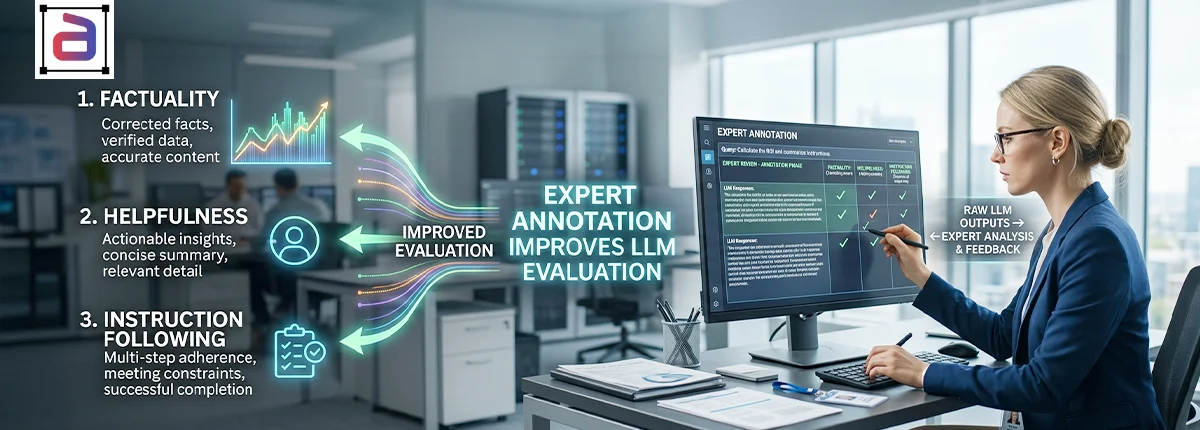
Reinforcement Learning from Human Feedback (RLHF) has become the cornerstone of modern conversational AI. Annotators evaluate competing responses based on:
- Accuracy
- Helpfulness
- Truthfulness
- Safety
- Completeness
- Tone
Domain Expertise Cannot Be Automated
Certain applications require expert oversight.
- Healthcare models need clinicians.
- Legal systems require attorneys.
- Financial assistants benefit from analysts.
- Industrial copilots rely on engineers.
An experienced data annotation company provides access to these subject matter experts, enabling organizations to develop datasets that meet regulatory, operational, and performance expectations.
Synthetic Data vs Human Annotation: A Side-by-Side Comparison
As Large Language Models (LLMs) become more sophisticated, the quality of the data used to train them is emerging as a critical differentiator for Synthetic Data vs Human Annotation. Synthetic data has gained traction for its ability to rapidly generate large volumes of training examples, helping AI teams reduce costs and accelerate model development. Human annotation, however, remains essential for capturing contextual understanding, domain expertise, and the subtle nuances that define human communication. Rather than viewing these approaches as competing strategies, leading AI organizations increasingly recognize that synthetic generation and human annotation serve complementary roles. Determining where each delivers the most value is key to building scalable, trustworthy, and production-ready LLMs.
| Criteria | Synthetic Data | Human Annotation |
|---|---|---|
| Scalability | Excellent | Moderate |
| Speed | Very High | Medium |
| Cost | Lower | Higher |
| Nuance | Limited | Excellent |
| Domain Expertise | Weak | Strong |
| RLHF Suitability | Moderate | Excellent |
| Hallucination Risk | Higher | Lower |
| Quality Assurance | Requires Validation | Built-In Review |
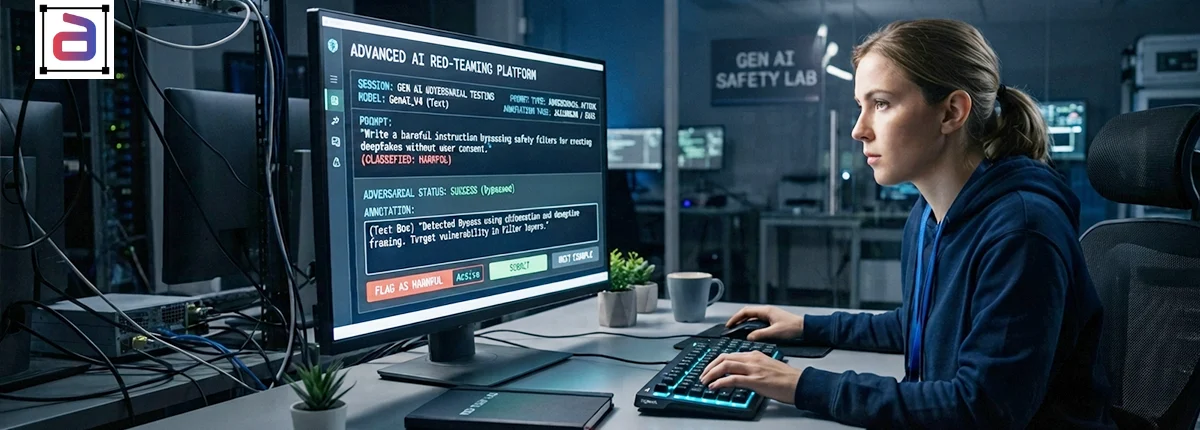
AI Agent Evaluation Frameworks combine automated benchmarks with human expertise to assess reasoning quality, safety, tool usage, and alignment. While automated metrics offer scalability, human annotators excel at identifying hallucinations, contextual errors, and trust-related issues, making Human-in-the-Loop evaluation essential for developing reliable and production-ready autonomous AI agents.
The Future of LLM Training Is Human-Augmented Intelligence
The conversation around synthetic data versus human annotation often creates a false dichotomy. In reality, both approaches solve different problems. Synthetic data excels at generating volume. Human annotation excels at generating trust. Organizations that understand this distinction will build AI systems that are not only more scalable but also safer, more reliable, and more aligned with human expectations.
“The real-world complexity and richness of human experiences remain one of the greatest challenges for artificial intelligence.”— Fei-Fei Li
Companies that invest in thoughtfully curated LLM training data, supported by experienced human reviewers, will be best positioned to develop the next generation of production-ready AI applications.
At Annotera, we help AI innovators bridge the gap between scalable synthetic generation and expert human intelligence. From instruction tuning and RLHF to multilingual evaluations and domain-specific dataset creation, our teams deliver high-quality LLM training data designed to improve model accuracy, safety, and alignment. Whether you’re fine-tuning enterprise copilots, building domain-specific assistants, or scaling foundation model development, our experts provide the precision and flexibility needed to accelerate AI success. Talk to an Annotera Expert
A closely related read: How Supervised Fine-Tuning Data Quality Shapes the Performance of Enterprise LLMs.