
AI agents are no longer experimental prototypes confined to research labs. They are scheduling meetings, triaging customer inquiries, writing production code, executing business workflows, and making decisions that directly impact business outcomes. The challenge facing enterprises today is no longer whether AI agents can act autonomously—it is determining when they can be trusted to do so reliably, safely, and consistently. As organizations increasingly deploy agentic AI systems, traditional evaluation metrics such as accuracy, precision, and pass rates are proving insufficient. Autonomous agents are expected to reason, plan, use tools, retain context, adapt to changing environments, and recover from errors. Learn more about evaluation datasets for vertical AI in healthcare and finance. Learn more about curating world model data for AI agents.
Measuring these capabilities requires a fundamentally different approach. At Annotera, we believe the future of trustworthy AI agents depends on robust evaluation frameworks that combine automation with expert human judgment. Human evaluators remain the critical layer that transforms promising AI systems into enterprise-ready digital workers. For autonomous AI agents, evaluation is no longer simply a quality assurance exercise. It has become a strategic discipline that determines whether enterprises can confidently scale agentic systems in production environments.
Key Points
- AI agent evaluation requires human annotators to assess complex reasoning chains.
- Standard accuracy metrics do not capture agent behavior in multi-step tasks.
- Human reviewers validate task completion, safety, and reasoning path quality.
- Scalable evaluation frameworks combine automated checks with human preference scoring.
Table of Contents
Why AI Agent Evaluation Has Become a Business Imperative
The pace of advancement in agentic AI is extraordinary. According to the 2025 Stanford AI Index Report, AI systems demonstrated significant performance gains across complex benchmarks, with coding agents showing dramatic improvements on SWE-bench evaluations within a short period. However, benchmark improvements alone do not guarantee enterprise readiness. Business leaders are increasingly asking critical questions:
- Can the AI agent recover gracefully from mistakes?
- Does it consistently follow organizational policies?
- Can it explain why it selected a particular course of action?
- Will customers trust its recommendations?
- How can performance degradation be detected after deployment?
These questions cannot be adequately answered using automated scoring systems alone. They require human expertise capable of assessing behavior, judgment, context, and intent.
“Human judgment remains indispensable for evaluating ambiguity, preference, trust, and safety—dimensions where automated metrics often fall short.”
Why Traditional Evaluation Metrics Fall Short
Traditional machine learning models are often evaluated using deterministic metrics such as:
- Accuracy
- Precision
- Recall
- F1 Score
- ROC-AUC
Autonomous AI agents, however, behave differently. They frequently perform multi-step reasoning tasks that involve planning, tool usage, memory retrieval, contextual understanding, and dynamic decision-making. The same prompt can lead to multiple reasoning paths and potentially different outcomes. Merely evaluating the final response does not reveal whether the agent followed an optimal reasoning process. An agent may arrive at the correct answer while relying on flawed assumptions, hallucinated observations, or inefficient workflows. Modern evaluation frameworks therefore place increasing emphasis on assessing not just outcomes, but also the quality of the decision-making journey itself.
The Role of Human Annotators in AI Agent Evaluation
Human annotators are evolving beyond traditional labeling roles to become behavioral evaluators and AI auditors. Unlike automated evaluators, humans possess the ability to understand nuance, infer intent, and judge appropriateness within context. These capabilities are particularly valuable when assessing highly autonomous systems. Human reviewers help organizations answer questions such as:
- Did the agent select the most appropriate tool?
- Was the reasoning process coherent?
- Did the agent seek clarification when needed?
- Was sensitive information handled correctly?
- Did the response align with organizational policies?
- Could the output negatively affect user trust?
These insights are difficult to capture through automated evaluation pipelines alone.
Core Components of AI Agent Evaluation Frameworks
1. Task Completion Accuracy
The most fundamental aspect of agent evaluation involves measuring whether an agent successfully completed its intended objective. Examples include:
- Booking appointments
- Generating executable code
- Resolving customer issues
- Querying knowledge bases
- Updating enterprise systems
Annotators assess:
- Success rates
- Partial completion
- Failure patterns
- Error recovery capabilities
2. Reasoning Path Assessment
Modern AI agents are expected to think through problems systematically. Human evaluators inspect:
- Planning strategies
- Intermediate decision steps
- Tool invocation logic
- Memory utilization
- Error handling mechanisms
- Context switching behavior
Human reviewers frequently identify subtle deficiencies such as:
- Circular reasoning
- Unnecessary actions
- Tool misuse
- Hallucinated evidence
- Incomplete plans
These observations provide invaluable feedback for iterative model improvement.
3. Safety and Alignment Testing
AI agents increasingly operate in high-stakes environments including healthcare, finance, insurance, legal services, and enterprise operations. Human reviewers evaluate:
- Toxic outputs
- Bias
- Data leakage risks
- Prompt injection vulnerabilities
- Regulatory compliance
- Unsafe recommendations
Safety-focused evaluations are rapidly becoming a standard component of enterprise AI governance programs.
4. Preference-Based Evaluation
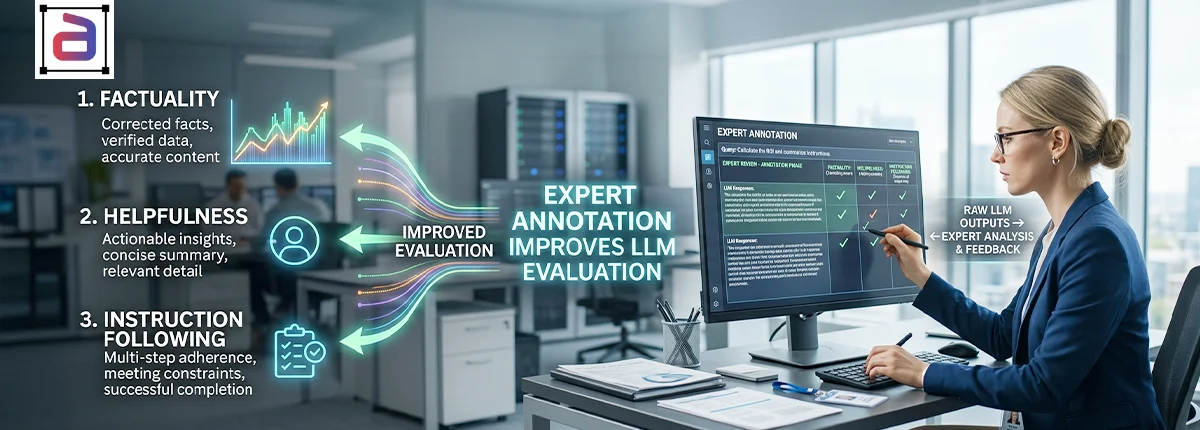
Preference annotation has emerged as one of the most effective methods for aligning AI systems with human expectations. Annotators compare multiple responses and rank them based on criteria such as:
- Helpfulness
- Accuracy
- Professional tone
- Clarity
- Empathy
- Policy adherence
These preference signals directly support reinforcement learning workflows and improve the quality of LLM training data. High-quality preference datasets often determine whether an AI assistant evolves from merely functional to genuinely trustworthy.
How Annotera Enables Human-Centered AI Agent Evaluation
At Annotera, we recognize that evaluating autonomous agents requires significantly more than conventional labeling processes. As a specialized data annotation company, Annotera helps enterprises establish scalable human evaluation ecosystems designed specifically for agentic AI systems. Our capabilities include:
Preference Annotation and RLHF
Expert annotators compare outputs, rank trajectories, and generate high-quality preference datasets that strengthen model alignment and improve LLM training data pipelines.
Trajectory-Level Reviews
Annotators evaluate complete decision paths, including planning behavior, memory usage, tool selection, reasoning quality, and recovery mechanisms.
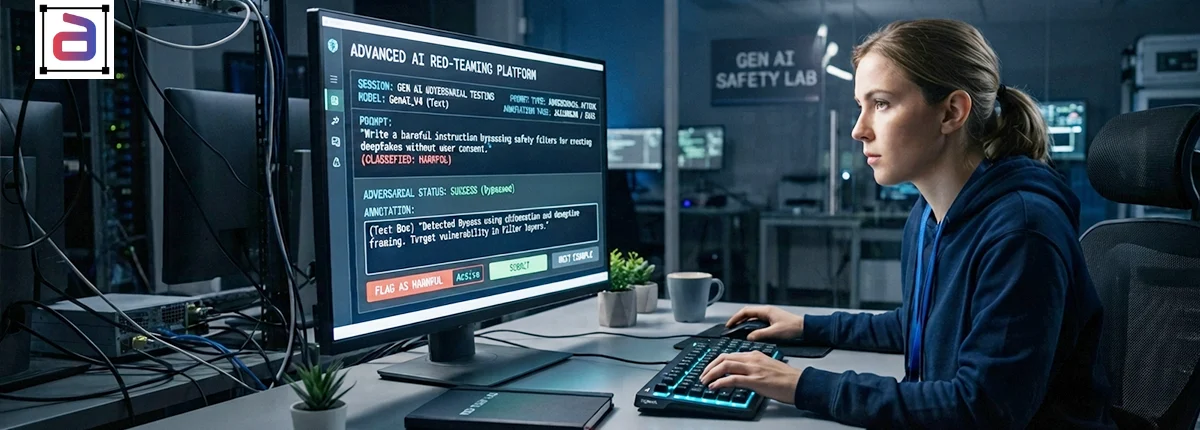
Red Teaming and Safety Validation
Our teams conduct structured adversarial testing to identify hallucinations, policy violations, prompt injection risks, and unsafe behaviors before deployment.
Scalable Human Feedback Operations
Organizations pursuing data annotation outsourcing initiatives benefit from Annotera’s flexible review programs, multilingual capabilities, and quality-controlled evaluation workflows that support rapid model iteration. By combining domain expertise with scalable Human-in-the-Loop operations, Annotera enables organizations to continuously evaluate and optimize autonomous agents throughout their lifecycle.
The Future of AI Agent Evaluation
AI agents are not merely language models generating text responses. They are behavioral systems capable of planning, adapting, remembering, and acting independently. Users ultimately evaluate these systems using human standards. They care less about benchmark scores and more about whether an agent is trustworthy, transparent, helpful, and aligned with organizational objectives. The organizations that lead the next generation of agentic AI will not simply develop smarter agents. They will invest in sophisticated evaluation ecosystems that combine automated testing with expert human judgment. Human evaluators remain essential because they provide contextual understanding, ethical oversight, and nuanced assessments that algorithms alone cannot reliably replicate.
Ready to Build Trustworthy AI Agents?
Whether you’re fine-tuning enterprise copilots, validating multi-agent workflows, or improving alignment through human feedback, Annotera provides the expertise and scalable human intelligence needed to accelerate deployment. Partner with Annotera to establish robust AI evaluation frameworks, preference annotation programs, and Human-in-the-Loop review workflows that help you deploy safer, smarter, and production-ready autonomous agents.
To go deeper on this topic, safety testing frameworks for generative AI.
A closely related read: Acoustic Scene Labeling for Autonomous Vehicles.