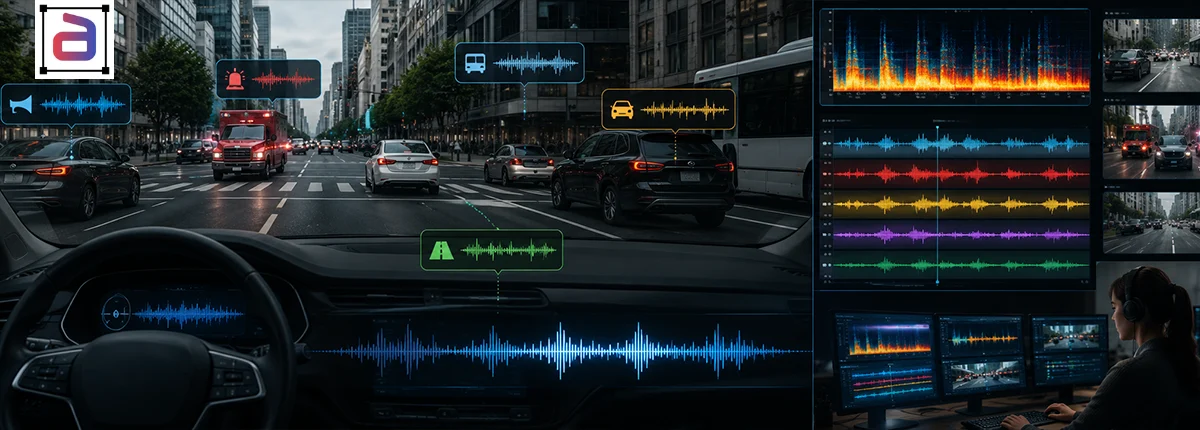
Imagine an autonomous vehicle approaching a busy city intersection. Buildings obstruct its cameras, and a delivery truck blocks its LiDAR’s field of view. Suddenly, an ambulance is approaching from behind with its siren blaring. Long before the emergency vehicle enters the camera’s frame, the sound reaches the vehicle. Can the AI understand what it hears? For next-generation autonomous vehicles, the answer increasingly depends on high-quality acoustic scene labeling. While computer vision has dominated autonomous driving discussions for years, audio intelligence is emerging as an equally important perception layer.
The ability to recognize sirens, horns, tire screeches, road construction, and ambient traffic noise enables vehicles to react faster, make better driving decisions, and improve overall road safety. However, even the most advanced AI models are only as intelligent as the data used to train them. That’s why organizations developing intelligent mobility systems are turning to experienced data annotation company partners that provide scalable audio annotation services through reliable data annotation outsourcing.
Key Points
- Acoustic scene labeling enables autonomous vehicles to detect critical sounds such as sirens, horns, tire screeches, and road noise, enhancing situational awareness beyond what cameras and LiDAR alone can provide.
- High-quality audio annotation services are essential for training AI models to accurately recognize overlapping environmental sounds, reducing false detections and improving safety in real-world driving conditions.
- Partnering with an experienced data annotation company through data annotation outsourcing helps AI developers access scalable, accurate, and cost-effective labeled audio datasets while maintaining stringent quality standards.
- Annotera delivers expert human-in-the-loop audio annotation services that empower autonomous vehicle developers to build safer, more reliable AI perception systems with high-quality acoustic training data.
Why Autonomous Vehicles Need “Ears,” Not Just Eyes
Modern autonomous driving systems combine cameras, LiDAR, radar, GPS, and ultrasonic sensors to understand their surroundings. Yet every one of these sensors has limitations. Visual sensors can struggle with:
- Blind intersections
- Heavy rain and fog
- Large vehicles blocking visibility
- Poor nighttime lighting
- Temporary road obstacles
Audio fills these perception gaps. A distant ambulance siren, an impatient vehicle horn, construction alarms, or even screeching tires often provide the first indication that something unusual is happening—sometimes seconds before the event becomes visible. As Bosch Research explains:
“The AI learns to recognize the acoustic signature of each sound, so it can distinguish sirens from other acoustic signals.” — Dr. Andreas Merz, Physicist, Bosch Research
This simple observation highlights why acoustic intelligence is becoming indispensable for autonomous mobility.
What Is Acoustic Scene Labeling?
Acoustic scene labeling is the process of identifying, timestamping, and categorizing environmental sounds within audio recordings used to train machine learning models. Instead of treating an audio clip as a single sound, annotators identify every relevant event occurring throughout the recording. Typical annotations include:
- Emergency sirens
- Vehicle horns
- Engine idling
- Tire screeching
- Motorcycle acceleration
- Reverse alarms
- Pedestrian crossings
- Road construction equipment
- Rain and wind
- Highway traffic
- Tunnel acoustics
- Railway crossings
These annotations help AI models understand not just what happened—but when, where, and how important the sound is.
The Challenge: Real Roads Are Noisy
Unlike controlled laboratory recordings, urban roads are acoustically chaotic. An autonomous vehicle may simultaneously encounter:
- Heavy traffic
- Multiple vehicle engines
- Rainfall
- Wind
- Car horns
- Emergency sirens
- Pedestrians talking
- Construction equipment
The AI must isolate critical sounds from continuous background noise without generating false alarms. This is where expert audio annotation services become essential. Professional annotators carefully identify overlapping sounds, assign precise timestamps, and distinguish subtle differences between similar acoustic events that automated labeling tools frequently miss.
Human Annotation Remains the Gold Standard
Although AI-assisted pre-labeling can accelerate dataset creation, human expertise remains irreplaceable for safety-critical applications. Experienced annotators can accurately distinguish:
- Police sirens vs. ambulance sirens
- Short warning horns vs. continuous honking
- Emergency vehicles approaching vs. moving away
- Mechanical failures vs. normal engine sounds
- Roadwork alarms vs. construction machinery
As Gartner notes, one of the biggest challenges facing audio analytics is collecting comprehensive, high-quality sound databases, making expertly annotated datasets a strategic differentiator for AI developers. In autonomous driving, annotation quality directly influences perception accuracy, making human validation indispensable.
Industry Data Shows the Scale of Audio Annotation
The growing importance of acoustic perception is reflected across the AI industry. Consider these examples:
- Google’s AudioSet contains more than 2.08 million human-labeled audio clips, covering hundreds of environmental sound classes and serving as one of the world’s largest annotated audio datasets.
- Bosch trained its embedded siren detection AI using over 200 GB of audio data—approximately 44,000 minutes of recordings collected across multiple countries and acoustic environments.
- Bosch also emphasizes that data quality matters more than data quantity, noting that carefully selected recordings from challenging scenarios contribute more to model performance than hours of ordinary background noise.
- Academic research on autonomous driving demonstrates that environmental audio classification significantly improves perception by recognizing critical sounds such as car horns, emergency sirens, and engine noise, achieving classification accuracy exceeding 97% on AV-relevant sound categories when trained with high-quality labeled data.
These examples reinforce a simple truth: reliable AI begins with reliable annotations.
Why Data Annotation Outsourcing Accelerates Autonomous AI
Building an in-house annotation team capable of labeling thousands of hours of audio is expensive, time-consuming, and difficult to scale. That’s why many AI companies choose data annotation outsourcing. Partnering with an experienced data annotation company offers several advantages:
- Access to trained audio annotation specialists
- Scalable annotation teams for large datasets
- Faster project turnaround
- Multi-level quality assurance workflows
- Consistent annotation guidelines
- Cost-efficient operations
- Support for multilingual and region-specific driving environments
Rather than investing months in recruiting, training, and managing annotation teams, engineering organizations can focus on developing better perception models while trusted annotation experts manage data quality.
Why Annotera Is the Right Annotation Partner
At Annotera, we understand that autonomous driving AI depends on precision at every stage of the data pipeline. Our expert annotators combine domain knowledge with rigorous quality assurance processes to deliver high-fidelity audio datasets for advanced AI applications. Our audio annotation services support:
- Acoustic scene labeling
- Sound event detection
- Timestamp annotation
- Multi-label audio classification
- Emergency siren annotation
- Horn detection
- Environmental sound tagging
- Quality validation and human-in-the-loop review
Whether you’re developing perception systems for Level 2 ADAS or fully autonomous vehicles, Annotera provides scalable annotation workflows tailored to your project requirements. Our commitment to consistency, accuracy, and rapid delivery makes us a trusted data annotation company for organizations building next-generation AI solutions.
Best Practices for High-Quality Acoustic Annotation
To maximize model performance, organizations should follow several proven practices:
- Develop standardized sound taxonomies.
- Use frame-level timestamp annotations.
- Capture diverse weather and traffic conditions.
- Include geographically varied siren patterns.
- Label overlapping sounds independently.
- Apply multi-stage human quality assurance.
- Continuously validate annotations using model feedback.
These practices produce datasets that are more robust, transferable, and representative of real-world driving environments.
The Road Ahead
The future of autonomous vehicles isn’t just about seeing the road—it’s about understanding everything happening around it. Audio perception enables vehicles to detect hidden dangers, respond to emergency vehicles faster, and navigate increasingly complex environments with greater confidence. But exceptional perception starts with exceptional data. High-quality audio annotation services transform raw recordings into structured, machine-readable intelligence that powers safer AI systems. Through strategic data annotation outsourcing, organizations can accelerate development while maintaining the precision required for safety-critical applications.
Partner with Annotera
If you’re building AI solutions for autonomous mobility, don’t let poor-quality training data limit your model’s performance. Annotera delivers scalable, high-precision audio annotation solutions designed for real-world AI applications. From acoustic scene labeling and sound event detection to human-in-the-loop quality assurance, our experts help you create reliable datasets that improve model accuracy, reduce development time, and accelerate deployment. Ready to build smarter, safer AI? Contact Annotera today to discover how our expert audio annotation services can power your next autonomous vehicle project.
A closely related read: Video Annotation for Robotics: Teaching Autonomous Systems to Understand Motion.