From autonomous warehouse robots and collaborative manufacturing systems to agricultural machines and delivery robots, the next generation of robotics depends on one critical capability—understanding motion. Discover how high-quality video annotation services enable robots to perceive, predict, and act with confidence in dynamic environments. Robots are rapidly moving beyond structured factory floors into dynamic, unpredictable environments where they work alongside people, vehicles, and other machines. Whether it’s an autonomous mobile robot navigating a busy warehouse or a robotic arm collaborating with assembly-line workers, success depends on one fundamental capability: understanding motion over time.
Static images can teach AI what an object looks like, but they cannot explain how that object behaves, where it is moving, or what it is likely to do next. This temporal intelligence comes from video annotation, where every frame contributes to teaching AI systems how movement unfolds in the real world. At Annotera, we specialize in delivering scalable, high-quality video annotation services that empower robotics companies to build safer, smarter, and more reliable autonomous systems. As a trusted data annotation company, we combine human expertise with rigorous quality assurance to create datasets that accelerate AI innovation.
Key Points
- Video annotation enables robots to understand motion, not just objects. By capturing movement, trajectories, and interactions across video frames, it helps autonomous systems make safer and more intelligent real-time decisions.
- High-quality video annotation is essential for robotics AI across industries. Applications in manufacturing, warehouse automation, healthcare, agriculture, and security rely on accurately annotated video data to improve navigation, action recognition, and human-robot collaboration.
- Human expertise ensures reliable robotics training data. Professional video annotation services combine AI-assisted tools with human validation to handle complex scenarios such as occlusions, motion blur, multi-object tracking, and temporal consistency.
- Annotera accelerates robotics innovation with scalable annotation solutions. As a trusted data annotation company, Annotera provides expert data annotation outsourcing and enterprise-grade video annotation services that help organizations build more accurate, reliable, and production-ready autonomous systems.
Why Motion Understanding is the Foundation of Robotics AI
Motion understanding enables robots to interpret actions, predict movements, and respond intelligently to dynamic environments. As a result, they can navigate safely, collaborate effectively with humans, and make accurate real-time decisions, ultimately improving the reliability and performance of autonomous systems. For a robot, recognizing a pedestrian is only the beginning. It must also determine:
- Is the person walking toward or away from me?
- Will that forklift cross my planned route?
- Has the package been picked up or left behind?
- Is a worker signaling the robot to stop?
- Is another robot about to enter my workspace?
These decisions rely on motion understanding, not single-frame object detection. Unlike image annotation, video annotation preserves the continuity between frames, enabling AI models to learn object trajectories, interactions, behavioral patterns, and temporal context. As renowned AI researcher Fei-Fei Li aptly stated:
“The key to artificial intelligence has always been the representation.”
For robotics, that representation must include not only objects but also how they move through space and time.
The Growing Demand for Robotics and High-Quality Video Data
The robotics industry is expanding at an unprecedented pace, driving demand for accurately labeled video datasets. According to the International Federation of Robotics (IFR):
More than 4.28 million industrial robots are now operating in factories worldwide, with annual installations continuing to reach record levels.
Meanwhile, McKinsey & Company estimates that AI-powered automation technologies could contribute up to $13 trillion to the global economy by 2030, with intelligent robotics serving as one of the primary growth drivers. These figures highlight a simple reality: The better the training data, the better the robot.
Why Image Annotation Alone Cannot Train Autonomous Robots
Image annotation is excellent for identifying objects. Video annotation teaches robots to understand:
- Motion trajectories
- Human activities
- Cause-and-effect relationships
- Object interactions
- Temporal consistency
- Behavioral prediction
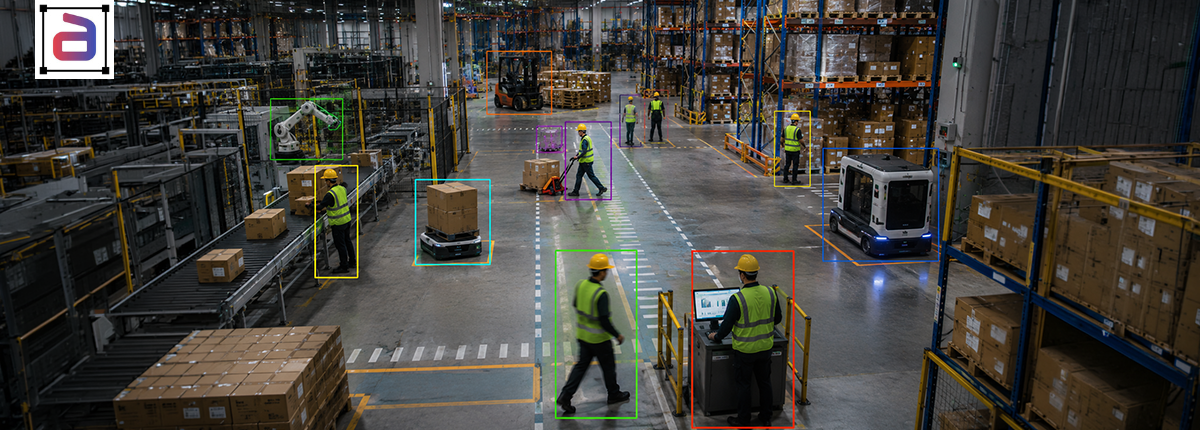
Consider an autonomous warehouse robot. A still image may identify:
- Worker
- Pallet
- Forklift
- Shelf
But a sequence of annotated video teaches the robot:
- The worker is bending to lift a package.
- The forklift is approaching an intersection.
- The pallet is moving toward the loading dock.
- Another robot is slowing down to avoid congestion.
This contextual understanding dramatically improves autonomous decision-making.
Types of Video Annotation Used in Robotics
At Annotera, our video annotation services support diverse robotics applications through specialized annotation techniques.
Multi-Object Tracking
Objects are tracked continuously across thousands of frames while maintaining unique identities. Examples include:
- Warehouse workers
- Forklifts
- Mobile robots
- Conveyor packages
- Delivery vehicles
Continuous tracking enables AI models to predict future movement rather than simply reacting to the present.
Action Recognition
Entire activities—not just individual frames—are labeled. Examples include:
- Picking
- Placing
- Loading
- Walking
- Welding
- Assembly
- Inspection
- Packaging
Action annotation helps robots understand complete workflows instead of isolated movements.
Pose Estimation
Key body landmarks are annotated across video sequences to capture human posture and gestures. Applications include:
- Collaborative robots (Cobots)
- Industrial safety
- Gesture-controlled robotics
- Human-robot interaction
- Rehabilitation robots
Understanding body motion enables robots to respond naturally and safely around people.
Semantic and Instance Segmentation
Pixel-level annotation allows robots to distinguish:
- Floors
- Walls
- Machines
- Humans
- Storage racks
- Obstacles
Instance segmentation further assigns a unique identity to every object, enabling precise tracking in crowded environments.
Industries Powered by Robotics Video Annotation
Warehouse Automation
Autonomous Mobile Robots (AMRs) rely on video datasets to:
- Navigate narrow aisles
- Detect moving workers
- Avoid collisions
- Track inventory
- Optimize picking routes
Smart Manufacturing
Manufacturing robots use annotated video to:
- Monitor production
- Detect anomalies
- Improve collaborative safety
- Analyze assembly processes
- Validate robotic operations
Healthcare Robotics
Medical AI systems learn from annotated motion data for:
- Surgical assistance
- Rehabilitation monitoring
- Patient mobility assessment
- Robotic caregiving
Agricultural Robotics
Autonomous farming equipment benefits from video annotation by learning to:
- Harvest crops
- Navigate uneven terrain
- Detect weeds
- Track machinery
- Monitor livestock movement
Security Robotics
Security robots depend on motion-aware AI for:
- Suspicious activity detection
- Crowd monitoring
- Intrusion recognition
- Behavioral analysis
Challenges in Robotics Video Annotation
Unlike static image labeling, robotics video annotation involves significant complexity.
Maintaining Temporal Consistency
Annotations must remain accurate across thousands of consecutive frames without losing object identity.
Occlusions
Workers, machines, and equipment frequently block one another from view. Professional annotators ensure objects remain consistently tracked despite temporary visibility loss.
Motion Blur
Fast-moving robots and vehicles generate blurred frames that automated tools often misinterpret. Human validation remains essential.
Complex Interactions
Robotics environments often involve numerous moving entities interacting simultaneously. These scenarios demand expert annotation for accurate AI learning.
Why Human Expertise Still Matters
Automation tools can accelerate annotation, but they cannot fully replace human judgment. As AI pioneer Andrew Ng observed:
“AI is the new electricity.”
However, electricity only powers machines when the underlying infrastructure is reliable. Similarly, AI only performs well when trained on trustworthy, high-quality labeled data. Human annotators excel at interpreting:
- Ambiguous movements
- Behavioral transitions
- Rare edge cases
- Complex interactions
- Safety-critical scenarios
This human expertise is what separates production-ready robotics AI from unreliable prototypes.
Why Robotics Companies Choose Data Annotation Outsourcing
Developing robotics datasets internally often leads to higher costs, inconsistent quality, and slower model development. This is why many organizations adopt data annotation outsourcing. Partnering with an experienced data annotation company offers significant advantages:
- Access to trained annotation specialists
- Faster project turnaround
- Scalable annotation teams
- Consistent quality assurance
- Lower operational costs
- Reduced engineering overhead
Instead of managing annotation workflows internally, robotics teams can focus on developing perception models, navigation algorithms, and autonomous decision-making systems.
Why Choose Annotera for Robotics Video Annotation?
At Annotera, we understand that robotics AI demands more than accurate labels—it requires temporal precision, consistency, and domain expertise. Our comprehensive video annotation services are designed to support robotics companies developing intelligent autonomous systems across manufacturing, logistics, healthcare, agriculture, and smart infrastructure. Our capabilities include:
- Multi-object tracking
- Action recognition
- Pose estimation
- Semantic segmentation
- Instance segmentation
- Temporal event annotation
- Custom annotation workflows
- Multi-stage quality assurance
Every dataset undergoes rigorous validation to ensure consistency across frames, enabling AI models to perform reliably in real-world environments. As a trusted data annotation company, Annotera delivers scalable annotation solutions tailored to enterprise AI initiatives.Whether you require large-scale data annotation outsourcing or specialized robotics datasets, Annotera’s expert teams deliver the accuracy and scalability needed to accelerate AI development. Moreover, our rigorous quality assurance processes ensure consistent, high-quality annotations that support reliable and production-ready robotics AI.
The Future of Robotics Begins with Better Training Data
The future of robotics is not simply about building smarter machines—it’s about enabling them to perceive motion, understand human behavior, and make safe, intelligent decisions in constantly changing environments. High-quality video annotation forms the foundation of that intelligence. By capturing movement, interactions, and temporal context, annotated video data empowers robots to navigate complexity with confidence. As industries continue to embrace automation, organizations that invest in superior training data today will build the most capable autonomous systems tomorrow.
Ready to Build Smarter Robotics AI?
Whether you’re developing warehouse robots, collaborative manufacturing systems, agricultural automation, or next-generation autonomous machines, Annotera is your trusted partner for precision video annotation services. With our expertise and scalable approach, we help accelerate AI development while ensuring high-quality training data for reliable robotic performance. Contact Annotera today to discover how our expert annotation teams and scalable data annotation outsourcing solutions can help you accelerate robotics AI development with high-quality, enterprise-grade training data.
A closely related read: Data Annotation for Dynamic Robotics Environments.
Read also: Landmark Labeling for Video in Emotion Detection AI.