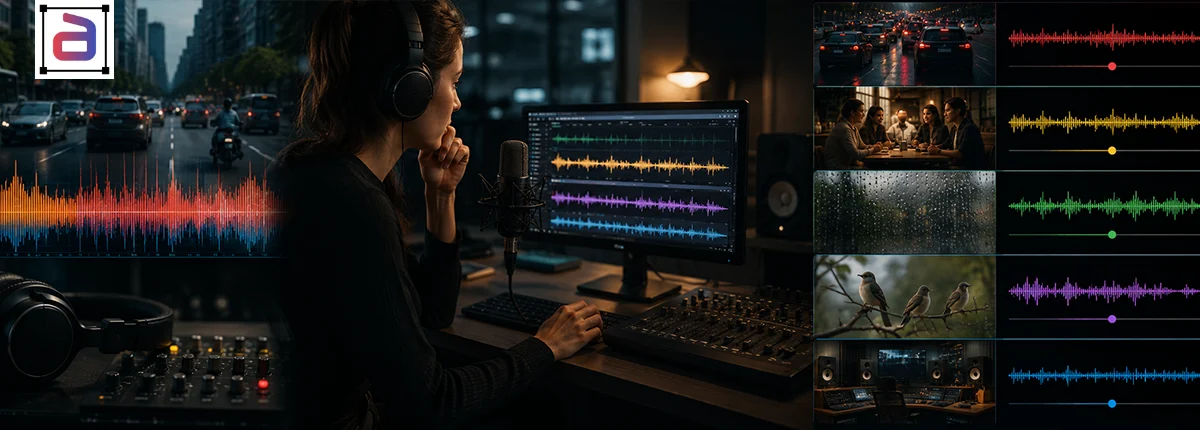
Real-world AI doesn’t operate in silence. It operates in airports, factories, hospitals, highways, and bustling call centers. The future of speech AI depends not on perfectly clean datasets—but on accurately annotated, real-world audio. Artificial intelligence has made remarkable strides in understanding human speech, yet one misconception continues to limit the performance of many AI systems: the belief that only clean audio makes good training data.
Whether it’s a virtual assistant interpreting commands in a noisy kitchen, an autonomous vehicle detecting emergency sirens, or a healthcare AI transcribing conversations in a busy emergency room, AI must learn to perform in environments that are anything but quiet. That’s why leading AI companies are shifting their focus from removing noise to understanding and annotating it. Instead of discarding imperfect recordings, they are investing in comprehensive audio annotation services that identify environmental sounds, recording quality, and acoustic conditions—creating datasets that reflect the complexity of the real world. At Annotera, we believe that the strongest AI models are trained on the realities they’ll encounter—not idealized versions of them. This is also why a well-structured noise labeling taxonomy matters so much.
Key Points
- Real-world AI needs real-world audio. Training models only on clean recordings limits performance, while annotated noisy audio helps AI understand speech accurately across diverse environments.
- Noise is valuable training data—not a flaw. Labeling background sounds, recording quality, speaker overlap, and acoustic conditions enables AI models to become more robust and production-ready.
- Human expertise drives annotation quality. Experienced annotators provide the context and consistency that automated tools alone cannot, ensuring high-quality datasets for speech recognition and conversational AI.
- Partnering with Annotera accelerates AI success. As a trusted data annotation company, Annotera delivers scalable audio annotation services and data annotation outsourcing to help organizations build resilient, enterprise-grade AI solutions.
The Reality of Audio Data: Noise Is Everywhere
Everyday conversations happen amid countless acoustic distractions:
- Traffic and construction noise
- Air conditioning and machinery
- Wind interference
- Echoes and reverberation
- Keyboard typing
- Multiple overlapping speakers
- Television and music
- Microphone distortion
- Telephone compression
- Static and packet loss
These aren’t flaws—they’re valuable training signals. If an AI model only learns from studio-quality recordings, it often struggles when deployed in production, where audio conditions are unpredictable. As Andrew Ng famously stated:
“AI is the new electricity.”
Just as electrical systems must function under varying conditions, AI systems must perform reliably across every acoustic environment.
The Business Case for Realistic Audio Annotation
Speech AI is no longer a niche technology—it is becoming fundamental across industries. According to Grand View Research, the global speech and voice recognition market is expected to grow significantly throughout the coming decade, fueled by increasing adoption across healthcare, automotive, banking, customer service, and consumer electronics. Meanwhile, MarketsandMarkets projects continued expansion of conversational AI as enterprises invest heavily in virtual assistants, intelligent customer support, and multilingual communication platforms. This explosive growth creates a simple challenge: AI trained on perfect audio will ultimately be deployed in imperfect environments. That gap can dramatically reduce model performance.
Why “Clean” Audio Isn’t Always Better
Many organizations still remove noisy recordings during dataset preparation because they assume cleaner data automatically produces better models. Unfortunately, this often creates dataset bias. Models trained exclusively on pristine recordings frequently struggle with:
- Higher speech recognition error rates
- Reduced wake-word detection accuracy
- Poor intent recognition
- Speaker identification failures
- Difficulty processing overlapping conversations
- Lower transcription quality in production environments
In contrast, models trained using properly annotated noisy recordings become significantly more resilient. The objective isn’t eliminating noise. The objective is teaching AI how to interpret it.
What Is Noise and Audio Quality Annotation?
Noise annotation involves labeling the environmental and technical characteristics surrounding speech—not just the spoken words themselves. Professional audio annotation services typically capture multiple dimensions of audio quality simultaneously.
Environmental Noise
Annotators identify sounds such as:
- Road traffic
- Rain
- Wind
- Construction
- Industrial machinery
- Crowd conversations
- Household appliances
- Office environments
- Animal sounds
Recording Quality
Technical characteristics may include:
- Echo
- Clipping
- Static
- Compression artifacts
- Background hum
- Low microphone gain
- Signal distortion
- Packet loss
- Audio dropouts
Speech Characteristics
Datasets may also include labels for:
- Number of speakers
- Speaker overlap
- Speaking rate
- Whispering
- Emotional tone
- Accent
- Pronunciation variation
- Speech clarity
Instead of simply labeling audio as “good” or “bad,” modern datasets capture rich contextual information that allows AI to learn under diverse conditions.
Human Expertise Makes the Difference
Although automated tools can detect certain audio properties, they cannot consistently interpret complex acoustic scenarios. Human annotators can recognize subtle distinctions such as:
- Background chatter versus overlapping conversation
- Temporary microphone pops versus persistent static
- Environmental sirens versus speech interruptions
- Relevant ambient sounds versus distracting interference
As Fei-Fei Li, Professor at Stanford University, has emphasized:
“The real challenge of AI is not just building smarter algorithms, but creating better data.”
That insight lies at the heart of every successful AI project. A trusted data annotation company combines experienced annotators, standardized workflows, domain expertise, and multi-layer quality assurance to produce consistent, production-ready datasets. At Annotera, every annotation project undergoes rigorous validation to ensure labels remain accurate, scalable, and aligned with each client’s machine learning objectives.
Industries Where Noise Annotation Drives Better AI
Customer Service Automation
Call center recordings often contain background conversations, poor network quality, keyboard clicks, and varying microphone quality. Detailed annotation enables conversational AI to maintain transcription accuracy even in challenging acoustic environments.
Healthcare
Hospitals are filled with alarms, ventilation systems, medical equipment, and simultaneous conversations. Noise-aware datasets help medical AI distinguish clinically relevant speech from environmental sounds.
Automotive and Autonomous Vehicles
Modern vehicles increasingly rely on acoustic perception. AI systems must identify:
- Emergency sirens
- Vehicle horns
- Tire noise
- Engine abnormalities
- Pedestrian alerts
Without properly annotated environmental audio, these safety-critical systems become less reliable.
Smart Devices and Consumer Electronics
Voice assistants must recognize commands while televisions play, children speak, appliances run, and music fills the room. Training datasets enriched with realistic acoustic labels significantly improve user experience.
Why Businesses Choose Data Annotation Outsourcing
Building an internal annotation operation requires significant investment in hiring, training, infrastructure, workflow management, and quality control. This is why many AI companies choose data annotation outsourcing to experienced partners. Working with an established audio annotation company provides access to:
- Expert human annotators
- Large-scale multilingual workforce
- Consistent annotation guidelines
- Dedicated quality assurance teams
- Faster project turnaround
- Flexible scaling for enterprise datasets
Rather than spending months building annotation capabilities internally, organizations can accelerate AI development while maintaining exceptional data quality.
Why Annotera Is the Right Annotation Partner
High-performing AI begins with high-quality data—and high-quality data begins with expert annotation. As a trusted data annotation company, Annotera delivers scalable, human-in-the-loop audio annotation services tailored for enterprise AI initiatives. Our experienced annotation specialists understand that context matters just as much as content. Instead of treating background noise as a problem to eliminate, we help clients transform it into valuable training intelligence. Whether you’re building conversational AI, speech recognition systems, healthcare applications, automotive solutions, or multimodal foundation models, Annotera provides:
- Human-reviewed audio annotations
- Noise and audio quality labeling
- Multilingual speech annotation
- Speaker diarization and timestamping
- Custom annotation workflows
- Enterprise-grade quality assurance
- Secure, scalable data annotation outsourcing
Our mission is simple: empower organizations with reliable, real-world datasets that improve model accuracy, robustness, and production readiness.
Conclusion
The future of speech AI isn’t about creating perfectly clean datasets—it’s about creating representative datasets. Real users don’t speak in recording studios. They speak in factories, vehicles, airports, hospitals, homes, and crowded streets. AI systems that learn only from ideal audio will inevitably struggle when faced with the complexity of the real world. By investing in comprehensive noise and audio quality annotation, organizations can develop AI models that understand speech more accurately, adapt to diverse environments, and perform consistently at scale. Partnering with an experienced audio annotation company ensures that every recording—whether crystal clear or acoustically challenging—contributes meaningful intelligence to your training data.
Ready to Build More Resilient Speech AI?
Don’t let imperfect audio limit your AI’s potential. Annotera helps enterprises transform complex, real-world audio into high-quality training datasets through expert-led audio annotation services and scalable data annotation outsourcing. From noise labeling and speech segmentation to multilingual annotation and enterprise quality assurance, our specialists deliver the precision your AI models need to succeed in production. Get in touch with Annotera today to discover how our expert annotation solutions can accelerate your next AI project with reliable, production-ready data.
A closely related read: Noise Labeling and Audio Quality Annotation for Robust AI Models.
Read here : Global Audio Transcription with Native Linguists
Read more : Noise Labeling for Industrial Safety and Alarms