
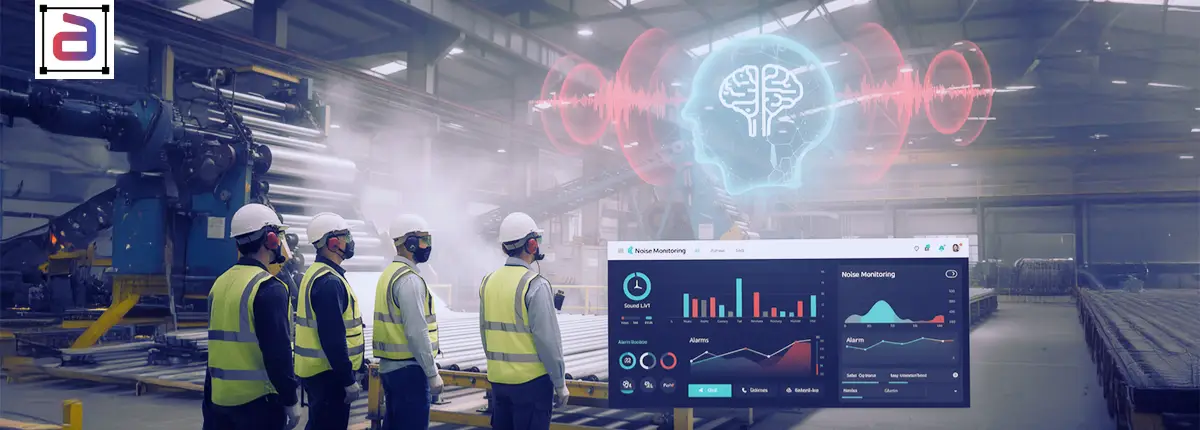
In industrial environments, noise is constant—but not all noise is equal. Machinery hum, compressors, tools, vehicles, alarms, and human activity all compete in the same acoustic space. For safety systems powered by AI, the challenge isn’t detecting sound—it’s knowing which sounds require action and which should be ignored. This is where industrial noise labeling becomes critical. Without properly labeled noise data, AI-driven safety and alarm systems produce false positives, missed alerts, and ultimately, loss of trust on the factory floor.
“In safety systems, a missed alarm is dangerous—but a system that cries wolf is ignored.”
Table of Contents
Key Points
- Industrial noise labeling must distinguish machine-normal sounds from machine-anomalous sounds for each specific piece of equipment, because the same acoustic frequency range that indicates normal operation in one machine indicates failure in another.
- Safety alarm annotation must cover alarms at the full range of distances and background noise levels found in the deployment environment to prevent AI systems that only detect alarms from nearby sources in quiet conditions.
- Industrial noise programs must cover the temporal patterns of normal and anomalous machine sound, not just isolated audio events, because equipment degradation produces changing acoustic signatures over extended time periods.
- False negative rates in industrial safety audio AI have direct safety consequences: an annotation program that misses subtle acoustic precursors to failure produces a system that does not alert before the incident occurs.
The Challenge: Noise-Dense Industrial Environments
Industrial settings generate overlapping machine hum, alarms, impacts, and human activity, creating acoustically complex datasets. Distinguishing critical operational sounds from routine background noise is difficult, demanding granular audio labeling to support predictive maintenance, safety monitoring, and intelligent industrial AI systems. Industrial sites are acoustically hostile by design. Unlike consumer environments, background noise is:
- Continuous
- High-energy
- Overlapping
- Equipment-specific
- Environment-dependent
Common issues seen in poorly trained systems include:
- Alarms masked by machinery noise
- False alerts triggered by routine operations
- Inconsistent detection across shifts or facilities
- Operator fatigue caused by alert overload
| Industrial Reality | AI Failure Mode |
| Constant machinery hum | Alarm suppression |
| Sudden mechanical events | False positives |
| Multiple overlapping sources | Missed safety cues |
Why Noise Labeling Matters More Than Noise Reduction
Traditional approaches aim to filter out noise. In industrial safety, this often backfires. Noise labeling captures contextual sound intelligence that noise reduction discards. For AI systems in automotive, smart devices, and surveillance, accurately tagged background sounds improve model robustness, situational awareness, and real-world performance—making structured audio annotation more valuable than simply removing unwanted noise. Through structured noise labeling, diverse environmental and electronic sounds are tagged across recordings. This enables AI systems to differentiate signal from distortion, resulting in cleaner training data, stronger acoustic models, and more reliable voice-enabled technologies in complex listening environments.
Aggressive noise reduction can:
- Remove critical alarm frequencies
- Distort signal timing
- Mask early warning cues
- Reduce system reliability
Noise labeling takes a different approach.
By labeling noise explicitly, AI systems learn:
- What sounds are “normal operations”
- What sounds indicate risk
- How alarms differ from background noise
- When multiple sounds coexist
“You don’t make factories quieter—you make AI smarter.”
What Is Industrial Noise Labeling?
Industrial noise labeling is a specialized audio annotation service that identifies, categorizes, and timestamps sounds in industrial audio so AI systems can respond correctly. From alarms to sirens, reliably tagging audio events is what makes these systems trustworthy.
Unlike generic audio tagging, it focuses on:
- Operational noise vs hazard signals
- Alarm prioritization
- Equipment-specific sound profiles
- Temporal patterns tied to risk
Moreover, Annotera performs industrial noise labeling on client-provided audio, tailored to each environment and safety objective.
The Industrial Noise Labeling Playbook
Audio noise reduction training uses labeled noisy and clean samples to help models distinguish speech from interference. Through structured audio annotation and diverse acoustic scenarios, systems learn to suppress background sounds, improving clarity, transcription accuracy, and performance in real-world environments.
1. Separating Operational Noise from Safety Signals
The first step is defining what “normal” sounds like.
| Sound Category | Examples | AI Treatment |
| Operational noise | Motors, conveyors, fans | Ignore or de-prioritize |
| Safety alarms | Sirens, buzzers, alerts | High priority |
| Transitional sounds | Pressure releases, impacts | Context-aware handling |
Labeling operational noise prevents systems from reacting to routine activity.
2. Labeling Alarm Signals with Precision
Safety alarms are often short, repetitive, and frequency-specific. Audio noise tagging labels background sounds and acoustic events in recordings, enabling AI models to separate speech from interference. It improves recognition accuracy, reduces false triggers, and prepares hardware AI systems to function reliably in complex, real-world acoustic environments.
Noise labeling ensures:
- Alarm boundaries are precisely tagged
- Frequency patterns are preserved
- Overlapping alarms are recognized independently
“An alarm is only useful if it’s detected at the right moment.”
This precision supports faster response times and fewer missed alerts.
3. Handling Overlapping and Masked Sounds
Further in real facilities, alarms rarely occur in isolation.
Noise labeling supports:
- Multi-label annotation (alarm + machinery + human speech)
- Temporal alignment of overlapping events
- Recognition even when alarms are partially masked
| Without Overlap Labeling | With Overlap Labeling |
| Alarm missed | Alarm detected |
| False negative | Correct prioritization |
| Unsafe silence | Reliable alerting |
4. Environment-Specific Noise Taxonomies
Factories, warehouses, oil & gas sites, and construction zones all sound different. Environment-specific noise taxonomies standardize how sounds are categorized across contexts; as a result, models learn relevant acoustic patterns rather than generic noise. Moreover, structured hierarchies improve annotation consistency while enabling scalable training data for surveillance, automotive, healthcare, and smart-city AI applications. By converting spoken content into annotated text, transcription training enables AI models to learn. Subsequently, systems recognize patterns more effectively. Furthermore, quality-controlled transcripts reduce bias and noise, ensuring scalable, high-performance training for speech, language, and multimodal AI applications.
Industrial noise labeling must adapt to:
- Equipment type
- Facility layout
- Operating conditions
- Regulatory requirements
Also, custom taxonomies ensure models learn site-specific acoustic behavior, not generic assumptions.
Why HSE and Safety Teams Outsource Noise Labeling
HSE and safety teams outsource noise labeling to access specialized acoustic expertise; consequently, annotation accuracy improves. Moreover, external partners ensure scalability, faster turnaround, and quality control, while internal teams focus on risk mitigation, compliance, and operational safety across complex industrial sound environments. Security audio labeling involves tagging acoustic recordings with threat-related categories such as alarms, gunshots, or distress signals. By structuring sound data, organizations train AI models more effectively; consequently, systems achieve faster detection, reduced false alarms, and stronger situational awareness. Industrial noise labeling requires:
- Domain-specific sound understanding
- High accuracy thresholds
- Audit-ready documentation
- Scalable annotation processes
Most HSE teams outsource because:
- Internal teams lack ML/audio expertise
- Safety systems demand consistent quality
- Scaling annotation internally is impractical
- Compliance requires traceability
| Internal Effort | Specialized Service |
| Limited expertise | Trained annotators |
| Hard to scale | Flexible capacity |
| Inconsistent results | Standardized QA |
Annotera’s Approach to Industrial Noise Labeling
Annotera applies domain-trained annotators and structured acoustic taxonomies; therefore, industrial sounds are labeled with high precision. Moreover, multi-layer quality validation ensures dataset reliability, while scalable workflows accelerate delivery, enabling AI teams to build robust models for safety, monitoring, and predictive maintenance applications. As a matter of fact, Annotera provides industrial noise labeling as a secure, production-ready service.
Capabilities include:
- Custom safety-focused noise taxonomies
- Alarm vs operational noise separation
- Overlap-aware, multi-label annotation
- Human QA with strict agreement checks
- Secure handling of sensitive industrial audio
- Dataset-agnostic workflows (client-provided audio only)
Further, Annotera does not sell datasets or generic sound libraries.
The Business Impact: Safer Operations, Fewer False Alarms
Accurate noise labeling reduces false positives in alert systems; consequently, teams respond only to genuine risks. Moreover, improved acoustic intelligence enhances workplace safety, while minimizing downtime. As a result, organizations achieve more reliable monitoring, lower operational costs, and stronger compliance across high-risk industrial environments.
Well-labeled industrial audio delivers measurable operational benefits.
Organizations achieve:
- Fewer false alarms
- Higher alarm detection reliability
- Reduced operator fatigue
- Better compliance readiness
- Increased trust in AI-driven safety systems
| Poor Labeling | Industrial Noise Labeling |
| Alert fatigue | Meaningful alerts |
| Missed hazards | Reliable detection |
| Low trust | Operator confidence |
“A safety system people trust is a safety system people use.”
Use Cases for Industrial Noise Labeling
Industrial noise labeling enables predictive maintenance by identifying anomaly sounds; furthermore, it strengthens worker safety through real-time hazard detection. Additionally, labeled acoustic data supports equipment health monitoring, process optimization, and automated compliance tracking, thereby improving operational efficiency across manufacturing, energy, and heavy-industry environments.
- Manufacturing plants
- Warehouses and logistics hubs
- Oil & gas facilities
- Construction sites
- Power generation plants
In each case, AI must learn to hear risk through routine noise.
Conclusion: Safety Starts with Understanding Sound
In industrial environments, silence is not the goal—clarity is.
Further, noise labeling enables AI systems to distinguish between routine operations and real danger, ensuring alarms are heard, trusted, and acted upon. Further for HSE leaders, investing in industrial noise labeling is not just a technical decision—it’s a safety decision. Partner with Annotera to build noise-aware safety systems that perform when it matters most.